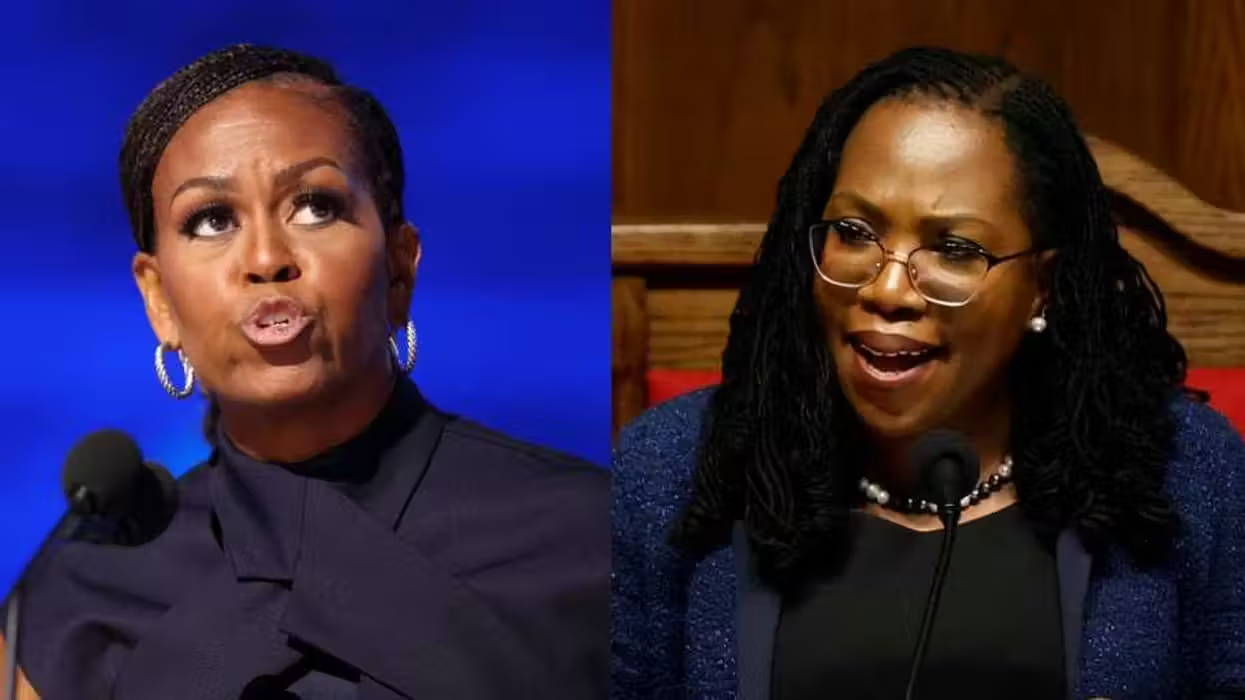
CHARLY TRIBALLEAU/AFP/Getty Images (L); Butch Dill/Pool/Getty Images (R)
Jackson's self-awareness hit a new low this week.
This week, U.S. Supreme Court Justice Ketanji Brown Jackson discussed with Michelle Obama, of all people, the importance of justices appearing impartial — and so far, the reactions to their conversation have been just about what you'd expect.
She told the hosts on the Wednesday episode of "IMO with Michelle Obama & Craig Robinson" that "we all have to believe that there is a judicial system that is going to be fair, that is going to be neutral, that when you bring your dispute to the court, that judge doesn't have any pre-existing stake in the particular issue."
'Can't make this up.'
It's a surprising take, considering Jackson's background.
For one thing, former President Joe Biden explicitly chose Jackson for the Supreme Court on the basis of her race and sex, though she said during her confirmation hearing that she could not define "woman" because she's "not a biologist."
Jackson has also made a habit of penning bias-saturated jeremiads that have in some cases been extreme enough to raise the eyebrows of even other liberals on the bench. For instance, she:
Despite these opinions, Jackson and Obama seem to believe that Jackson has been a relatively neutral jurist.
RELATED: Platner's replacement in Maine is a family man — just not in the way voters might expect
Obama pressed Jackson about whether she has to closely monitor her exposure to news, media, and other content "so that there isn't a bias."
After noting that certain individuals employed at the court screen her invitations for various appearances and events "to make sure that there are no ethical conflicts," Jackson replied that "there are lots of limits on what judges can do, and I try to be very, very mindful and scrupulous with respect to that because, as you say, our obligation is to be unbiased in our approach."
"And, so, you have to then navigate all the sources that could make for an appearance of partiality, which you want to avoid," the Biden nominee continued. "So there are lots of things that I end up not accepting for that reason. News sources, I think, you know, I don't have a lot of time — unfortunately, you know — but I do, you know, the normal, general media sources are made available, and I think it's harder when you're talking about — there's so much social media now."
Jackson's expression of concern about bias and perceptions of bias while in the company of a rank partisan like Michelle Obama struck some critics as insincere or at the very least tone-deaf.
House Republican Conference Chairwoman Lisa McClain (R-Mich.) highlighted the cognitive dissonance, writing, "Justice Ketanji Brown Jackson says SCOTUS must avoid even the appearance of political bias ... while appearing on Michelle Obama's podcast."
Sen. Marsha Blackburn (R-Tenn.) wrote, "Ketanji Brown Jackson finds a way to inject political bias into just about everything she does. Whether it's attending the Grammys, joining Michelle Obama's podcast, or refusing to define the word woman, she couldn't care less about remaining impartial."
"DEI hire justice Ketanji Brown Jackson says she's careful about which public engagements she accepts because she has to be impartial ... As she appears on MICHELLE OBAMA's podcast," Libs of TikTok tweeted. "Can't make this up."
Like Blaze News? Bypass the censors, sign up for our newsletters, and get stories like this direct to your inbox. Sign up here!