Photo by Michael Kovac/Getty Images for Vanity Fair
"I gotta start out with a confession," Joe Allen said. "Human beings get on my f**king nerves."
He paused for effect. "I think the only creatures on earth more annoying are mosquitoes, AIs, and robots."
It was an unexpected confession from a man who has spent the post-COVID years as a sort of John the Baptist for the cause of the human race. Joe Allen, a contributor to Steve Bannon's War Room and author of "Dark Aeon," has been on a speaking tour, warning against the machinations of tech titans and how they intend to turn the human race into a sort of human/machine hybrid, a mix of genetically optimized meat meshed with artificial intelligence.
A comprehensive worldview where humanity either upgrades or disappears.
Here's the thing: They really believe in this stuff, and Joe has the receipts. Heady stuff for a Thursday night in Nashville.
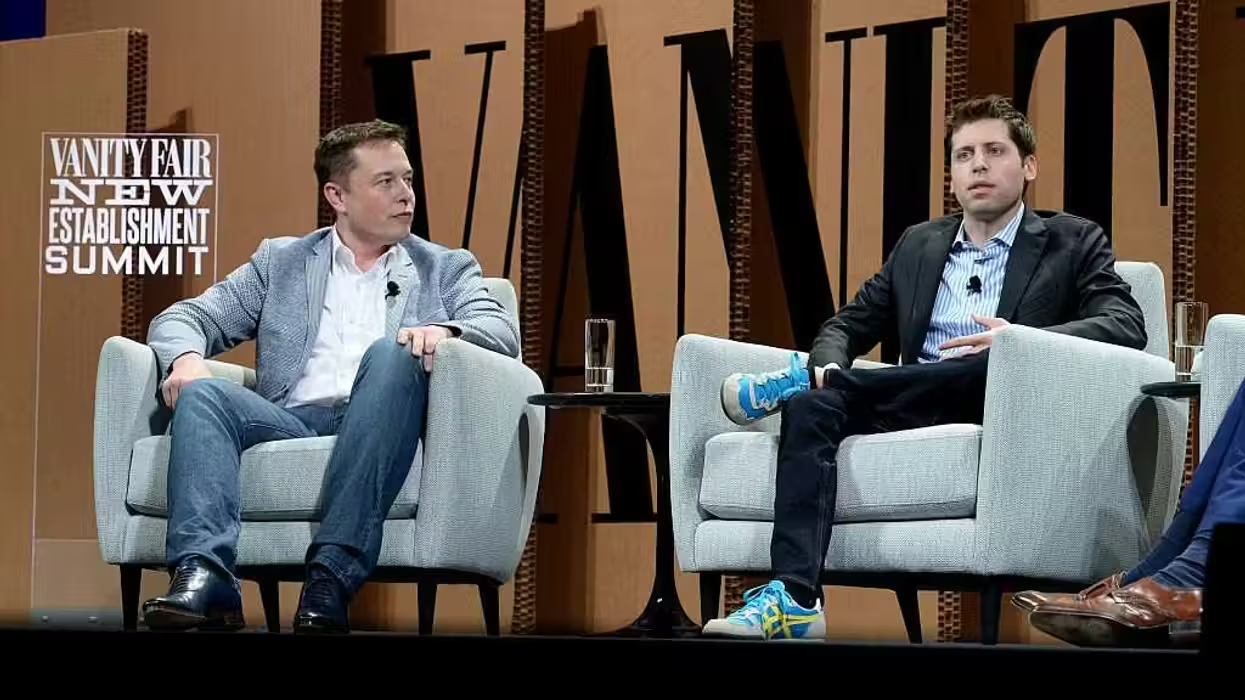
Allen frames the transhuman future around two figures he calls "the Emperor and the Twink": Elon Musk and Sam Altman. Augustus and Hadrian. The productive empire-builder and the more, as Allen puts it, "degenerate" aesthete.
Both are building toward the same goal through different paths: a future where humanity merges with machines or gets left behind. Maybe eliminated entirely.
Altman's funding a start-up called Conception that would let two men produce biological children together through synthetic ova. He's backing Genomic Prediction for algorithmic eugenics. Scraping embryos for height, IQ, looks, then selecting the "best" ones. "Sanitized eugenics," Allen calls it. "At scale, it would be an algorithmic filter for humanity."
Then there's the AI work itself. OpenAI and ChatGPT aren't just productivity tools. They're the foundation for what Altman believes will be artificial superintelligence. First the little-g gods, then maybe the big-G God. Artificial general intelligence self-improving into something that makes humanity obsolete.
RELATED: Cash-starved OpenAI BURNS $50M on ultra-woke causes — like world's first 'transgender district'
 Photo by AaronP/Bauer-Griffin/GC Images
To keep humans relevant in that future, Altman's pushing World ID: biometric iris scans linking your eyeballs to a government ID and blockchain cryptocurrency. "One of the many tentacles," Allen said, "of the vast digital beast system slowly strangling the life out of everything we once knew to be human."
He's also invested in Merge Labs, ultrasound systems to read brain waves and create higher-bandwidth communication with AI. A chance for some biological humans to keep up when the machines take over.
Musk presents himself as the alternative. The "based" option. xAI is the competitor to OpenAI's "woke" ChatGPT, because when we're all consulting chatbots to determine what's racist or sexist, you'll want "maximally truth-seeking" AI that hasn't been neutered by progressive ideology.
Fair enough. But the destination's the same.
Neuralink is the centerpiece. First sold as healing technology, helping the paralyzed walk and the blind see. But Musk's open about the long-term plan: hundreds of millions of normal humans drilling holes in their skulls to install high-bandwidth interfaces with AI. "If I'm not to be emperor," Allen said, "I'll at least be cooler than the gaybies wielding drones and flamethrowers around me."
Then there's Optimus: the humanoid robots Musk promises will outnumber humans three or four to one within a decade or two. "Algorithmic immigrants," Allen calls them, "coming across the border from the platonic realm of mathematical possibilities and swarming into reality."
Right now, they can barely fold laundry. But if the vision succeeds, we'll be surrounded by entities that can do everything we can do, only better. Which raises an obvious question: What are we for?
Allen organized his talk around three concepts: race, robots, and religion. Or as he rephrased it: bloodline, cultural transmission, and cosmic worldview. Genes, memes, and spirit.
The bloodline question is straightforward enough when it comes to Altman's synthetic reproduction technology. But it applies more broadly. Who continues? What survives? The transhumanist vision explicitly embraces what Allen calls "cultural and perhaps even biological genocide": the gradual or rapid replacement of biological humans by superior cyborgs and AI.
"First the coders, then white-collar workers, then blue-collar workers," Allen said, echoing Musk and Altman's own predictions. "We're left completely economically unviable. Obsolete."
The robots are the mechanism. They'll do our work. They'll fill our needs. They'll provide "radical abundance." A world where no one has to labor, where everything is taken care of, where we live as pets or preserve species while the AI spreads through the solar system and beyond.
Or we get turned into biofuel. "Better to reconfigure our atoms into robot components," Allen notes, "than keep us around using up resources as pets."
The religion part is where it gets really dark. This isn't just technology. It's theology. The conscious creation of artificial gods to rule over us or replace us entirely. A "sacred canopy" that fills the void in a godless universe.
Allen quotes Bryan Johnson, whom he describes as a vampire who injects his son's blood to stay young, laying out the five goals every ambitious man should have: Found a company, found a country, found a religion, don't die, become God.
"It's a bold claim," Allen said dryly. "I am somewhat skeptical."
Championing humanity doesn't come naturally to Allen. He grew up in the hollers of Appalachia, developing "a keen sense of misanthropy and technophobia," where he related better to the trees and streams than to people.
But we have to put that aside for what Allen sees as a war. "If we're not going to be replaced by machines, if we are not to become robotic entities ourselves, it's going to require a certain degree of tolerance for humanity."
He means accepting human messiness. Human imperfection. The "dirtiness and nastiness of humanity" that makes us frustrating but also makes us us. Because the alternative is accepting that machines really are superior. That Silicon Valley's wealthiest men, backed by the most powerful governments on earth, are right about where we should go.
"Everyone is going to have to make a choice," Allen said. "Accept the status quo or reject it outright."
The rejection requires something most of us aren't good at: forgiving people we disagree with. Looking past differences. Banding together. "When you are fighting a hyper-cooperative superorganism," Allen said, "you're going to need a gang."
Allen argued that human solidarity, even with people whose beliefs or lifestyles or sins we can't stand, is the only viable resistance to algorithmic replacement.
"That person is a human being," he said, "and you will have to put humans first."
At one point, Allen pitched a satirical product: transhumanist trading cards. Each card would feature a prominent figure in the movement (or occasionally an anti-transhumanist). Statistics like net worth, number of concubines, humans replaced. A small stick of gum "alternately dosed with LSD or nanobots."
It was a bit. But like good satire, it made a point: These people have names. Sigmund Freud, who prophesied humanity becoming "a kind of prosthetic God." Julian Huxley, who coined the term transhumanism to describe a human race taking control of its own evolution through technology. Pierre Teilhard de Chardin, the priest who saw technological civilization as the face of Christ incarnating on earth.
Then the modern saints: Ray Kurzweil and the singularity. Peter Thiel, the accused vampire with rumored interest in young-blood transfusions. Ben Goertzel with his leopard print cowboy hat, giving "dire prophecies of machines taking over with a kind of jolly glee."
And of course, Yuval Noah Harari. "Looking like the demonic dark elf that he is," Allen said. "So often quoted, almost never understood, but probably the greatest anti-tech propagandist of our time. Which goes to show you how stupid people are that they believe he's a transhumanist himself."
The point isn't the cards. It's that these aren't random technologists tinkering in garages. They're building toward a vision. A comprehensive worldview where humanity either upgrades or disappears.
Allen's message is bleak enough that you want to dismiss it as paranoia. Nobody's actually going to drill holes in billions of skulls. Sam Altman's not really going to create algorithmic master races. This is science fiction, not policy.
Except they're building it right now. They're funding it. They're selling it. They're openly stating these goals.
Allen compared it to communism. An insane vision that seems impossible until you realize people really believed it and acted on it and reshaped the world trying to achieve it. The reality that emerged wasn't the utopian dream, but it killed tens of millions of people and enslaved hundreds of millions more.
"These futures that these guys are putting forward," Allen said during the Q&A, "some approximation already exists. A greater degree of approximation will exist, and you just simply have to draw your lines where you will."
Here's the uncomfortable part: Most of us have already crossed some lines. We're already cyborgs, as Allen admits. Smartphones, wearables, the constant digital interface with our brains. The question isn't whether to engage with technology. It's where the sacred boundary sits. How much is too much.
Allen compared it to having "a pristine, simple cyborg on one shoulder and a very smelly Amishman on the other. And you're never going to be either of those things, but they're always vying for your decisions, trying to steer you one way or the other."
Fair enough. But the cyborg has enough cheerleaders. We need more people willing to LARP as armed Amishmen.
Allen was asked: Is there a peaceful way to interface with these technologies? Some middle path between full rejection and full adoption?
"I'm no fundamentalist," he said. "These sacred boundaries are really important, but they're always going to be bound against."
His line for himself: zero use for AI in creative work. Anyone using AI to write, compose music, or create images should list the model alongside their name "as a mark of shame for being a hack and basically a vessel for an algorithmic parasite."
That's harsh. But it's a clear boundary. And it matters because the question isn't just about capabilities. It's about what makes us human and what makes work meaningful. Whether the polished precision of algorithmic output is worth losing the messy, opaque, human quality of actual creation.
Allen mentioned reading "Paradise Lost" and finding the confusing passages charming "because they're self-evidently the personal creation of John Milton." The alternative is flawless, efficient, and utterly dead.
Allen mentioned James Poulos, a tech thinker he respects, who takes a different approach. Poulos argues we need to "identify the tools that are of use to you to protect against this sort of nightmare future" while cultivating deeply religious life and communities. But crucially, "not to reject technology out of hand and see it as somehow inherently evil." It's a middle path that acknowledges we're already compromised but still draws meaningful boundaries based on what actually serves human flourishing.
Allen's not optimistic about avoiding horror. "I don't suspect maybe that won't be the case," he said when asked about preventing a high-tech repeat of 20th-century atrocities. He sees deepfakes and AI erosion of trust requiring "a hyper-vigilant posture in which we don't trust anything at face value."
His advice: Cultivate human relationships with people you trust. Develop channels where the person on the other end is verified. "Hope for the best. I'm not going to say all of us are going to make it. But enough of us are going to make it."
But here's the thing he said that stuck with me: "This war against humanity, this war in favor of machines and more particularly in favor of the men who own the machines — this isn't something that will be solved or concluded in our lifetimes. This is something that began long before we were born, will continue long after we die."
If you care about your children or other people's children, you have to accept this isn't ending anytime soon.
Allen closed by urging us to write our own futures. Not to accept the vision laid out by Musk, Altman, and the rest. "Write it boldly," he said. "Write it without apology. Write it beautifully. And for God's sake, write it in a way that is not cliché or irritating."
Then he added, "Because I don't think I can take any more."
The question now is what we do about it. Whether we have the will to resist the most powerful technological and financial forces on earth. Whether we can tolerate each other enough to band together. Whether we can draw our sacred boundaries and hold them.
Allen's asking us to make a choice. I don't know what mine is yet. But I know that men like Altman and Musk aren't waiting for us to decide.
They're building the future right now. Whether we like it or not.
You might expect Joe to be an angry misanthrope, but nothing could be further from the truth. I've known Joe for a few years now, and he's quite possibly the most upbeat, happy-go-lucky guy I know. Always the life of the party, always a joy to hear speak, and a walking encyclopedia of esoterica.
After his talk, I was talking to folks in the crowd who would ask, "How did he memorize all that?" The thing about Joe is that he is always "on." What you see on stage is what you see in person: a happy warrior riding full bore into existential dread with a grin and a devil-may-care attitude.
I asked Joe how he's able to retain such a sunny disposition in the face of seemingly insurmountable darkness. "Memento mori: In the end, it's all a momentary drama," he told me.