Blaze Media Illustration
Jason Arday is almost certainly a fraud. But I hope he is something vastly more interesting.
Until very recently, Arday was one of those people liberal institutions put on a pedestal: Cambridge professor, youngest black professor in the university’s history, working-class, autistic, illiterate until late adolescence, scholar of inequality, champion of diversity, ultramarathon runner. And, by every indication, a man of the left.
It’s a fair bet Arday understood liberal institutions well enough to know that their pants-soiling terror of violating ideological taboos left them ripe for manipulation.
That last part I believe. The rest? Well.
Now there are serious questions about plagiarism, his curriculum vitae, fundraising claims, ultramarathon feats, and some of the more lurid tales he fed the press about racist abuse. Cambridge opened an investigation. Arday promptly resigned.
Right on cue came the liberal anguish: What does this mean for black academics? Neurodivergent scholars? Will racists exploit this? Is the scrutiny itself racist?
I have a better question: What if Jason Arday knew what he was doing all along?
Not merely that he lied. Anybody can lie. What if he understood what the people around him feared, understood what they desperately wanted to believe, and fed it back to them until he landed at Cambridge?
I can’t prove that. But I know the type.
Years ago, I had a close friend who was one of the most brilliant people I ever knew. He was black, an artist and journalist, a trickster, and a magnificent pain in the neck. He loved racial games.
He understood white liberal anxiety about race better than most white liberals did. This was a dude who hung a Confederate battle flag in his apartment just to get a reaction. I thought it was hilarious.
He would also have been deeply insulted by any suggestion that he needed affirmative action. He was too good. He wanted to beat his competition straight up, and he did. Over and over.
RELATED: DEI’s favorite trick: Failure proves discrimination
 Chris Harris/UCG/Universal Images Group/Getty Images
So when I read what Arday told a reporter asking pointed questions, I stopped and smiled: “To be honest with you, I thought you’d just believe me.”
Of course you did, you magnificent bastard! Never give a sucker an even break, right?
Look again at the bio: black, poor, autistic, victimized by racism, couldn’t read, then fell upward and upward until he landed at Cambridge. It’s exactly the kind of story liberal institutions want to tell about themselves.
Look at us! Look how inclusive we are! Look how far we’ve come!
Here a little ideological taxonomy becomes necessary. Conservatives are much too quick to conflate leftism with liberalism. The two overlap, especially in their preference for faux equality and social justice over liberty, but they are not the same. Leftists often look at liberals and see weak, bourgeois, self-congratulatory people who can be bullied with their own moral vocabulary.
Now, I don’t know what to believe about Arday’s biography. My default is to believe nothing at all. But I have little doubt he’s a genuine left-winger. And it’s a fair bet he understood liberal institutions well enough to know that their pants-soiling terror of violating ideological taboos left them ripe for manipulation.
That’s the game. He didn’t need to infiltrate enemy territory. He only needed to know which buttons to push and what gaps to fill.
Did he really hold that job? Did anyone actually read the dissertation? Did he raise those millions? Did he run that far? Was any of it true?
Why are you asking, bigot?
Once Arday became evidence of liberal virtue, liberals stopped looking at Arday and started looking at what he represented. That’s where judgment went limp.
My old friend would have understood that instantly.
He later became severely mentally ill. Last I heard, he was homeless. I don’t know whether he’s alive. Every so often I Google his name, looking for an obituary I pray I never find.
So forgive my limited patience for ritual concern about what Arday’s downfall means for “neurodivergent scholars.” My friend’s illness wasn’t an inspirational bullet point. It wrecked his life.
Maybe Arday really is autistic. I don’t know. But once a man has told enough big stories that prove phony, dubious, inflated, or impossible to verify, he loses the right to say: Trust me on the rest.
RELATED: Cambridge star Jason Arday was the perfect DEI success story. Is that why nobody questioned him?
 Simon & Schuster; Anselm Ebulue/Bloomberg/Getty Images
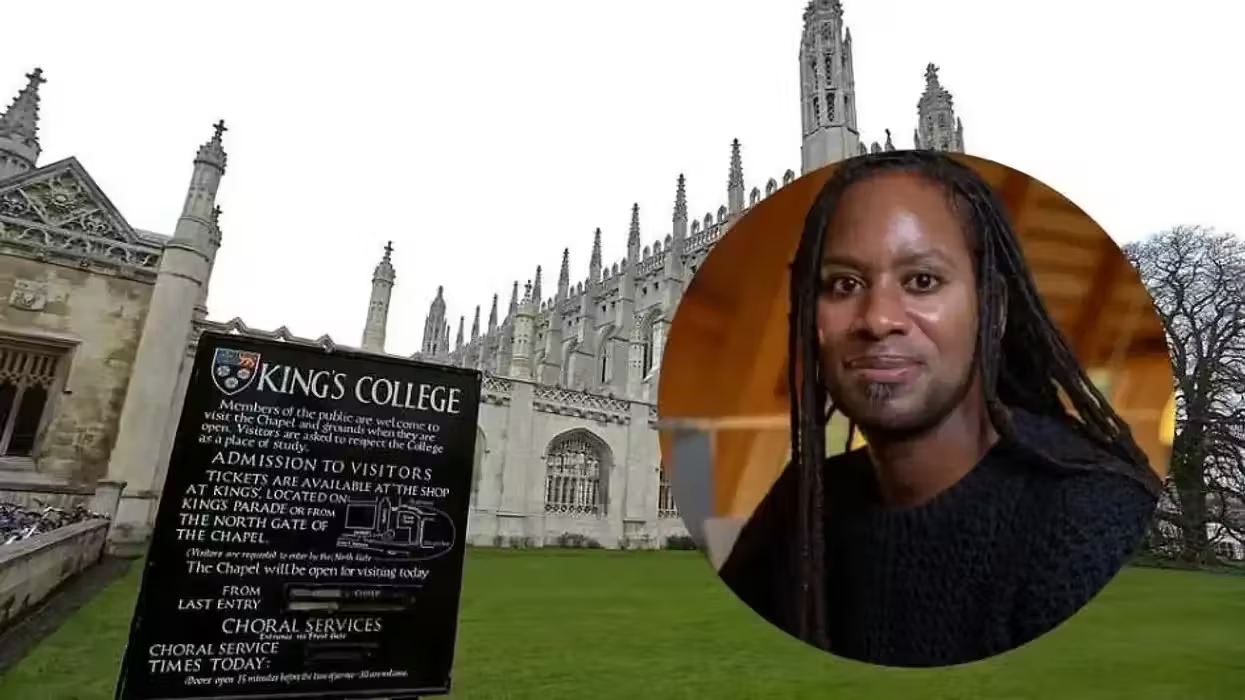
Arday has a memoir coming out this week called “Great and Unfortunate Things.” Simon & Schuster reportedly paid over $1 million for the ghostwritten manuscript. I’m not interested. It probably it belongs alongside James Frey’s “A Million Little Pieces” in the fiction section.
No, the book I want to read will come later and has only one possible title: “I Thought You’d Believe Me.”
I want the confession. I want Arday to tell us he really is a leftist, really does believe the ideology, and nevertheless realized that respectable liberal institutions had made themselves absurdly easy marks.
I want him to tell us he kept pushing and pushing, waiting for somebody to say, “Hold on.”
And for years, nobody did.
If that’s the story, Jason Arday isn’t merely another academic fraud. He’s a world-class trickster.
And somewhere, I hope, my old friend is laughing.
Game recognizes game.