Tom Williams/CQ-Roll Call Inc./Getty Images
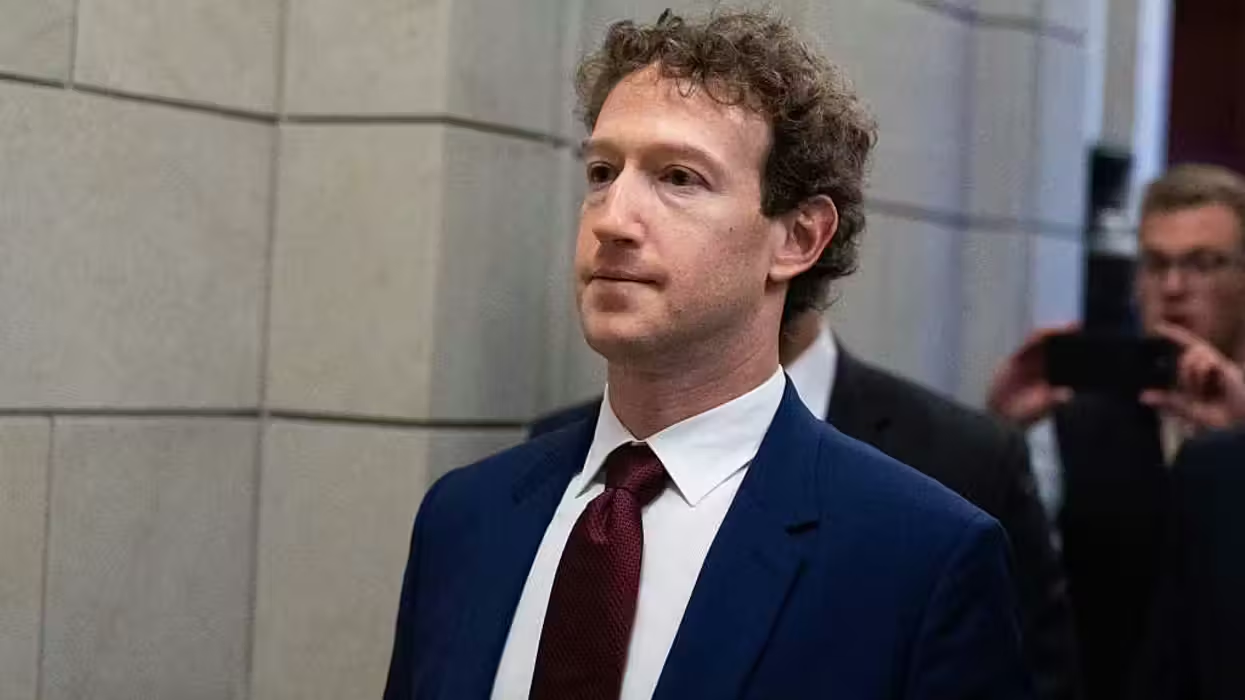
It hasn’t been an easy path for Mark Zuckerberg. However you keep score on his performance as a major figure in American life, he has survived attacks from the highest levels of government against his business, reputation, and livelihood. Few major figures in tech, with the possible exception of his longtime mentor, investor, and friend Peter Thiel, have endured quite the same treatment. Simply put, Zuck won’t quit.
That indestructible attitude has carried straight into AI. Amid criticism, naysaying, and ridicule, Zuckerberg has refused to concede the race to the leading hyperscalers. Now, as those frontier companies hit their own buzz saw of criticism, Zuck has dropped a long manifesto laying out his vision for America’s technological future and Meta’s place in it.
Liberal democracy must discipline superintelligence. Superintelligence must revive liberal democracy. Each is supposed to save the other.
The most striking thing is not that Zuckerberg wants Meta to win. It is what he thinks victory requires. Despite years of periodic hostility from the U.S. government, he has positioned Meta as perhaps the most explicitly pro-American player in the AI industry. He is betting the farm on the proposition that America’s political principles — not merely its capital, engineers, or computing power — are what can carry us through the age of superintelligence.
That’s a gigantic wager, and it arrives at an awkward moment. Dissatisfaction with America’s actual system of government is near a breaking point. More Americans are asking whether the assumptions grounding the regime are viable any more — or even true.
Even many who still defend America’s founding principles believe the government we actually have has become corrupt, broken, and badly detached from them. The appetite for a “new founding,” on the left and the right, keeps growing. Yet the country is too divided and degraded for any ordinary political movement to break through to the other side.
That frustration is part of why so much American energy, ingenuity, money, and willpower have poured into the narrow goal of building the most powerful technology possible — something that may soon go far beyond what any individual human being can comprehend or control.
The irony is brutal. Technological prowess was once among America’s great sources of pride. Now millions of people increasingly experience it as a curse from hell rather than a blessing from God. They already feel reduced to peonage and stripped of agency by institutions they do not trust. And now tech, they fear, is preparing to sweep the refuse we have become into the trash.
Not so fast, says Zuck. His argument begins with a surprisingly old-fashioned insight: Human beings disagree. They struggle, suffer, compete, fear, and want incompatible things. No technical breakthrough abolishes politics because no technical breakthrough can reconcile every human value at once.
“There is no technological solution that can align with everyone’s opposing interests and values at once,” Zuckerberg writes. "Any singular superintelligence would have to prioritize some values over others." His answer is not perfect alignment but a balance of power — the same basic insight, he argues, that underlies Western democratic institutions.
That is why America’s humbler principles — dispersing power, allowing people to define their own goals, and trusting them to work things out for themselves — matter so much in Zuckerberg’s vision. Paradoxically, political humility produces personal ambition. It renews energy more reliably than any genius, planner, or guru could ever manufacture from above.
RELATED: Is this the number-crunchers’ come-to-Jesus moment?
 Inkoly/Getty Images
If this sounds familiar, it should. Zuckerberg is singing from the hymnal of good old-fashioned liberal democracy. His wild idea is that machines powerful enough to transform human life beyond recognition are best developed by patriotic Americans who still believe liberal democracy is basically right about how human beings ought to live together.
And here is the problem.
If liberal democracy brought us to a point where the American government has largely expunged liberal-democratic habits from its own operation, how exactly are we supposed to encode those habits into superintelligence?
Do you believe your vote counts?
Do you believe legislative, executive, and judicial power are effectively separated?
Do you trust your fellow citizens to form judgments and pursue their own plans?
Do you think most of us still possess the maturity, education, thoughtfulness, and patriotism that self-government demands?
In other words: Do Americans still believe in liberal democracy strongly enough to teach it to machines?
That is where Zuckerberg’s argument becomes both elegant and unnerving. The same country that increasingly doubts its political order is now being asked to use that order as the operating principle for technologies more powerful than any previous institution.
Many Americans, meanwhile, are trapped between two impulses: burn it all down or run for the hills. Almost nobody has a plausible alternative regime that could actually work here, much less arrive through a peaceful and orderly transition. People feel bereft of political options, which is one reason the hunger for some higher, almost spiritual answer keeps growing.
The trouble is that whatever spirituality emanates from the upper reaches of the tech world often combines the creepiest and least American aspects of the hippie and the nerd.
Zuckerberg’s answer is startlingly different. He is not proposing that superintelligence replace liberal democracy. He is proposing that the arrival of superintelligence may force Americans to recover it. The new computational powers will be so immense that only a political order committed to dispersed authority, pluralism, and limits can keep a handful of self-appointed global masters from remaking everyone in their own image.
RELATED: The path to America-first AI
 Yunping liang/Getty Images
That is the real bet: AI does not redeem liberal democracy because the machines become wise. AI redeems it by making the alternatives intolerable.
It is a surprisingly elegant and tantalizing vision. But there is one catch. For it to work, Americans will have to treat AI the way they treat liberty itself — not as an accessory or afterthought, but as something woven into daily life. Maybe you personally can remain mostly outside it. But if most Americans do, Zuckerberg strongly implies, the country may not generate the distributed competence, power, and agency his model requires.
So Zuckerberg’s wager runs in both directions. Liberal democracy must discipline superintelligence. Superintelligence must revive liberal democracy. Each is supposed to save the other.
Maybe that circle is virtuous. Maybe it is impossible.
But Mark Zuckerberg has placed his bet. Now? It’s your turn.