Michael M. Santiago/Getty Images
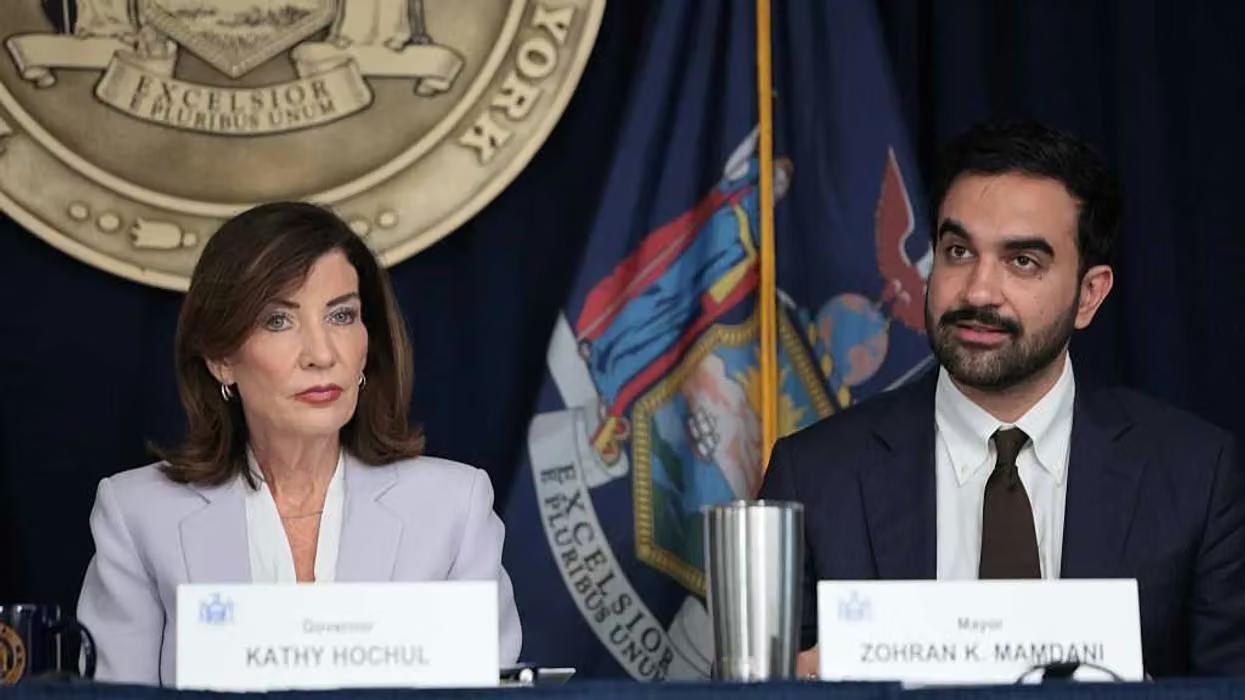
Kathy Hochul (D) last week won another term as New York governor by roughly 20 points. Democrats also flipped governors’ offices in Texas, Georgia, Ohio, Iowa, and Nevada. If you live in a small town or suburb in any of those states, here’s a question worth asking: Who will be paying for what comes next?
Most of the postelection attention has focused on Congress. I would keep an eye on the governors' offices and legislatures, because that is where a great deal of your money gets allocated.
The serious question is whether state spending is justified, how long it lasts, and which communities bear the cost. A governor should be able to answer without hiding behind the word ‘free.’
I live in upstate New York, not far from the dairy farms where I grew up. For most of my life, New York City might as well have been another state. Whatever its mayor did didn’t seem to affect us very much. I have changed my mind about that, and I think people who live far from big blue cities should, too.
Zohran Mamdani took over New York City Hall in January promising free buses, free child care, and city-run grocery stores. He calls himself a democratic socialist, and to his credit, he never hid his ambition to enlist Albany in his efforts. A city can make promises on its own. Paying for those promises is another matter entirely.
In February, Mamdani presented a $127 billion preliminary budget and warned that without state permission to raise taxes on wealthy residents and corporations, he might have to increase city property taxes by 9.5%. The final budget adopted in June was $125.8 billion, without that proposed property tax increase. But the argument about state help was hardly theoretical.
Hochul and Mamdani announced $1.5 billion in additional state support over two fiscal years. Part of it reversed costs that earlier administrations had shifted onto the city; $500 million was one-time assistance.
Separately, Albany budgeted $2.4 billion for child-care assistance statewide, including money for New York City’s programs. Those are different appropriations, and the distinction is worth making. So is the fact that taxpayers across New York have a stake in them.
A lot of that money comes out of the pockets of people in Elmira and Buffalo who will never ride one of Mamdani’s free buses. And the city isn't finished looking for other people’s money. Its adopted financial plan projects a $6.44 billion gap in fiscal 2028 and gaps exceeding $8 billion in each of the two years after that. Those are the city's own estimates, not a hostile guess from somebody upstate.
The serious question is whether state spending is justified, how long it lasts, and which communities bear the cost. A governor should be able to answer without hiding behind the word “free.”
RELATED: The day after tomorrow: A new GOP
 Tom Brenner/Getty Images
Other states face their own versions of this problem. Illinois approved a transit-funding overhaul that redirected gas-tax revenue, raised regional sales taxes, and changed tollway financing to help Chicago-area transit. Those decisions have winners and losers. Georgia just elected Keisha Lance Bottoms, a former Atlanta mayor, as governor. I would be curious how many voters in Valdosta or Dalton have started asking whose priorities she will carry into the state Capitol.
My career has been in the energy and utility business, and I have seen how rules written in Albany can reach people who never asked for them. In 2024, New York enacted a Climate Change Superfund Act designed to collect $75 billion over 25 years from major fossil fuel companies, starting in 2028. Lawmakers called it a “bill for industry.” I would have liked to hear more about how much could eventually be passed along to customers, including farmers and families who heat their homes with propane.
Federal courts blocked that law earlier this year, and New York has appealed. The state isn’t collecting those billions — yet. But the attempt tells us something about the spending and taxing ideas that can get traction in Albany. Texans with a new Democrat governor of their own might take a look before anyone in Austin proposes a similar experiment.
RELATED: Trump conquered the Republican Party. What a waste of a victory.
 Brendan SMIALOWSKI/AFP/Getty Images
Cities sometimes deserve state aid. Fine. Make the case and open the books. Statewide policy reaches everyone, including communities without a big-city mayor sitting across the table from the governor. A promise aimed at one constituency can become an obligation for many others.
Last week’s election was a hard one for conservatives. I won’t pretend otherwise. But elections are battles, not the whole war. A lot of us poured everything into Washington while barely learning who was running for governor in our own states. The left has spent years organizing in statehouses. Mayors like Mamdani with expensive agendas are counting on it.
The next election will be here soon enough, and it won't be only about the White House. Learn your state senator's name. Watch what your biggest city asks the capital to pay for. Ask the governor what it will cost, who benefits, and what happens when the money runs out. And the next time a mayor promises something for free, find out who is actually paying for it. Odds are it’s you.