© 2026 Blaze Media LLC. All rights reserved.
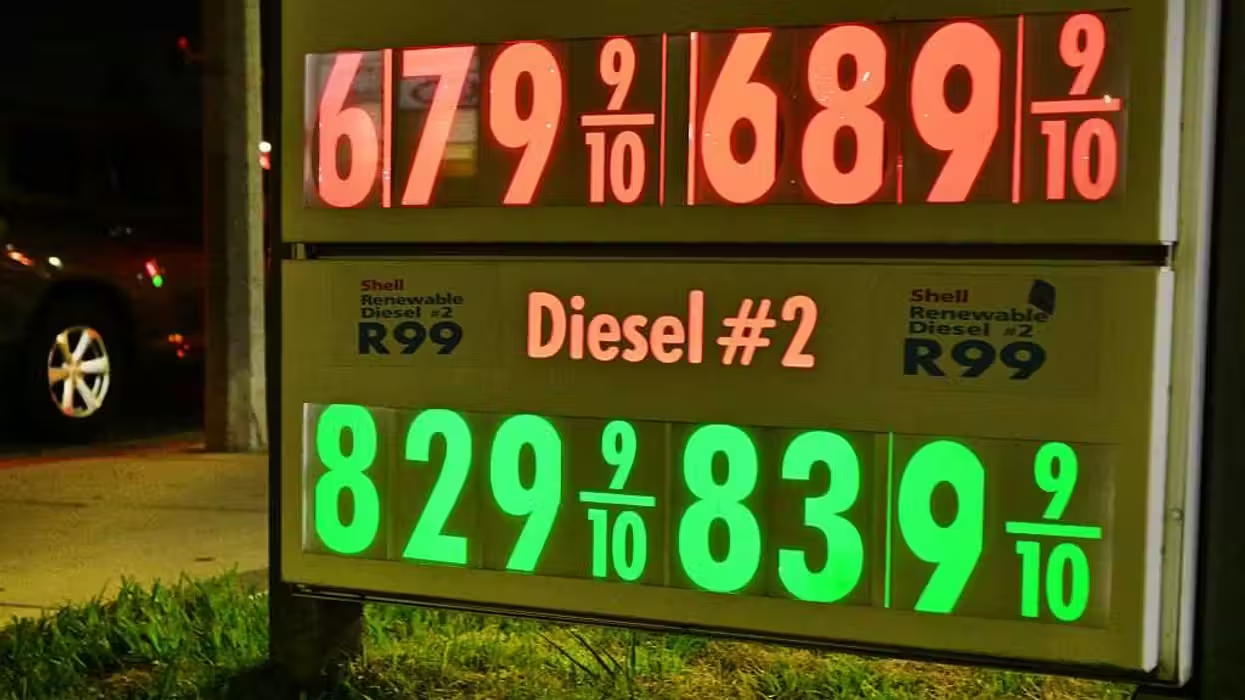
Diesel prices are at all-time highs, and panic has set in. Several Republican senators from Midwest farm states in competitive midterm races are calling on the administration to ban diesel exports. Even President Trump expressed support for the proposal. Lawmakers desperately want to curb the pain felt at the pump and throughout the agricultural industry. It’s understandable. But the knee-jerk reaction to “do something” by banning diesel exports is ill advised and would quickly backfire.
Logic might dictate that preventing all diesel from leaving our borders will allow it to fulfill our needs first. It just doesn’t work that way. Petroleum is a global market.
The only way to curtail a diesel surplus would be to cut back on crude altogether, a move that would be economically devastating.
The U.S. fuel network is not set up to distribute gas throughout our country. Nearly 55% of the nation’s refining occurs along the Gulf Coast, producing more than enough diesel for the region. But much of the surplus must be exported, as there are very few avenues to ship it to other domestic markets, like the East and West Coasts, where it is needed. Both those areas rely on imports to satisfy their diesel and other gasoline demands.
The U.S. has too few pipelines and cargo capabilities to transport energy to these locations. And storage is not an option; there is only so much space.
Refineries cannot flip a switch to produce only the diesel needed at a given time. Processing a barrel of crude oil produces certain proportions of gasoline and other distillates (like diesel and jet fuel); refiners are limited in their ability to adjust those proportions.
The only way to curtail a diesel surplus would be to cut back on crude altogether, a move that would be economically devastating.
At a time when we are already experiencing significant gasoline shortages and steep prices, constricting our supply further would only continue to inflate prices. Voters still rate the economy and affordability as their top concern; higher conventional gas prices would increase financial strain on household budgets.
U.S. diesel exports represent roughly 20% of global supply, which means they put downward pressure on global prices. Removing that portion would push those prices up, and the regions that depend on diesel imports — like the East and West Coasts — will face higher prices.
A ban on diesel and other refined products has been proposed before and soundly rejected. The Biden administration broached the topic in late 2021 but ultimately decided against it. Several analyses concluded that the action would adversely impact the country.
RELATED: The one loophole in Trump’s tariff policy
 Jeff Swensen/Getty Images
A 2022 American Council for Capital Formation study predicted that such a ban would shut down roughly 1.3 million barrels a day of refining capacity. More than two-thirds of U.S. consumers would see price increases of roughly $0.15/gallon for gas and $0.45/gallon for diesel, and GDP would drop by $44 billion the following year.
McKinsey & Company similarly calculated bad news for U.S. consumers. A ban may initially provide relief for Gulf Coast and Midwest customers, but it wouldn’t last. Import-reliant regions, such as our coasts, would experience diesel price spikes due to global prices inflating by at least $0.60 per gallon.
Unfortunately, until there is a durable resolution to the geopolitical conflicts and disruptions abroad that would restore a steadier flow of resources, there is not a quick remedy that can bring energy costs down. Since energy markets and refinery operations are globally interconnected, a rash course of action has ripple effects felt across supply chain networks, some of which touch parts of our own country.
Lawmakers should focus on long-lasting solutions at home that will provide better insulation and protection from outside forces beyond our control.
- Make federal land leasing more predictable and feasible for petroleum exploration and development.
- Streamline permitting to facilitate and hasten building energy infrastructure like refineries for processing fuel and pipelines to transport it across the country.
- Create a regulatory environment that fosters investment in the essential energy sources that run our economy.
A durable fix requires resisting the temptation of quick, politically satisfying moves and instead doubling down on policies that expand supply, modernize infrastructure, and strengthen the resilience of our energy system.
Banning diesel exports would raise prices for most Americans, destabilize global markets, and weaken the very regions already under strain. Rather than constricting flows in a tightly interconnected network, lawmakers should pursue reforms that unlock investment, improve distribution, and ensure that the U.S. can reliably meet its own needs.
The path to lower prices runs through growth and modernization — not restriction.
Editor’s note: This article was originally published by RealClearEnergy and made available via RealClearWire.
Want to leave a tip?
We answer to you. Help keep our content free of advertisers and big tech censorship by leaving a tip today.