Alishia Abodunde/Getty Images
I wanted a reckoning. I did not want Jason Arday dead.
Three days before he was found dead at his London home last week, I published a column entertaining what I admitted was a mischievous theory: Maybe the disgraced Cambridge professor was not merely a fraud but a world-class trickster who understood liberal institutions well enough to play their racial and ideological anxieties for all they were worth.
Maybe the cruelty was not that somebody finally checked. Maybe the cruelty was that almost nobody checked sooner.
I hoped someday he would confess. I even had the title of the book I wanted him to write: “I Thought You’d Believe Me.”
I wanted that book. I did not want an obituary.
Graeme Wood, writing this week in the Atlantic, makes a persuasive case that my trickster theory was a tad too generous. Arday apparently did not respond to exposure with the wink of a con man finally caught. He insisted he was not a liar. Wood reaches for Henrik Ibsen’s “The Wild Duck” and its livsløgn — the “life-lie,” a sustaining self-delusion that eventually becomes impossible to let go.
Maybe that’s closer to what happened. We’ll likely never know.
What we do know is that Arday lied. A lot. His public biography accumulated claims about academic appointments, fundraising, extraordinary athletic feats, and racist attacks that proved false, dubious, or impossible to verify. His scholarship contained extensive passages alleged to have been lifted from the work of less prominent academics. Cambridge ultimately opened investigations into his academic work and qualifications and, after his resignation, agreed to an independent inquiry into his appointment.
Enough of these lies!
That includes the lie now being told about the people who exposed them.
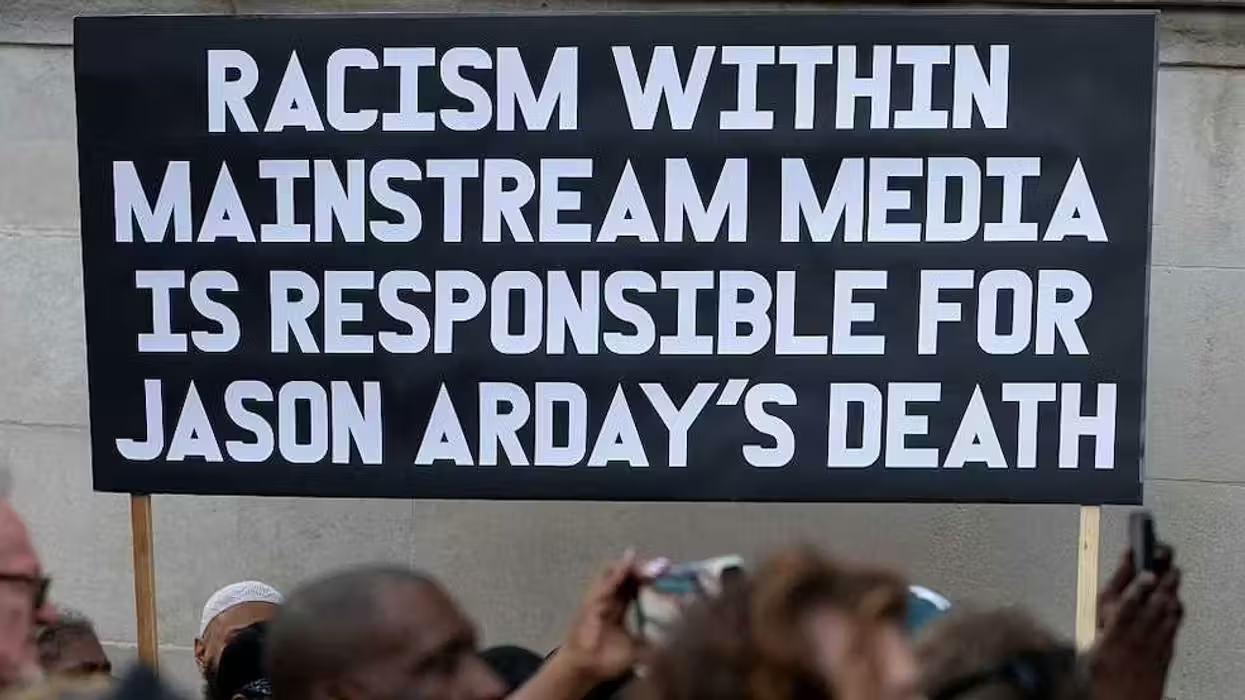
The fraud Ibram X. Kendi titled his response “The Media Lynched Jason Arday.” He says journalists have blood on their hands and treats Cambridge’s decision to investigate Arday as an abandonment of a prominent black scholar under racial attack. Wrong.
A lynching is not a metaphor for journalism you dislike. Reporting true and newsworthy facts does not become murder because the subject later dies.
What, exactly, should reporters have refused to investigate? The dissertation? The nonexistent appointments? The millions supposedly raised for charity? The 30 marathons in 35 days? The stories of racist attacks? The memoir?
RELATED: 5-star reviews for a fabulist memoir
 Denise Baker/Getty Images
Precisely which question was forbidden?
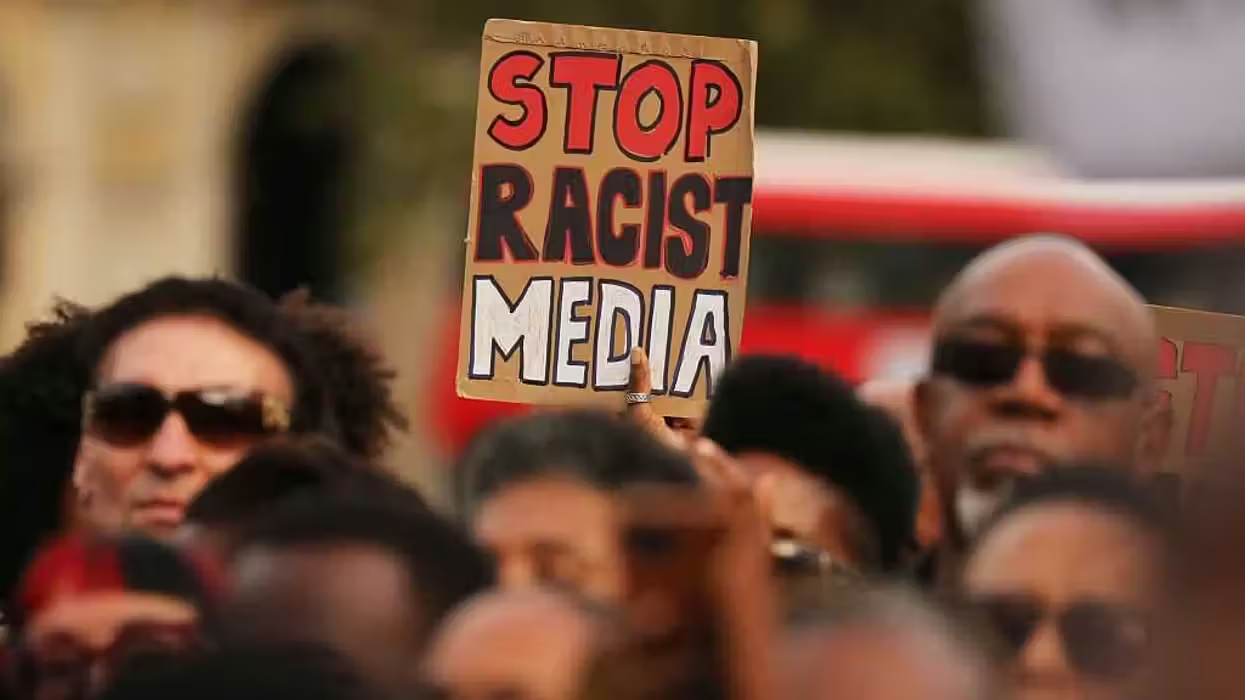
Thousands gathered in Trafalgar Square on Monday to mourn Arday. The grief was real. So was the anger at the press and at Nathan Cofnas, the academic whose investigation of Arday’s work helped start the avalanche. Cofnas has controversial views about race. So what? If he found copied work, the relevant question is whether the work was copied. His politics cannot restore originality to somebody else’s prose.
This is how the evasion works: Stop talking about the evidence and start talking about the man who found it.
Now comes the possibility of “Arday’s Law.” A petition circulating in Britain actually proposes legislation limiting how many articles may be published about one individual within a given period, on the theory that excessive coverage causes mental anguish. It had garnered more than 3,500 verified signatures as of Wednesday.
The answer to too much journalism, apparently, is a government quota on journalism.
I sometimes fear Britain is lost. Thank God for the First Amendment!
This idea did not appear from nowhere. We have spent years teaching people that speech itself can constitute harm and that institutions therefore have a duty to build ever-safer spaces around anyone who might be harmed by it.
But no space is ever safe enough.
Once speech becomes violence, censorship becomes “care.” Eventually, as we’ve seen, the safe-space logic escapes the campus. A reporter asks too many questions. Too many newspapers publish the answers. Somebody suffers. Therefore, the state must decide when everybody has said enough. No thanks.
RELATED: No, the founders did not ‘tell you so’
 Guy Smallman/Getty Images
That is not “liberalism.” Liberalism properly understood demands something harder: accepting that free speech can be intrusive, offensive, unfair, and occasionally cruel while recognizing that giving government power to decide when enough has been said is much worse.
If we want to talk about who failed Jason Arday, look first at the institutions that elevated him.
Graeme Wood’s harshest argument is also his most compelling. Arday was placed in a position for which the evidence increasingly suggests he was nowhere near prepared, while colleagues and institutions such as Cambridge, the BBC, and Simon and Schuster amplified an extraordinary biography instead of bothering to check it. Eventually somebody was going to notice.
Maybe the cruelty was not that somebody finally checked. Maybe the cruelty was that almost nobody checked sooner.
After I learned that Arday had been found dead, I wrote one of my writers: Hubris met Nemesis. And the outcome was invariably the same.
That does not mean Arday got what he deserved. Quite the opposite. Nemesis in tragedy is not proportional justice. It is catastrophe. Recognition comes too late, the machinery is already moving, and the ending is worse than anyone wanted.
Arday’s family and friends deserve compassion. His kids especially. They lost someone they loved.
But compassion does not require one more lie.
Death does not authenticate a false claim. It does not make plagiarism original. And if Arday took his own life, suicide does not retroactively turn reporters into murderers.
The tragedy is terrible enough. Don’t lie about that, too.