© 2026 Blaze Media LLC. All rights reserved.
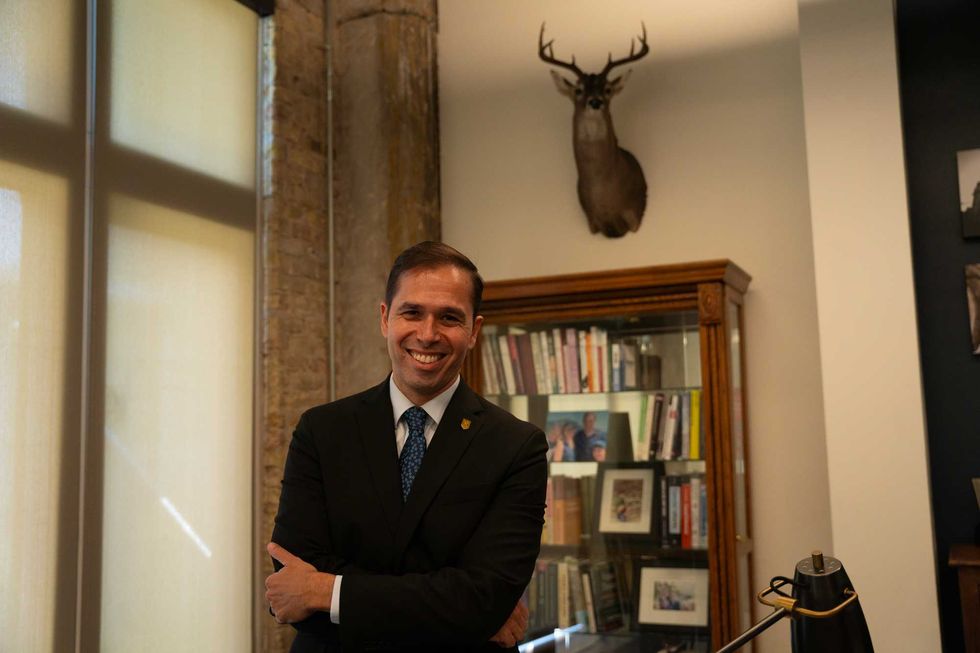
The University of Austin, founded in 2021 as a bold challenge to the bleak trends of COVID-era tyranny, now has half a decade under its belt and a promising vision for the future. We sat down with the university’s second president, Carlos Carvalho, who assumed the role in the summer of 2025, to discuss this vision and the challenges the fledgling school for free thinkers has overcome. President Carvalho expanded upon some exciting news and showed no signs of slowing the momentum of this unusual experiment in the center of the Texas capital.
FRONTIER: Tell me about yourself and how you found your way to the University of Austin.
CARLOS CARVALHO: I’m a statistician by training. I got a PhD at Duke University. And I’m from Brazil originally. Then I became a professor at the University of Chicago. I’ve been in the reform trying to bring viewpoint diversity and trying to fight the exaggerations of the left at university for a while. And through the process, I got to know the folks starting UATX a few years back, and I helped them in the beginning, consulted for them, and tried to help set things up.
F: Looking back on the broader culture of 2021, there was rampant censorship and a lack of viewpoint diversity. Can you talk about what came about from that when you began helping, and where you went from there into the modern moment?
CC: I think we forget, because we’re very optimistic people generally, we forget how tough of a moment 2020 and 2021 were for one’s ability to speak freely in this country . . . If you questioned things associated with the orthodoxy of lockdowns, or if you questioned things associated with mask mandates, or if you questioned policies related to the BLM Summer of Floyd in 2020, you were in dangerous territory. I think it was this notion that, yeah, we need to build something where freedom of expression is going to be protected, a place where it’s committed to the pursuit of truth, regardless of where it takes you, regardless of the kinds of questions that it requires. There are a few pillars of what we are that I think are very distinctive and very important. We are an institution that is proudly American, that understands that America is a special place, is a place that has delivered an enormous amount of prosperity and freedom and happiness to the world and it’s worth defending.
F: What was the thought process behind offering the incredible opportunity of free tuition, and why do you think it is important?
CC: We are really making an investment on the creativity of these future citizens. The burden of an enormous amount of debt is something that delays their ability to really engage in the most productive activities in those early years. They might take the job that is secure because it pays well enough so that it can service their debt versus the job that would really propel them to a successful career long term.
F: Is there a through line of the types of students you’re looking to attract or to build around?
CC: Our admissions is radical, and we think it is the most moral and most meritocratic admissions process in the country. We look at nothing other than quantitative, objective measures of merits. We are clearly a place that wants to build future successful patriots, people that are free thinkers, people that are willing to take on the risk to join an institution like ours. The students are not my customers, they are my equity partners, and we are fully invested. We’re creating this lifelong
partnership as they come in. And those are the students that we’re getting.
F: How were you able to attract so many high level and widely respected academics to teach there?
CC: I think there’s enough people that have been unhappy. And they saw with very positive eyes the idea of something new, partly because it was something new for them to go work at, but also to support, because they see us as a way to maybe highlight to the world that reform is needed, and we can serve as an example.
F: How are you laying the foundation for what you hope this will become?
CC: We are purposely small . . . That allows us to have a very close relationship with the student, really develop a bespoke opportunity to learn and think about what they’re doing, what they want to do, and how to support that journey and adapt to the realities that are ever changing on the ground. My students can have access to all the factual knowledge in the world through the technology that’s now available. What I need to do as an institution is now add to that, make that into something real and human and really elevate that potential. And that’s going to require something that’s going to be done in smaller spaces.
F: What’s your best pitch for why prospective students should apply to the university?
CC: Free helps. . . This is not a mass market experience. It’s something for the ones that really have the desire for a challenge, have the skills to engage in the challenge, and have the goal to build great things and really support this experiment of America in the future . . . We’re trying to prove that universities can be both excellent and accountable. I truly have the best interest of your kid in mind, because their future success is the only way I succeed.
Want to leave a tip?
We answer to you. Help keep our content free of advertisers and big tech censorship by leaving a tip today.