Adobe
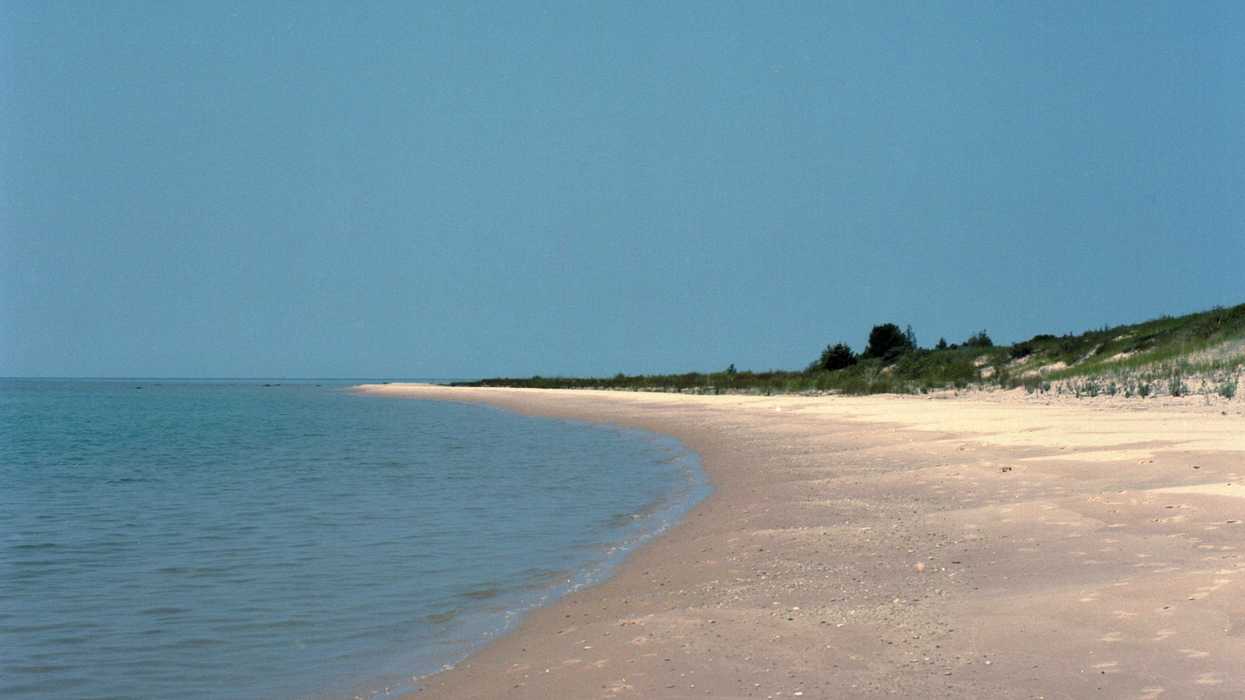
The earth has a memory, its ledger etched in stone and soil. And in those places that bear witness to great tragedy, the earth cries out. It speaks things to man, even things alien to the events that preceded him. There, the earth’s memory appears as a specter, less remembrance than haunting.
The works of man, themselves built of earth, retain the same proclivity for memory. They tell stories long after they have been abandoned. As long as they stand, what once was can be felt, and like the earth from which they came, they appear to the observer haunted.
It is this haunting, I believe, that lies behind Gen Z’s peculiar fascination with liminal spaces.
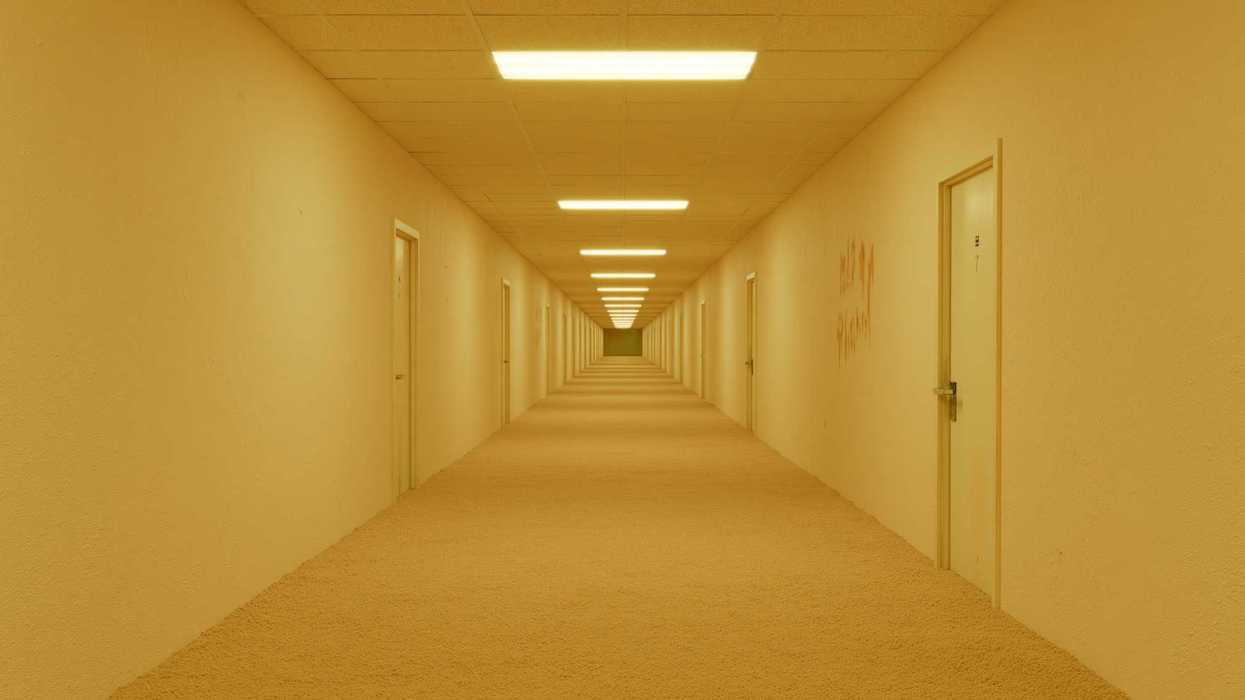
The liminal space: the empty mall, the abandoned water park, the uninhabited office building. Pictures of these spaces have been memed across image boards, dissected through video essays, and endlessly reproduced online, all marked by the same commentary of fear and unease. It is a sensation not unlike what one feels on a battlefield, where the memory of what was touches the unconscious.
This is not a niche internet phenomenon. The success of Backrooms, which began as an image and creepypasta before becoming an entire genre of internet horror, speaks to the universality of the feeling across Gen Z. There is nothing particularly threatening about a Sbarro at closing time. And yet an entire generation has organized a genre of horror around the simple experience of standing in one.
That is not an accident, and it is not merely an aesthetic trend. It is a symptom of something deeper.
To find the cause, we have to go back roughly thirty years, to a French anthropologist named Marc Augé and a concept he called the non-place.
A place, in the older sense, is not simply a specific physical location. It is a relational and historical space where identity is formed. It is built slowly, over years, by people who stay put long enough to accumulate a history with one another. The village square. The church. The corner shop. The shopkeeper knows your name. You know his. History, identity, and relationship are the substance of the place itself. Strip them away, and the architecture remains, but the place ceases to be.
Modernity did not destroy these places all at once. It replaced them with a new category of space, one that demanded nothing personal, remembered no one, and asked only that you pass through. Augé called it the non-place, and it has since swallowed nearly all that came before.
The non-place is the airport terminal. The Circle K. The big-box store. These are not corrupted versions of a place; they were never meant to be places at all. You do not need a history with a rest stop. You need a ticket, a receipt, a badge. Augé called this “solitary contractuality,” the condition of interacting with the space itself rather than with the people inside it.
A non-place does not remember you, nor you it.
And then the ruins are handed to a generation that never knew the world that built them.
But a non-place, in its early and functioning form, is not empty. A mall in 1985 was a non-place by Augé’s own definition: impersonal, transactional, asking nothing of anyone. But it was a living non-place.
Crowded. Humming. Kids meeting up after school, music playing, stores glowing, food courts brimming with vitality. It didn’t offer the older kind of village relationships, but it had life. And for the people who passed through it in that state, it left behind a real memory.
Ask anyone who came of age in the ‘80s or ‘90s about the mall and you will get a heavy dose of nostalgia, not because the mall was ever a place in the deeper sense, but because it was, at minimum, alive.
It had a pulse.
Every non-place does.
However, non-places do not stay full. Entropy remains undefeated. They decay, the way anything unmaintained decays, and what is left after the decay is a husk: the dying strip mall, the pool deck nobody has swum in for a decade, the office building with a sea of empty cubicles.
The generation that saw these places in their prime carries a memory of their fullness. That memory softens decay into nostalgia. It is a loss, but it is a loss with a shape, a soul tied to something that once lived.
This memory is something Gen Z never had.
What they inherited is the husk itself, with no memory behind it to make sense of the decline. They did not lose something. They arrived after it was already gone. And what they are left holding is not a memory but a residue—and residue is exactly what a haunting is made of.
This residue should not be confused with mourning. Mourning requires the loss of something you once held, where its absence leaves a sense of loss, a pang, a wanting. What a Zoomer standing in a dead mall corridor is experiencing is closer to what a man feels on a battlefield: the recognition, without evidence, without personal stake, that something with weight and purpose used to occupy this exact ground and does no longer.
The distinction is important.
The person who remembers the mall in its prime can mourn it. He remembers the fluorescent lights, the music, the food court, the girls he knew, the friends he met there. The mall’s death is attached to the death of something in his own life.
The Zoomer has no such memory.
It is made worse by the fact that whatever image he holds of the mall or the diner in its prime did not come from his own life. It came second-hand, through film, through a parent’s story, through the sitcom version of the American third place. So, when he stands in the real, degraded version of that space, there is a gap between the inherited myth and the thing in front of him.
That gap is where the dread lives.
It is not a memory returning. It is the absence of a memory that was never his, pressing against a space that plainly, physically, once held one.
For the Zoomer, this registers as dread, not as sadness.
The empty corridor, the flickering light, the carpet pattern repeating into nothing, are not frightening because anything supernatural is present. They are frightening because they are saturated with detail and empty of meaning.
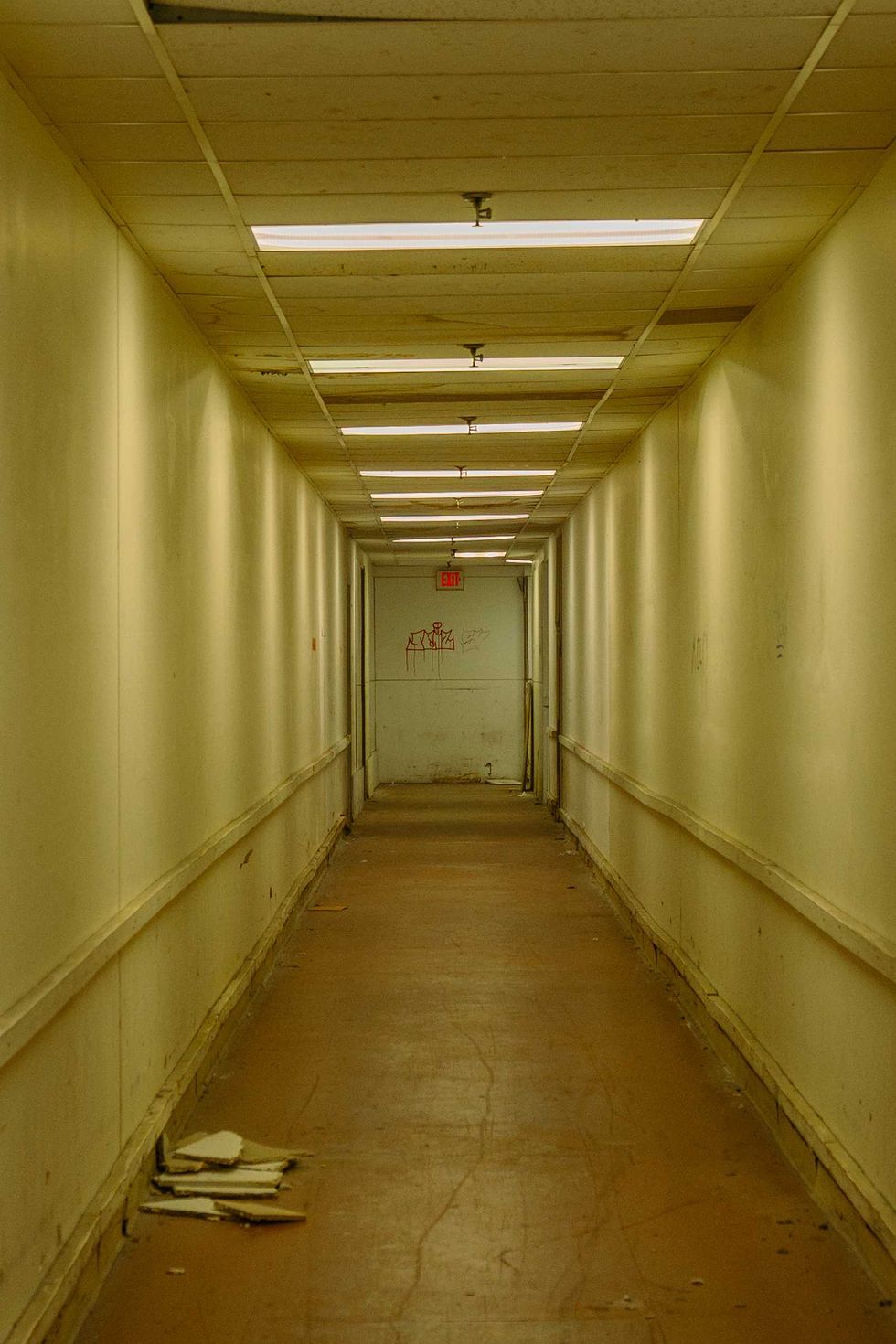 The disconcerting feeling of déjà vu, of having been here before.Adobe
The sale banner is still up.
The directory board still lists the stores.
The hours are still posted on the door.
Nothing they signify is happening anymore.
This is what Baudrillard meant when he described the sign coming loose from what it once represented. The symbol survives. The referent is gone.
The sign for Sears remains, but Sears is gone.
The swimming pool remains, but no one swims in it.
The office remains, but no one works there. The space retains the physical vocabulary of human activity after the activity itself has disappeared.
This is where the non-place becomes something more than merely impersonal. It becomes haunted.
A non-place, in its early and functioning form, still tends to be shaped by a fairly specific set of people—a particular town’s mall, a particular region’s diner chain, built around and for whomever was most likely to use it. But a non-place has to remain legible to everyone who passes through it, and as the people moving through any given space grow more numerous, more transient, and less connected to one another, the space itself is forced to become more generic simply to keep functioning.
It sheds whatever local character it had.
It becomes flattened, more purely transactional, more purely a non-place, in order to remain usable by anyone and no one in particular.
That flattening is not separate from the decay already described. It is the same mechanism, working from the inside out. The “non-ness” of the non-place intensifies itself over time, and that intensification is underway long before the last store closes.
The place becomes less capable of remembering.
Then, eventually, it becomes incapable of remembering at all.
All of this follows an easily definable pattern:
Augé’s non-place—the death of relationship, replaced by transaction. The prime—the non-place alive, transactional but full, leaving real memory behind for those who saw it. The husk—the non-place after its own decline, inherited by a generation with no prime to remember. The haunting—the dispossessed Zoomer standing in the wreckage, registering absence the way a stranger registers a battlefield: without evidence, without history, and without the comfort of knowing exactly what it is they’re mourning. This is more than an aesthetic, a mood board, or a genre of video. A civilization that keeps building non-places and then abandoning them is manufacturing haunted ground. It builds spaces designed for human presence, fills them with people, strips them of their particularity, and eventually abandons them. The physical structure remains after the social world that gave it meaning has disappeared.
And then the ruins are handed to a generation that never knew the world that built them. They see the carpet. They see the fluorescent lights. They see the empty storefronts. They see the faded advertisements and the signs still promising what is no longer there. They do not remember what happened there. But they can feel that something did.
Perhaps that is why the images disturb them.
The ancient ruin does not frighten us because we know nothing happened there. It frightens us because we know something did. The stones are evidence. The walls are witnesses. The absence of the people who built them is itself a presence of its own kind.
The same is true of the dead mall, of the abandoned water park, of the empty office building. The earth remembers. So do the things we build upon it.
And when the people who remember are gone, what remains is the specter of the life that once occupied the ground.
The place does not forget.
The earth cries out.