
Xan Doane
My instructions arrived as a set of coordinates and a flame emoji.
33°55'12.97"N, 118°24'55.84"W 🔥
By dusk I was standing beside a bonfire in El Segundo, the refinery town pressed between Los Angeles International Airport and the Pacific. Around the fire were young men intent on splitting atoms, manufacturing rain, automating mines, rebuilding American industry, and, in several cases, restoring Christendom.
They call the place the Gundo.
During COVID, while much of their generation was ordering dinner through an app and sinking deeper into the upholstered gloom of the internet, a loose fraternity of engineers and founders began moving here. El Segundo offered warm weather, cheap industrial space, machine shops, aerospace veterans, and the vast inherited apparatus of Southern California manufacturing. It also had the right psychological distance from Silicon Valley.
The Gundo founders speak of “hard tech,” technology made from atoms rather than abstractions. Their companies build nuclear reactors, weather-modification systems, mining equipment, surgical robots, radios for space, and factories for reshoring chemical production to the United States. They admire industry because it imposes a discipline absent from much of digital life. A machine either works or it does not. A reactor cannot be persuaded by a presentation deck. A factory fire, as one founder told me, does not care what you think.
This revolt against abstraction extends beyond business. Its leaders talk about marriage, children, country, duty, physical courage, and God with a directness that would embarrass the human resources department of any “respectable” corporation. Many are Catholic, some Protestant, some Orthodox. Some are not Christian at all. But Christianity supplies much of the scene’s language and moral atmosphere.
“We are going to win,” Josh Steinman writes on X each morning.
It is the Gundo’s reveille, half declaration and half dare.
Isaiah Taylor and Augustus Doricko met on what was then Twitter in 2023, joking in the comments under Josh’s tweets. In the few years since, the three have built companies whose value continues to climb, and a culture worth even more.
Steinman, a middle-aged family man, is a sort of godfather to the group; Taylor and Doricko serve as the 20-something firebrands.
It would be difficult to find a more striking pair of foils.
Isaiah looks like a clean-cut military man ready for his flight suit; Augustus sports an aggressive mullet and mud-caked boots.
At the breakfast table in rural Kentucky, Isaiah heard stories about his great-grandfather Ward Schaap, a scientist on the Manhattan Project; high above the ground on construction sites in his affluent Connecticut enclave, Augustus developed a penchant for pyromania.
“We need to teach the next generation that they need to play Minecraft in real life.”
Young Isaiah wanted to serve his neighbor through technology and, one day, build a network of churches on Mars. He struggled to reconcile that ambition with what he calls the “hunker-down, the-world’s-going-to-end-soon” dispensationalism he heard in church. His turnaround came by reading the transformationalist theology of the Reformed tradition in his father's library.
His nuclear energy startup, Valar Atomics, takes its name from the angelic powers in Tolkien's The Lord of the Rings. It was one of the startups tapped by President Trump’s Reactor Pilot Program last year to revitalize nuclear power in the United States ahead of the nation's 250th birthday.
 Grounded in God and country. Inspired by Tolkien.Xan Doane
Augustus came to faith by a darker road. His parents divorced during his adolescence, though he is close with both of them today. As he grew older, he struggled increasingly and was even homeless for a time. He secured a place at UC Berkeley, but a doom spiral had already set in. He remembers dragging himself to class one day, only to retreat to the bathroom. In the shame of exhausting an entire eight ball, he recalled the Columbine shooters saying that they felt no good could be great enough to justify the pain of their existence. He felt the same.
But on the walk home, even the "urban dystopia chic" of his COVID-era surroundings seemed to possess more meaning than his own life did. Yet there the young man encountered an undeniable truth: his little sister mattered, even if he didn’t. He opened the Bible his nana had given him, and after a long, dark night of the soul, the waters of baptism poured over him some months later.
Today, his company, Rainmaker, brings life-giving water to the world—a less exalted gift than the waters of baptism, but a vital one nonetheless. Its terraforming and weather-modification technologies follow a dominion-mandate theme, hoping to invoke nominative determinism with projects like Elijah, Eden, and Canaan.
Many in Gen Z describe their situation with the same resignation Augustus felt, if seldom to the same degree. “Doom-scrolling,” “brain rot,” and “blackpilling” are commonplace experiences in his generation.
Marriage, children, and the cost of living are out of reach, the thinking goes, and the only ways out are OnlyFans for young women or Kalshi gambling for young men. DoorDash, TikTok, and Netflix aren’t going to binge themselves, so at least there's something they can do better than AI.
Against this despondency, Josh Steinman marks each morning with his call to victory. His cherubic face belies the resolve behind it. After 9/11, he joined the Navy and eventually served as a Senior Director on the National Security Council. There, he reached dire conclusions about the robustness of the American economy in light of its hollowed-out industrial capacity.
He resolved not to be a mere doomsayer but to take responsibility and act. The Detroit native moved to Los Angeles, which he saw as America's last great industrial city. He decided to make a stand; he decided to build the Gundo.
As Isaiah’s chief of staff, Charlotte Nazarian, put it: "That's what El Segundo is. You can just split atoms. You can just make it rain. You can just mine for random minerals. If you believe that, you're going to cut it here."
Augustus met Jakob Diepenbrock on a bus ride, where, as young men do, they fell into a theological debate. By the end of it, Jakob decided to join the cause.
His opportunity was to build the startup incubation infrastructure to cultivate new leaders and to launch new businesses according to the Gundo ethos.
In the two years before meeting Augustus, Jakob had gone from climbing an old mill with other kids in rural areas of Washington State to school in Boston and an internship with the family office that managed the Microsoft CEO’s investments. Nonetheless, he decided, "I'll drop everything for three months, and if I raise enough to pay living expenses, I'll just keep going."
His twice-annual startup cohort rapidly grew from obscurity to a substantial event, with hundreds of investors attending the presentations on "demo day." In its first 2026 cohort, Diepenbrock’s firm, Discipulus Ventures, hosted founders from 10 startups. Their businesses feature terahertz radios in space, autonomous surgical robots, a social media influencer who wanted to make the world's best fitness supplements but ended up reshoring the underlying chemical supply chain, and a factory owner focused on automation who introduced himself with the winning line, "Hi, I'm Vin, and I love shampoo."
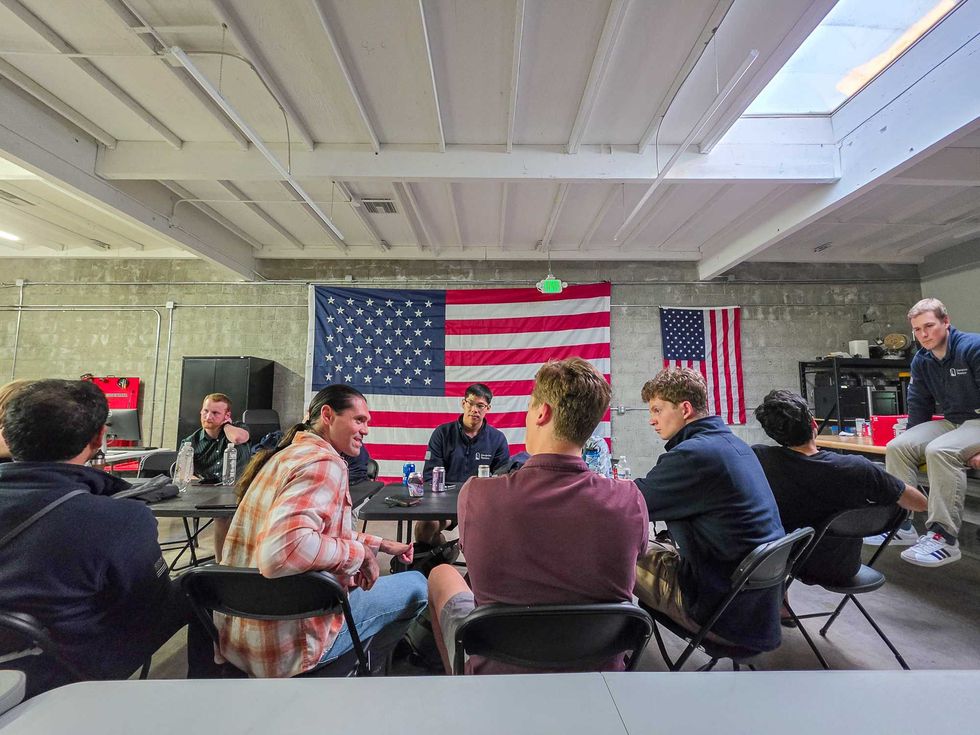 Chase Caffrey (right) holds court with members of the Discipulus community.Xan Doane
The fundamental idea is simple: until recently, software and financial services were much easier to scale rapidly than physical production, as the latter was often hobbled by slow development cycles, dirty processes, and huge up-front capital requirements. But the viability of hard tech startups is changing thanks to new technologies that include robotics, AI, and 3D printing, as well as the founders’ own research in government and university labs.
The founders spend two weeks together, attending presentations to cultivate the Gundo ethos with Steinman, Taylor, Doricko, and other key figures, honing their investor presentations, and bonding into a community. They embody their values in daily athleticism, flipping tires one day and surfing the next.
Jakob also lives his values with an uncommon calendar item for a venture capital itinerary: “(Optional) Church.”
Only three founders in this cohort are practicing Christians, yet all welcomed this invitation. In a generation that finds it difficult to believe in anything at all, there is something generous about sharing a faith you hold dear. Many joined Jakob on a visit to his Catholic parish.
While many in the Gundo are disciples of Jesus Christ, its mission is broad enough to attract many outside the faith; indeed, most participants are not Christian. For example, there were more Jews than practicing Christians in the cohort, and nearly as many Muslims. Illinois farmboy Jared West described the ethos of the Gundo as “God & Country,” and while some emphasize the “God,” others emphasize the “Country.”
Miguel Arratia, for instance, a professor at UC Riverside, looked forward to his US citizenship induction ceremony coming later this year. He expressed his gratitude for the chance to stand before a judge and vow that he loved this country so much that he would take up arms to defend it. He said the thing he is proudest of is that his daughter is growing up as an American.
People with no Christian confession can still appreciate a mission rooted in the organic depth of human life: "Gundo stands out as a point of vitality, creativity, even productive rebellion against the forces of atrophy . . . It’s in this place that has spiritually decided to decline—California, Los Angeles. It’s a rebellion against that evil. The movement is a celebration of human flourishing," Josh Steinman explains.
Many told me they wanted to make a direct, tangible impact. Robotics can support factory workers and miners, specifically in the parts of their jobs that are most prone to major injury or death. Turning wastewater into biofuel and building a thriving nuclear energy ecosystem replaces dirty processes with clean, new energy to power a new wave of industry. AI-powered surgical devices that specialize in procedures performed by a few trained surgeons bring care to patients who have waited years for treatment.
The Gundo is both a community with a shared mission and a coming-of-age pathway. Young people live together, form bonds, and find direction in a network of institutions and shared values.
The community's early founders invested in each other as a brotherhood. The group chat buzzed all day, and at night there came the "office check," when a founder steps outside at 1:00 a.m. to show, on his phone camera, whose lights are on and who has his "aura deleted" for the next month. Friday bonfires, like those I saw firsthand, became the signature ritual at which the whole community congregates. Smaller, in-person meetings emerged, like the prayer group, Ferrum. And now we are seeing the emergence of larger institutions. Jakob's Discipulus cohort, for example, serves as a crucible for new leaders.
Quests are at the heart of the Gundo's formation as a community. In the lounge at Valar, Isaiah and I noticed a theme unifying the room’s art and literature: Mayflower Pilgrims kneeling in prayer, unheralded fishermen navigating a storm, Teddy Roosevelt's Rough Riders, and the world of Tolkien. Taylor expressed the spirit this way: “I’ve got my boys with me, and we are going to win.”
The Gundo’s 2024 breakthrough into the broader consciousness came on just such a quest. When venture capital giant Andreessen Horowitz held a large event in San Francisco, a dozen founders, then short on funding, chartered a bus northward. Live-tweeting their revelry—their group singing, their stops for drone testing, and other unapologetic "vibe-maxxing"—generated 10 million X impressions and led to articles in major outlets.
The expansive mission has more room for cooperation than for rivalry, so the founders think of each other as teammates. As cohort member Alexander Cortes explained it, they are on "the golden path of destiny" together.
That golden path extends to anyone around the world on a quest contributing to the cause. On Friday evening, April 10, every room of the Durin Mining Technologies’ office buzzed with focused work when a roar of phone notifications, cheers, and high-fives erupted. The Artemis II astronauts had splashed down, completing the most ambitious NASA mission since 1972.
“In order to escape the iPad, you must go to the iPad,” Augustus tells me. While children today risk becoming “iPad kids,” many in the hard tech space see a huge upside to embracing technology and its incumbent opportunities, despite the risks.
One of Augustus’s employees is an excellent example: a year earlier, Ethan Arbuckle was a liberal arts freshman with no background in tech; today, he's frantically coding in a truck before a blizzard overtakes the mountain from which he’s launching advanced drones. I met him while he was supplying wood for the bonfire.
Isaiah's take on screen culture also leans in, not out:
We need to teach the next generation that they need to play Minecraft in real life. Why do you think young men are into these video games? There are worlds of meaning in there that people dismiss. You are going to battle with your brothers while you are building something. And that's not what they're doing at work. Society says this is a waste of time, but I say no; what they're doing all day is the waste of time.
A group of his employees told me Isaiah shows them, day after day, how to stand up to failure. As another employee from the early days, Elijah Froh, puts it, "The essential piece of this is the gut-level realization that it's possible." A Valar employee who proudly calls himself "Henchman #5" said that 90 percent of great work depends less on specialized training than on the agency to do what needs to be done, and that this environment reinforces that agency every day.
There is a coherence to the idea that those who have found true life in the crucified God would lead by putting themselves at risk for others. Just as important is the knowledge that the king is not beyond accountability, for there is a King of kings. Rainmaker's software lead, Darrion Vinson, is not a Christian, but nevertheless voices a confidence grounded in his boss’s Christian convictions: "There are so many ways for startup employees to get screwed—by their investors, by their founders, by everyone. I find it very comforting to know that the guy I'm throwing all my eggs in with expects to get judged at the end."
The Didache, the oldest surviving manual of Christianity, opens with this declaration: "There are two ways, one of life and one of death, and there is a great difference between the two ways." Jesus is not merely our ticket out of a fallen world. In Christ, God opens a way to a flourishing life here, in a world already touched by the resurrection but not yet remade. The same logic that drew in early Christians draws in these young converts.
Jakob explains, "Christianity is because you realize you have to choose. The other side is not livable, while objective truth and real values are." A past generation, living in relative comfort, might have accepted the good with the bad. But the problem confronting Gen Z is a generational either/or, they say. The only answer to this is a hard "No." The only answer is a totalizing vow to the Truth, who is the Way and the Life.
At 22, Ethan Wicko moved to Starbase, Texas, to work for SpaceX. A coworker invited him to a Bible study. He went because it felt good to be with people. Then he noticed it felt good to be with these people. Their life together pointed toward the familial life he wanted. A young man with him added that a lifelong marital commitment was inconceivable to him until he encountered the Christian understanding of sin, grace, and forgiveness.
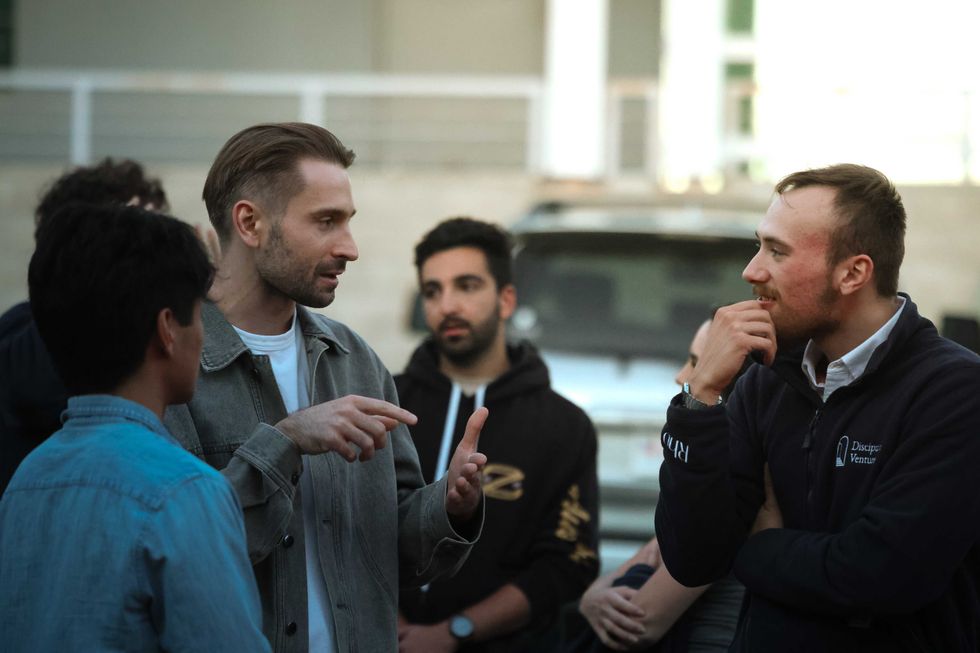 Transcend Mechanics’ Alex McLeod (right) considers the shape of things to come.Xan Doane
Growing up in Quebec, mining founder Elliott Poirier-Forcier believed two things about religion: you can be good without God, and religion is too dangerous to let it matter. Meeting Christians revealed that both guardrails rested on a caricature. “This argument is falling apart in real time,” he comments; being good "without" God is an illusion. Society can function if a core of people maintain the culture and some individuals dissent from it, but as cultural Christianity has waned, we have spun out of control. His thinking about sexual restraint illustrates his reconsideration of the dangers of religion. He was warned to expect repression and control, but he found love instead.
How should we understand this contrast? The freedom promised by the modern world, Elliott says, follows the way of death, while the freedom of Christ follows the way of life. This generation has more distractions than any before it, many tailored to the individual, many creating the illusion that one can indulge in them all the time, everywhere. Yet that freedom is a mirage: "Let's say you are free to do heroin—but is that really freedom? Because after you do heroin, you're not free from heroin." Christ therefore frees us not just by removing evil but by bringing us to good; indeed, by placing demands on us that give us guidance, community, and responsibility, Christ leads us to the greatest good. Elliott and his co-founder were baptized this Easter.
Isaiah looks further back, seeing the spirit of an early enemy of the Christian church in our midst: "We're throwing off gnosticism. Software land is gnosticism. Finance land is gnosticism." Gnosticism seeks the escape of the spirit from the world of the body. The Gundo instinct is not escape but inheritance: receive what has been handed down, then restore and tend it. Anything can find a second chance at life in El Segundo: the graphite-based nuclear reactor design followed by your great-grandfather; a strip of concrete pads laid down to manufacture WWII warplanes; or Nana’s Bible.
These young Christians are part of a turning tide, not only in the wider culture but also within the Church. At a large group happy hour, a debate broke out about the physical presence of Christ in the Lord’s Supper. Such a point of focus might be rare enough in a typical American church, but the range of views around the table was even more unusual.
Two Catholics argued that we know how Christ is present in the host. The Orthodox participant said we shouldn't presume to know the mechanism. The four Protestants agreed we do know but insisted on a different explanation. Symbolic memorialism, common in much of revivalist and dispensational Protestantism, had no seat at the table. It cannot be a mere coincidence that these people, so devoted to working with their hands, also stressed that the foundational ritual in the life of God's Church is physical communion with the Lord Jesus Christ Himself.
Perhaps we have breathed gnostic cultural air for so long that it is difficult to see the coherence of a union between the physical and the divine, but this is the core Christian truth of the Incarnation of Christ. To this end, Wendell Berry, an American writer and poet, notes that the Bible "is not a book about heaven . . . It is a book about the earth."
Silicon Valley’s software kings have built virtual worlds. El Segundo’s hard-tech leaders are more concerned with actual—embodied—human life. Augustus asks, “What is futuristic and what is eternal? Part of what that means is innovative art, innovative things, innovative cultural institutions.” Working with your hands, building for the whole society and not just the individual, crafting beautiful things all build on each other.
"It's all about what your end is. And the end here, for all of us, is heaven," Charlotte explains. Once, after Isaiah said, "We have to get back on track," I had to ask, "Who is ‘we’?" He is a patriot with a giant American flag draped on his wall, but this was not electioneering. "'We' as in Christendom," he replied, almost quizzically, as if it would be unthinkable for a social or political narrative to come before the kingdom of God.
In a world where God and humanity are united in the person of Jesus Christ, the foundational note of Christian life is His promise that we will "eat and drink at My table in My kingdom." The consummation of God's love is life made new. The eternal future of molecules and men is communion with the Father, the Son, and the Holy Spirit.
Change is on the horizon. The Gundo’s startups caught a glimpse of their possible futures in SpaceX’s recent $1.75 trillion IPO. SpaceX began in El Segundo in 2002 and now employs thousands at its corporate headquarters three miles east. Months later, Valar Atomics announced a fundraising round exceeding $1 billion, and Rainmaker announced a $100 million round. As these businesses grow, what will come of today’s bright-eyed 20-year-olds?
They are already starting families. Jakob and Augustus both recently got engaged. Isaiah welcomed his fourth child at age 26, and Durin's head of talent, Michael Mathews, has five children. So many Rainmaker employees are expecting kids that Augustus is cooking up plans for an in-house childcare co-op.
I sat down with one of those expectant fathers, 26-year-old Darrion Vinson, in the City Hall courtyard. The setting offered a glimpse of the culture they hope to build. He had walked five minutes from work to the sound of children playing while their mothers shopped at the Thursday afternoon farmers market. He grew up near Washington, D.C., with wonderful parents and had long cherished the idea of fatherhood. His wife's family showed him the value of having children young.
Vinson dreams of a future where Gundo’s innovative industrial institutions will be matched by equally strong family and community institutions. His excitement was infectious as he bragged about his wife’s determination and brilliance. Hours later, she went into labor. He asked me to pass along a sales pitch to other mothers who might build a family culture alongside her: “[come if] you want manly men who love you, in a walkable community with children everywhere.”
The Gundo is beginning to export its culture. Because these companies make physical things, they need facilities where their customers are, so secondary locations are sprouting up from Utah and Oregon to Chile and South Africa. Many of the latest Discipulus cohort's businesses have roots and even factories in Texas. Their hope is to serve places far beyond LA’s South Bay.
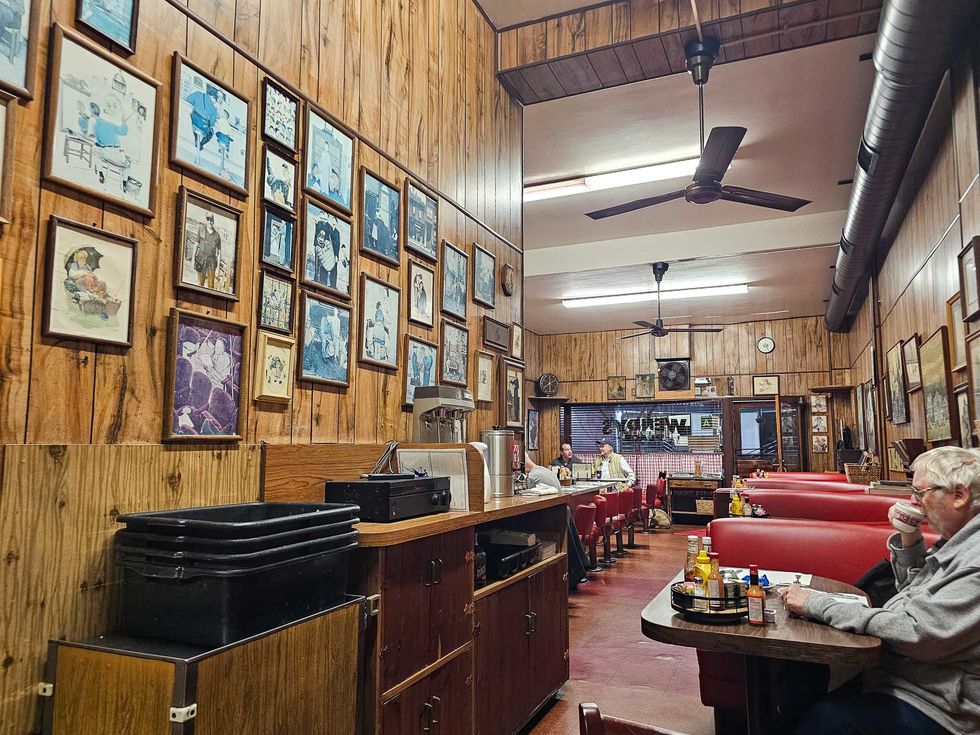 Authentic Norman Rockwell works cover the walls of Wendy’s Place, a favorite Gundo hangout.Xan Doane
But growth brings danger, too. Business leaders face the temptations of success, but as Augustus notes, the "raw power" of extraordinary, real-world technology carries a particular temptation toward pride. He characteristically prefaces bold statements with reminders like, "I am a very faulty sinner." This is a crucial discipline.
As a mission-driven culture grows, it also draws people attracted by its popularity and success rather than by its convictions. Isaiah paraphrases a warning from Puritan minister Cotton Mather that describes both the predicament the Gundo arose to answer and the danger its own success may bring: “Religion begat prosperity, and the daughter devoured the mother.”
As we circled the bonfire, it seemed at times a funeral pyre for the way of death and at others a hearth for the way of life. Josh Steinman spoke of Prussian military philosophy: “This is a Schwerpunkt. It means a decisive moment, that one moment you hold the position that everything turns on. You can change the world with 200 like-minded people. Really, it starts with five or 10."
The next morning, I came to wonder if he wasn't right.
Before my flight home, I spent a few hours gathering my notes and enjoying a local favorite, Espresso Dul’Sal, at a cafe in the heart of town. The young woman who took my order was covered in tattoos, had several piercings, and had neon-colored hair. On someone else, the look might have spoken first. With her, though, it was her spirit that did all the talking.
When business slowed, she began to improvise little songs, and after my other experiences in El Segundo, I shouldn’t have been surprised by the words. But I found my heart strangely warmed by them. “Thank you, Jesus,” she sang. “I’m forgiven, I’m free. Love has come to us again. Thank you, Jesus Christ, the King.” And then she talked with her coworker about how much she looked forward to the Sacrament at church that weekend.
A stirring of new life, not just in the homeless addict-turned-rainmaker or the henchman of the guy splitting atoms and meeting the president, but also in the young barista behind the counter.
“We are in the business of hard things," Isaiah tells his employees. Hard work, hard choices, and hard friends now for a better life. Hard tech startups that touch the world. For a generation fallen on hard times, the prospect of financial and cultural strength, of something that you love more than you love yourself, of families. They’re raising millions and billions, and retreading the science fiction parts of the tech tree we forgot generations ago. As they invite you to join the mission, they’ll make sure you know: “We are going to win.”
Second city, second chance. A reconquest of the soul from darkness. Thank you, Jesus Christ, the King.