Andrew Giangola
“Everything great is on the other side of fear.”
In a narrow locker room, a few rickety steps from the dirt floor in the birthplace of indoor rodeo, professional bull rider Chase Outlaw gives that advice to his son, Hayes.
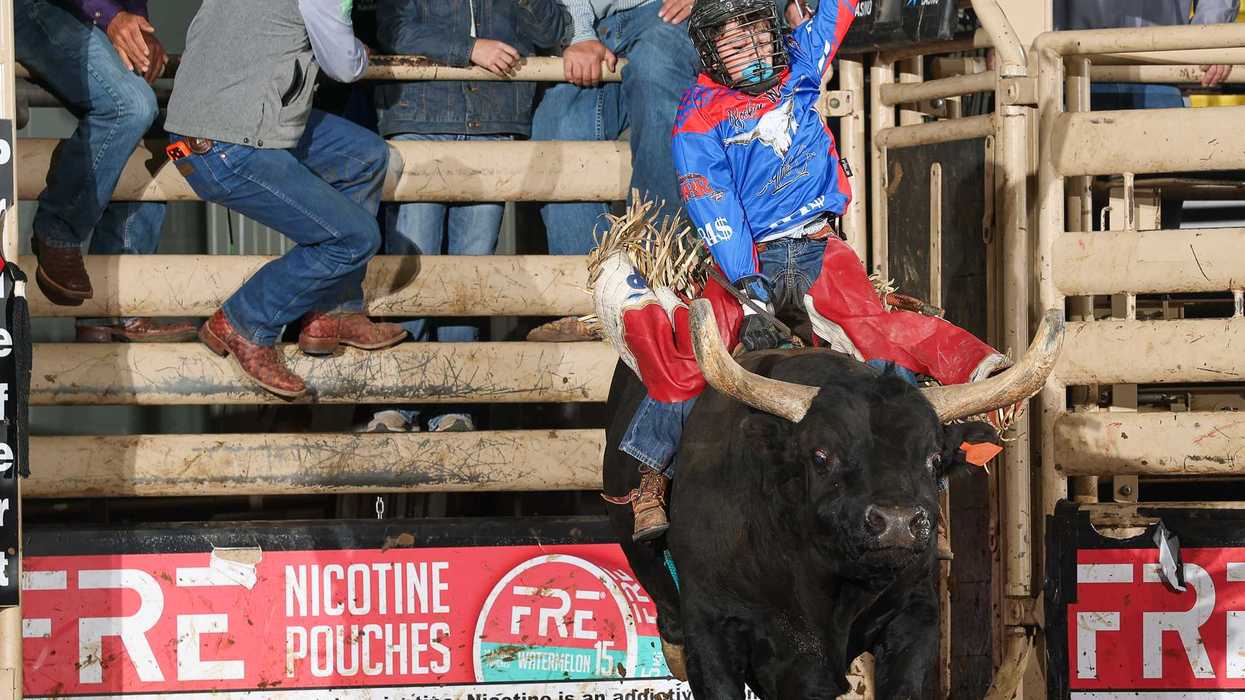
The freckle-faced eight-year-old, competing in Miniature Bull Riders (MBR) at Cowtown Coliseum in Fort Worth, would soon mount a “mini bull,” nod his head just like Dad, and blast from the chutes atop an animal weighing more than 500 pounds.
Hayes sees himself at the beginning of a career that will make him into one of the best—just like his dad, a nine-time World Finals qualifier who finished third in the world in 2019.
More than his seven wins and nine World Finals appearances, Chase Outlaw’s scene-stealing, Tasmanian-Devil-meets-Yosemite-Sam persona made him a fan favorite.
At 5 feet 6 inches, Chase was usually the smallest guy competing in the Big Show. He counterbalanced his diminutive stature with extraordinary effort. Obsessed with conquering bulls 10 times his size, he poured his guts into every out.
Hanging on to the rope when things go bad can pull a rider under the bull—not where any human wants to be. In Chase’s case, a jerk-down onto a bull’s head caused one of the most gruesome injuries in PBR history and put him in a helmet for the remainder of his career.
In July 2018 in Cheyenne, Wyoming, a bull named War Cloud yanked him down, shattering Chase’s face in 30 places. Surgeons rebuilt it during operations that lasted more than 20 hours. Outlaw has about as many plates in his face as your grandma keeps in her cupboard. He rode again a few months later. Nothing changed except the loss of his cowboy hat. He still wouldn’t let go until his rebuilt face hit the ground.
That Chase Outlaw—his birth name—didn’t find a new career after the accident, and is now coaching his son to ride bulls, says a lot about him and even more about his protégé—a gritty, free-spirited kid who could have stepped out of a school production of Huckleberry Finn.
Hayes’s ride lasted about three seconds. Chase gets it. It’s dangerous out there, regardless of your age or the size of the animal.
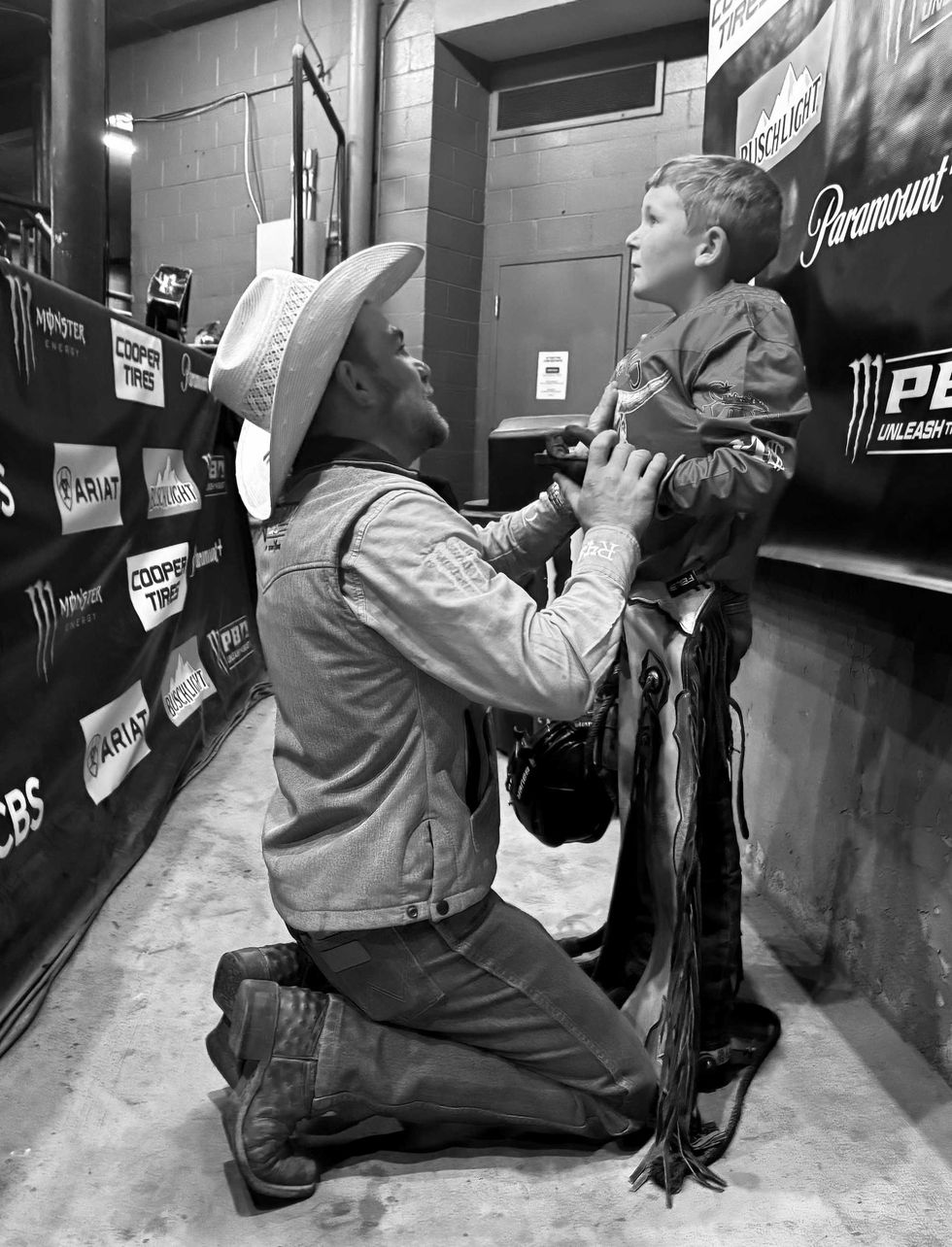 Chase Outlaw giving Hayes a pep talk.Andrew Giangola
Afterward, he told the boy: “Heck, everyone gets scared, even me. You face that fear and push past it.”
Little kids bouncing around the arena on miniature bucking bulls is no carnival sideshow.
This program has become a fertile pipeline for Professional Bull Riders (PBR) stars, including three Rookie of the Year winners (Keyshawn Whitehorse in 2018, Hudson Bolton in 2025, and Marco Rizzo in 2026). Other MBR graduates who learned about real competition in sold-out arenas include PBR World Finals qualifiers Andrew “Primo” Alvidrez, Austin “Lil A” Richardson, Daniel Keeping, and Ethan “Baby Gorilla” Winckler.
“Heck, everyone gets scared, even me. You face that fear and push past it.”
MBR was founded more than 15 years ago by Cirildo and Lillie Leal, a gentle couple who have been married for 51 years. The Leals run a cattle feed business in Texas, feeding 2,000 head a year.
In 2010, while getting her hair done in town, Lillie read an article in a women’s country magazine about folks raising miniature bucking bulls. The Leals bought a few and have since built a herd of more than 300 head. Their daughter, Alysa, now manages the day-to-day operations of competitions held nationwide in three divisions: Pee Wee, Junior, and Senior.
They held their first event in Amarillo, Texas. In Ogden, Utah, they met one of the all-time greats, Chris Shivers, who changed the trajectory of the small outfit. The two-time PBR World Champion came aboard in 2011, eager to guide the next generation of riders along a safer, more gradual path into a sport whose dangers will never be eliminated. His son, Brand, would compete in MBR events.
With Shivers as a partner and part owner—and with PBR bringing the kids’ events to marquee events like the World Finals while carrying the competition on the RidePass digital network—MBR has grown into a national circuit.
“We never had trouble getting kids; they’d just keep coming all the time,” Cirildo Leal said.
YETI, Montana Silversmiths, and American Hat Company are sponsors. The program has evolved to include teams. Chase Outlaw’s team is supported by Rockin W Cattle, while Gage Gay, who competed alongside Outlaw in PBR, has a team sponsored by MX Bull Ropes.
At the Finals in Fort Worth, Hayes Outlaw was among a dozen young riders competing on a Friday morning before a sparse crowd of friends, family, and a handful of die-hard Western sports fans. They gathered inside the hulking, stone-and-stucco rodeo cathedral—part fortress, part barn—where the pungent dirt still bears traces of blood, sweat, and snot, along with the shattered dreams and sweet celebrations of generations of riders stretching back more than 115 years.
The first indoor rodeo was held at Cowtown Coliseum in 1909. Out front on Exchange Avenue, where a daily Longhorn cattle drive entertains the tourists who make this one of the fastest-growing travel destinations in America, stands a life-size bronze sculpture of Bill Pickett, the first black rodeo cowboy rock star, performing his signature style of “bulldogging.” Nearly 90 years after Pickett pioneered the rodeo discipline, now known as steer wrestling, PBR held its first event here in 1993.
Since then, PBR has grown to a four-country operation with more than 200 events each year. In the U.S., the sport is nationally televised on CBS/Paramount+ and the CW Network. Some events stream on FOX Nation.
Although PBR sells out cavernous hockey arenas in New York, Boston, Chicago, Nashville, Las Vegas, and Los Angeles, in Fort Worth, the four opening rounds of the championship were staged in the smallest, most intimate down-home venue on the tour. It’s like being a Rolling Stones fan and seeing the band in a musty dive bar. For bull riding fans, it doesn’t get any better.
The previous night on this hallowed ground, the world’s top riders had competed in the opening round of the PBR World Finals—45 riders risking life and limb on the most powerful and athletic bulls for a million dollars and a gold buckle. (If they were forced to choose between the money and the buckle, most riders would likely take the buckle. Money gets squandered; the buckle is forever.) World No. 1 John Crimber, 20, won the MBR championship when he was 13.
In Round 1 of the most grueling championship in sports, Crimber’s night was wrecked by a bull aptly named Wreck It Ralph. Seven more days remained for him to stay on, put up points, keep his lead in the standings, and become the first MBR rider to win PBR’s gold buckle.
Tennesseans Kathey and Paul Porter, who were in the stands to see the opening round of the World Finals, returned in the morning to get an early look at the sport’s next generation. They traveled to 22 events last year and never missed the mini bull riders when they were at PBR.
“We just love watching the little kids ride, and we continue to follow them into their career at the top, just like John Crimber,” Kathey Porter said. “We began following him when he was 10. It’s fun to watch the kids imitate the professional riders with their celebration and helmet throwing after a ride.”
The kids are celebrating in part because they just won money doing something they love. Daniel Keeping, who started in MBR when he was 13, said he could make anywhere from $1,200 to $3,500 on a very good weekend.
“You feel like you’re doing the big stuff and making the big scores like the big guys,” Keeping said. “You get your own locker rooms, your own draw. The Leals make it professional; it helps you understand what you want to do, and you can see life on the road. Fans kept up with it. You get some recognition. You feel like you’re something.”
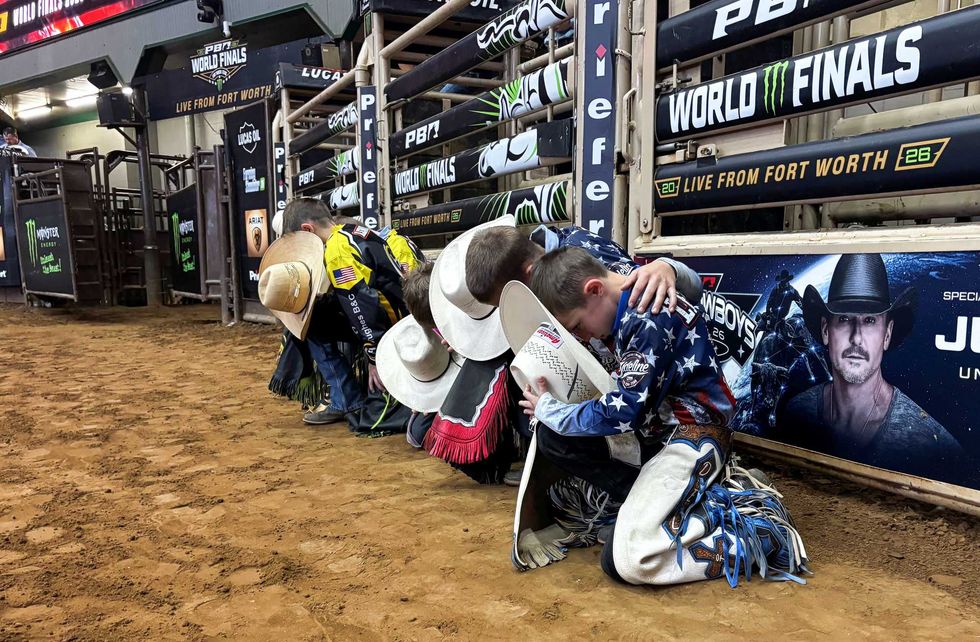 The boys kneel in prayer before taking on the bucking bulls.Andrew Giangola
Another benefit is that, unlike steers, the mini bulls are built a lot like regulation bucking bulls, making them the most logical animals on which young riders can develop.
“A steer’s body size isn’t as big as the mini bulls—which are a miniature version of a big bull,” said four-time PBR World Finals Qualifier Austin Richardson, who competed in MBR when he was 14. “To be able to get on bulls that size when you’re younger helped me out a lot.”
The Porters smiled at the kids dreaming of being just like Crimber, Keeping, and Richardson, who often struggled to remain centered atop the deceptively fast and cunning little bulls.
One of the kids, Bently Gay, the 12-year-old son of five-time PBR World Finals qualifier Gage Gay, supposedly begged his dad to ride when he was barely three years old.
Gage’s first reaction was to say with a laugh, “Pick up a golf club or baseball bat, please.”
That wouldn’t do. Bently began in MBR at the entry age of eight. He now rides nearly every weekend and is competing in the North Dakota junior high school rodeo state finals in late May.
Like Bently, Hayes Outlaw considers his dad to be Superman.
Chase’s biggest muscle is his heart, and that explains how his eight-year-old son can already seem like a veteran in the locker room with the other kids at the MBR Finals. Hayes crawled on top of his first four-legged beast when he was four.
“They didn’t have anything like MBR when I was around,” Chase said. “There was no such thing as mini bulls when I was these boys’ age. It was straight from calves to steers to bulls.”
According to sports science research, some bull riding wrecks generate impacts comparable to being thrown from a third-story window. At 33, Chase Outlaw has had more such impacts than he cares to count. Now, as his career winds down, Chase was asked whether this new generation of riders represents the future of professional bull riding.
“Shoot, I hope so,” he said. “If these kids ain’t the future, I don’t know who it would be.”