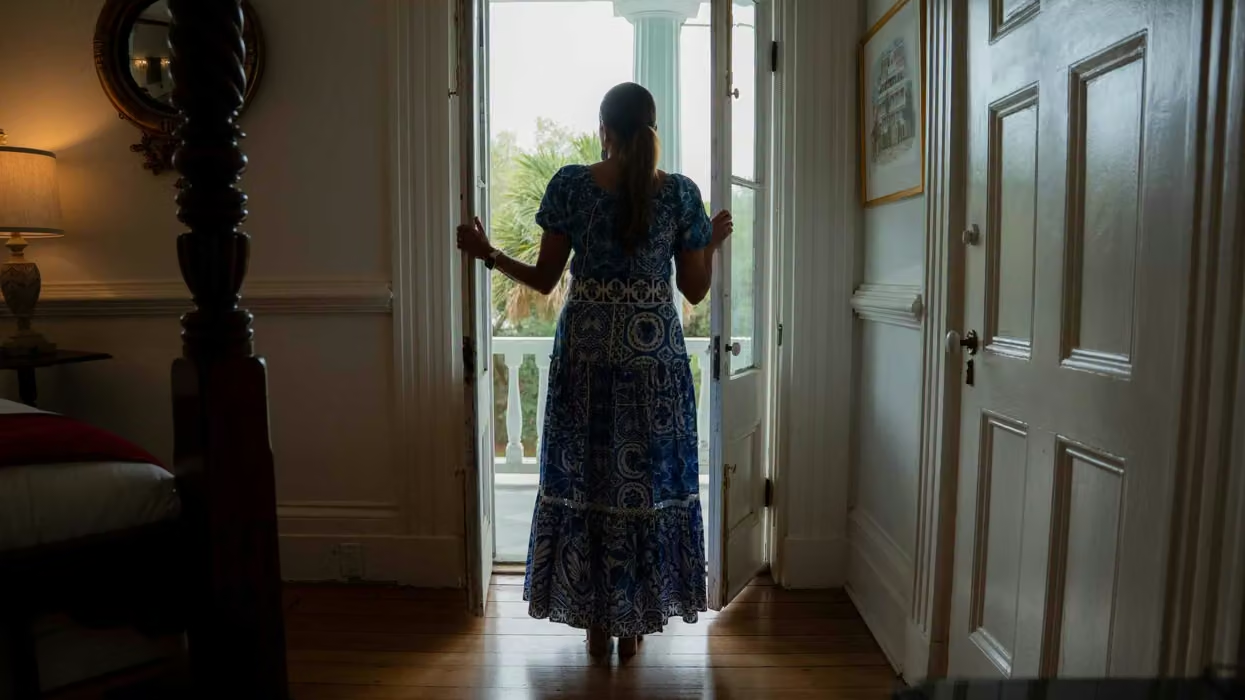
The folklore-laden South dutifully bears its history—spirits and all. | Photo courtesy of 20 South Battery
“They called me a historian only because all the other people who know these stories are dead,” a kind, lifelong South Carolinian woman told me as I set out to find the truth about some of the Palmetto State’s most famous ghost stories.
Her words stuck with me as I continued my search for the heart of South Carolina’s folklore, not least because I slowly realized that South Carolina is old—really old—yet refuses to die.
Behind each of the state’s ghost stories lies a clue to what makes South Carolina unique. For all the dead buried in the state over the last four centuries, there is a living advocate dedicated to telling their story, keeping the past walking among us.
Alice Flagg’s tragic love story is the foundation of one of South Carolina’s best known ghost stories.
Born into South Carolina’s plantation aristocracy in the first half of the 19th century, Alice Flagg was raised by her mother and her older brother, Dr. Allard Belin Flagg, who became head of the household at Murrells Inlet after their father, Ebenezer, died in 1838.
Alice was raised with the expectation that she would marry a Southern gentleman, a distinguished member of South Carolina’s gentry.
As fate would have it, though, her youthful heart found a different, apparently forbidden, first love.
As legend has it, Alice, who was 15 or 16 at the time, fell in love with a man well below her station, commonly said to have been a lumberman.
Dr. Allard Flagg, upon learning about Alice and the lumberman, sent his sister to Charleston shortly thereafter. While some versions of the story attribute this decision to her brother’s disapproval of their courtship, young women of her class were often sent away from home to receive their education.
But Dr. Allard Flagg certainly disapproved of the love between Alice and the lumberman, as became clear shortly after Alice left home.
While at boarding school in Charleston, Alice began to show symptoms of what was known as “country fever” (likely malaria by most accounts). Alice returned to Murrells Inlet for treatment at the capable hands of her brother.
While treating her in a comatose state at what would in time be the Hermitage, her brother discovered a ring around her neck, which she wore there instead of on her finger in order to avoid unwanted attention.
Connecting the dots, and coming to the conclusion that this ring was given to her by the lumberman, Dr. Allard Flagg took the ring and cast it into the wilderness.
Alice awoke after the ring had been taken from her, noticed it was gone, and succumbed to her grave illness shortly afterward.
Legend has it that Alice Flagg haunts both the Hermitage at Murrell’s Inlet, where she is sometimes called “The Lady in White,” and All Saint’s Episcopal Church, where she is in all likelihood buried in an unmarked grave near other members of her family.
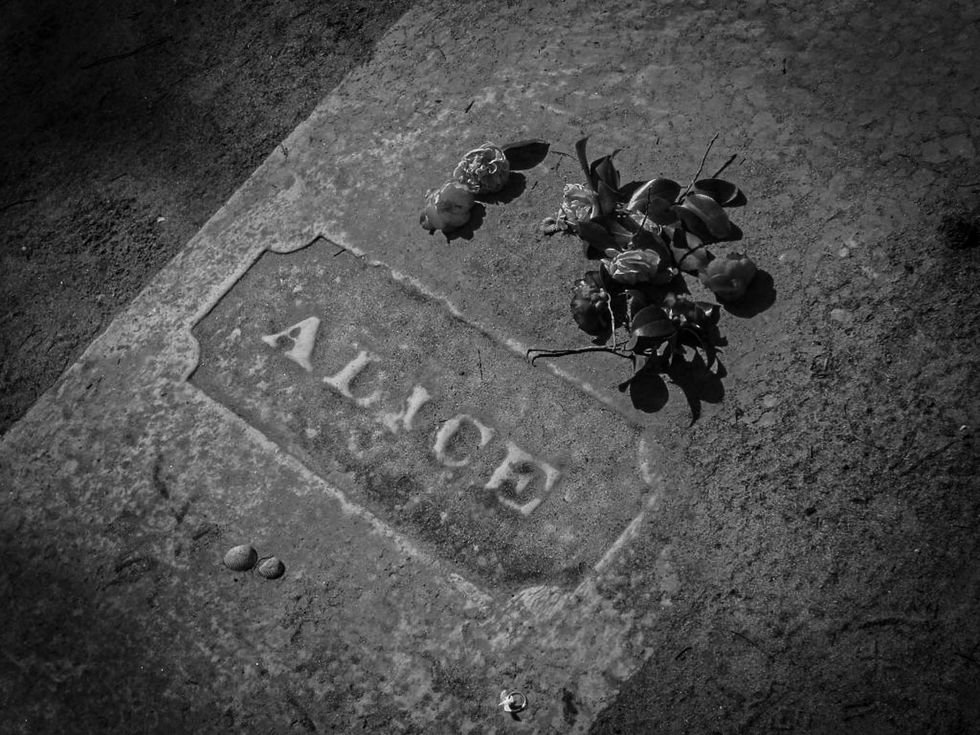 A grave marker becomes a place of ritual.
She is said to be searching for the ring her lover gave her to this day.
Visitors to the church cemetery occasionally attempt to communicate with Alice’s spirit at a simple grave marker bearing only the name, “Alice.” While this is likely not where she is buried, those searching for her ghost will leave small coins or trinkets on or around the commemorative burial site, walk backward around it anywhere between three and 13 times, and sometimes lie down on top of the site in an attempt to summon the ghost.
Some people who wear rings report feeling a slight tug on their hands and fingers when they visit Alice Flagg’s favorite haunts, where she continues her search, all these years later.
Spanning four centuries, the Circular Congregational Church’s graveyard carries with it enough folklore to single-handedly fill these pages.
With its oldest gravestone dating back to 1695, visitors can feel the weight of history all around them—and some report sights and feelings they can’t quite explain.
A tour guide of the cemetery told me that some people have caught glimpses of shadows, the sound of children laughing, unexplained footsteps, whistling, and whispers among the gravestones, all things that reinforce its reputation as one of the most haunted cemeteries in the state.
While many people hesitate to guess who the spirits may be, a tour guide I spoke with explained that supposed ghosts are often associated with tragedies or untimely ends.
Not missing a beat, Smokey told him he had made his peace with God and was ready to fly.
And this cemetery is the burial ground for many people who match that description.
Andrew Kuhn of Bulldog Tours told me that the graveyard is the resting place of three young brothers named Savage, ages three, five, and seven, who tragically died of yellow fever within 10 days of one another.
To add to the tragic irony, their father was a physician who treated yellow fever—but doctors had not yet discovered that yellow fever is transmitted by mosquitoes rather than through human-to-human contact. As a result, their father was likely haunted
by the mistaken belief that he had infected his three sons, who had been snatched away all too soon.
When graves in the state’s cemeteries date back to the 17th century, it stands to reason that where you find the oldest things, you may also find some firsts hiding not too far away.
One such first belongs to the man believed to have been the first person to be cremated in the United States. The story behind his decision to be cremated, which involved his newborn daughter Martha, will send shivers down your spine.
Before medical technology was able to guarantee that someone was “irrevocably dead,” the fear of being buried alive was not simply irrational; indeed, it existed for good reason, as the case of Martha Laurens clearly shows.
Martha Laurens contracted smallpox, which had been brought to South Carolina by British soldiers, during her first few months of life and, according to her doctors, died of the disease. Funeral preparations were made, and mourners soon gathered to pay their respects to the child they believed had been lost to the ravages of this disease.
Martha’s body was laid out beneath an open window in preparation for the burial, contrary to the “absurd mode of treating the smallpox in 1760,” according to which she was confined in a closed room during her illness.
Then the unthinkable happened.
As one of the last mourners, Dr. Moultrie—the physician who had confirmed her death—approached the coffin, he received the shock of a lifetime.
Martha woke up.
As one account later surmised, she was “probably recalled to life by the fresh air of the open window.”
Martha ended up narrowly escaping one of the most horrifying ways to die. She went on to marry and live a relatively long life. She died on June 10, 1811, more than 50 years after her nearly fatal burial.
“A valuable life,” her husband, Dr. David Ramsay, wrote in his memoir, ”was thus providentially saved for future usefulness.”
This incident, however, left a lasting impression on her father, Henry Laurens (1724–92). Laurens was among the American Founding Fathers. He signed the Articles of Confederation, succeeded John Hancock as president of the Second Continental Congress, and later served as a minister to the Dutch Republic.
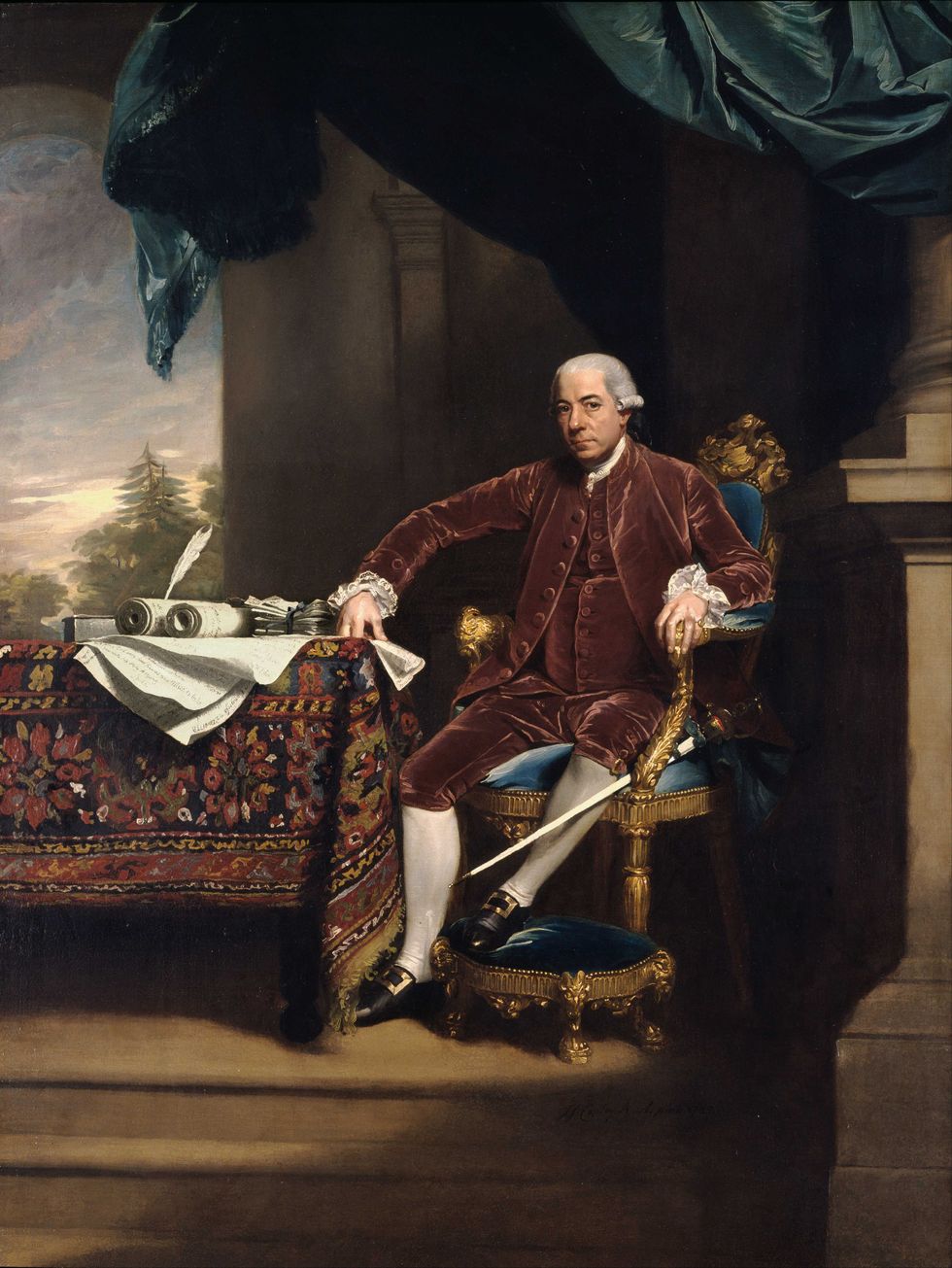 Founding Father Henry Laurens could never forget what almost happened to his daughter.
While on business en route to the Hague, he was captured by the British “on suspicion of high treason,” after which he became the only American to have been imprisoned in the Tower of London. He was held there from October 6, 1780, until December 31, 1781, while figures like Benjamin Franklin and Edmund Burke pressured the Brits to release him.
The British government supposedly used the documents Laurens carried with him on the day of his capture as a pretext for declaring war on Holland. Laurens was eventually released in exchange for Lord Charles Cornwallis, who had been captured after the Siege of Yorktown.
Laurens, despite his fascinating and busy life, never could shake his awful case of taphophobia.
Dr. David Ramsay wrote that Henry Laurens “dreaded, as infinitely worse than certain death, the possibility of life returning to him when shut up in a box in the cold ground, so far below the surface as to be out of the reach of human help.”
In his will, he gave his son, Henry Laurens Jr., an imperative upon his passing, which at that time was an exceedingly unusual request: “I solemnly enjoin it to my son as an indispensable duty, that . . . he cause my Body to be wrapped in twelve yards of tow cloth, and burnt until it be entirely and totally consumed.”
His son constructed a funeral pyre on their plantation, Mepkin, along the Cooper River outside Charleston. According to legend, as the flames consumed Laurens’s body on December 11, 1792, three days after his death, his head rolled down the pyre and settled at the feet of one of his slaves, who retrieved the mysteriously detached head and replaced it on the burning funeral pyre.
Henry Laurens’s cremation remained a highly unusual practice in America for almost exactly 84 more years, when Dr. Francis Julius LeMoyne facilitated the cremation of Baron dePalm in December 1876.
20 South Battery, a truly magnificent 16,000-square-foot historic mansion in Charleston, South Carolina, has its fair share of hauntings. The house remains a center of charity and preservation efforts and was the birthplace of what is now the Preservation Society of Charleston.
One of the mansion’s caretakers spoke to me over the phone and told me that, in addition to the two ghosts said to regularly appear in Rooms 8 and 10, both of whom deserve to have their stories told, many people have reported strange happenings elsewhere on the property as well.
Stories of unexplained sights and sounds deep in the garden at night abound, where, prior to the Civil War, roughly 10 slaves valued at $400 apiece lived in the quarters there.
The quarters have also been the source of some creepy stories, including reports of loud, unexplained sounds coming from the building’s empty upper level.
But for all the evidence of haunting on the grounds and around the property, two stories stand out at the house across the street from where, it is claimed, both the Revolutionary and the Civil Wars began.
 Courtesy of 20 South Battery
The first ghost, who is said to inhabit Room 8, is commonly referred to as The Soldier. His identity remains a point of controversy, as the historical record apparently contradicts some of the best guesses about who he was.
Nevertheless, the ghost of Room 8 is consistently described as a Confederate soldier in uniform. However, those who claim to have seen him say his head is either missing or otherwise impossible to see.
As one of the stories goes, a soldier in Charleston was struck in an ammunition explosion at a depot near the estate. He was brought to the slave quarters on the property, which doubled as a makeshift hospital for the war’s wounded. Some people say he was decapitated; others claim his head was severely damaged in the explosion, which may explain the unusual appearance of the ghost of Room 8.
The second ghost, who is said to reside in Room 10, is widely believed to be Colonel Richard Lathers, an aristocratic New Yorker who had a lifelong love for South Carolina and desperately wanted to be a Charlestonian.
Richard Lathers toured the South in an effort to stop the Confederates from launching the Civil War, even personally addressing Jefferson Davis mere days before the first shots were fired at Fort Sumter.
Although Lathers did not die in Charleston, his ghost is said to haunt room 10 simply because he loved the city and the house he owned for roughly five years.
Today, visitors to 20 South Battery’s Room 10 say they see a man dressed in a tuxedo. Others say they sense a presence or even feel a light pull on their hair—though he only appears to women.
Charleston’s Old City Jail, owing to its long operational history and the sheer number of detainees who have spent time in its cells, is widely considered one of the most haunted places in the state.
Completed in 1801 as the district, county, and city jail, the building held more than 10,000 prisoners over the years, running continuously until 1939.It is anyone’s guess as to how many people died in the jail, but we do know that many met their end there.
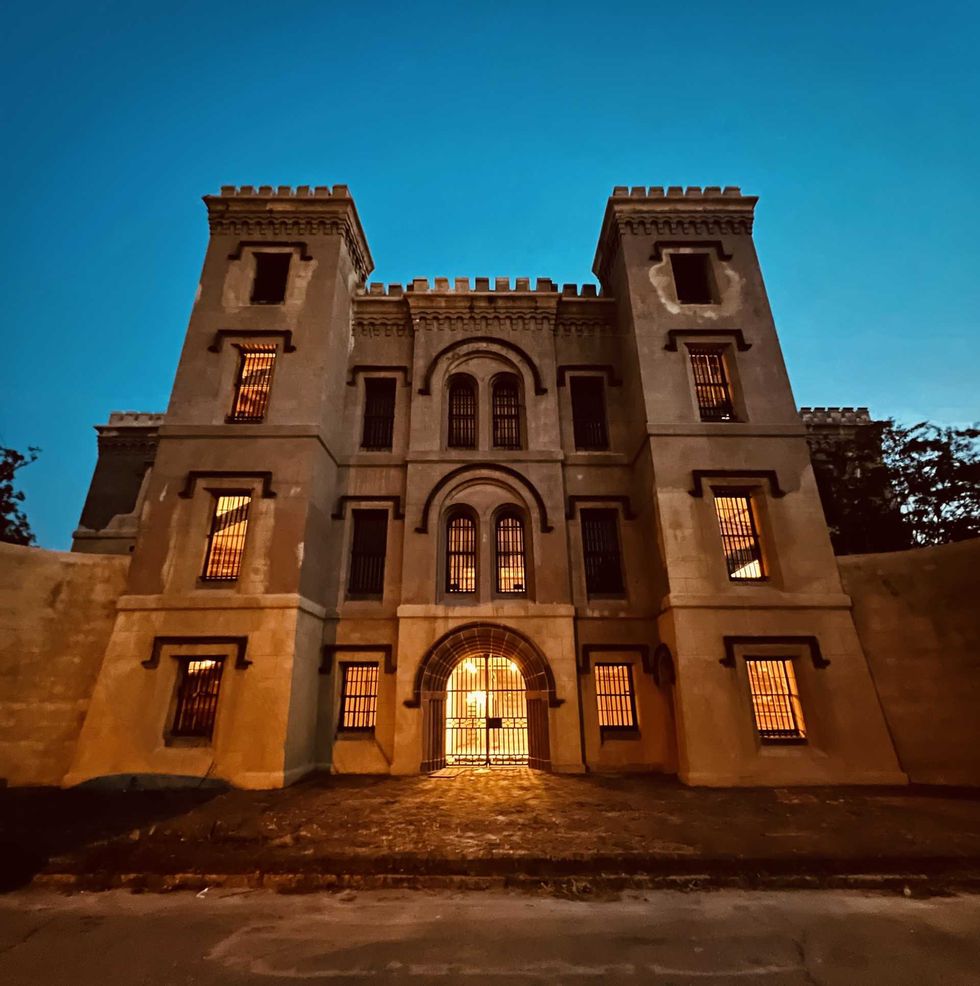 More than 10,000 souls have passed through Old City Jail.
“There were executions,” a tour guide tells me over the phone. “They did have a gallows out behind the building.”
Even before the jail was gutted after it was shut down, it had no running water or electricity—not a pleasant place to spend your final days, or, for that matter, any length of time whatsoever.
Guides on the ghost tour, who count themselves among the skeptics, have reported strange occurrences while showing the jail to visitors.
Most visitors who report something unusual tend to describe seeing only unexplained shadows or hearing footsteps without a clear source. But the jail is also known for more frightening incidents on tour.
Women, for example, sometimes report feeling their hair gently pulled behind their ears, or even sometimes pulled more aggressively as they make their way through the dark passages.
Perhaps even more “ominously,” some visitors emerge from the jail with unexplained scratches, always, apparently, in groups of three.
While skepticism may prevail in many of these anecdotes, others beg for a real explanation.
On a very cold winter night, a teenage boy said his back was burning, despite his four heavy layers.
When they exited the jail, they inspected the boy’s back. It was apparently covered in scratches—again, in groups of three.
Most people associated with these sites hesitate to venture opinions about the identities of these shadows and whispers, but others are willing to make educated guesses based on the deep history and lore of these ancient places.
In that spirit, some reckon that the Old City Jail could be host to the spirit of Lavinia Fisher, widely considered to be America’s first female serial killer.
Lavinia and her husband ran an inn for some time outside the city. When times got tough, though, they concocted a scheme to rob the guests at their inn.
At the time, highway robbery was a capital offense. After they were caught, the Fishers were held at the Old City Jail for a year before being publicly executed at the gallows.
As fate would have it, Lavinia Fisher’s reputation gained a more lascivious nature; lurid tales of her luring men into the inn and poisoning them were piled on. In reality, though, her only crime was robbery.
Those familiar with her story speculate that Lavinia Fisher may haunt the jail to this day—not because of any injustice surrounding her death, but because of the reputation she acquired afterward as something more than a highway robber.
A vessel that has seen three different wars, like the USS Yorktown, a World War II-era aircraft carrier that later served in Korea and Vietnam, is bound to have a few stories.
And the stories get all the more eerie for the superstitious among us.
Many people who have visited, toured, or worked on the ship have repeatedly reported seeing shadowy figures, especially on the hangar deck.
One day, a woman was on the flight deck with a couple of other people nearby. Strangely, however, she saw a figure walking on the island farther down the ship. When she asked a representative who else was on the deck with them, he told her that nobody else was outside besides their small group.
They rushed down to where they all saw the figure, but by then, it had seemingly vanished.
Others have reported feeling a presence below deck as well.
In the hallways, some have said they’ve felt somebody gently brush past them, as though a crewman were still making his way through the ship and carrying out his duties all these years later.
Not all ships are haunted, of course.
But the USS Yorktown’s history contains a major red flag, as it were, for anyone familiar with Navy superstition.
Sailors say that renaming a ship, especially before her maiden voyage, spells bad luck for the vessel. Yet that is exactly what happened to the USS Yorktown, which was initially intended to be named the USS Bon Homme Richard.
They changed the name in honor of the first Yorktown, which had been sunk at the Battle of Midway—an unusual practice in its own right, perhaps adding to the mystique surrounding the ship.
While some of the previous stories focus more on ghosts and paranormal spirits, the USS Yorktown carries with it the heroic spirit of one of its finest crewmembers, Elijah “Smokey” Stover.
Smokey Stover was an accomplished fighter pilot in World War II who, at 24, was among the oldest crew members on the ship during his service in the Pacific Theater starting in 1943.The fighter pilots were preparing for a major mission, Operation Hailstone, against the Japanese naval base at Truk, now known as Chuuk Lagoon.
Before the fateful mission, however, the other members of the crew couldn’t find Smokey at breakfast. They found him alone in his room polishing his shoes, lost in thought.
Shortly afterward, Smokey sought out the ship’s chaplain and told him about a dream he had had the night before.
In that dream, a USS Yorktown tour guide told me, Smokey described flying a mission, during which he was shot down by the enemy. He was then taken to an island, marched around, interrogated, and, finally, executed.
The chaplain told Smokey that it was just a dream, not a premonition. Not missing a beat, Smokey told him he had made his peace with God and was ready to fly.
Smokey Stover was shot down near Truk during the mission. He was able to deploy his life raft and land safely in the water, but that was the last anyone saw of Smokey during the battle.
No one knows for certain what happened to Smokey Stover. After the war, however, the Japanese confirmed that seven American soldiers from that battle had been captured, marched around, interrogated, and, finally, executed.
After the mission, they found the missing man’s journal. In it, he had reportedly written, in 1944, that he hoped to see “Luna” (the moon) up close as a member of one of the first space crews.
They thought he was crazy.
Yet, when the Apollo 8 crew splashed down in the Pacific Ocean a mere 24 years later, they needed a ride.
And the USS Yorktown was there to bring them to shore.