Grace and complexity move hand-in-hand. | Adobe
I walk under the stone arches of San Francisco’s War Memorial Opera House in my beat up Danners, a flannel, and my Space Force hat. The hat doubled as a contribution to the 2020 Trump campaign. I like to think I’m not the only Trump voter here, but I’m probably in a distinct minority. The magnificent entrance hall is cavernous, softly lit by what feels like some of the last lightbulbs on the West Coast that aren’t Home Depot Renovation: Harsh White LED Specials.
I’m seeing Swan Lake with my girlfriend Naomi. It’s my first time at the ballet, and my first time coming to the city for “pleasure” in years despite living right across the Bay Bridge. In fact, I sort of hate San Francisco, and have for decades. It should be the jewel of the country, and beautiful remnants of its glory still linger, but I’d cheer if archangels, old veterans of the Gomorrah campaign, smited the place. But my lady loves ballet. So here I am.
The first thing I learn about the ballet is that “special event parking” is 40 bucks. The elevator up from the parking garage smells faintly like piss. But even I’ll admit that City Hall just before twilight is breathtaking, and the city does a pretty good job maintaining a bubble a few blocks wide where you can imagine the city as a whole is this beautiful. There are only one or two bums passed out on the grass. Later, on our way out, I’ll miss a turn (pretty common when you drive a half-junker F-150 into the eldritch nightmare of SF city streets) and end up driving past a gauntlet of fentanyl zombies. Harsh white streetlights draw a line down the middle of the sidewalk. They seem to cling to the shadows, nestled up against the dirty walls of a skyscraper.
There’s an electronic boop as the gender-ambiguous greeter scans my girlfriend’s phone (this is where tickets live now), and mumbles something through zir’s N95 that sounds like “have a good evening.” There are far more N95s (and other masks) here than I’ve gotten used to seeing several years into the backwash of the “pandemic,” and their wearers never fail to strike me as birdlike and alien. However, there aren’t as many masks here as there were at the last dance performance I accompanied my lady to: a “concert” by the dance company at the small liberal arts college we went to (she graduated, I dropped out to enlist in the Marine Corps). The dancing there, which was mostly “interpretive” walking and wavering about in shapeless beige smocks, sucked. Pretty much the entire crowd was masked up, right down to a disturbingly similar spheroid gender goblin that handed me a mask at the entrance, which I promptly threw in the trash. Here in the imperial tech core, the message is getting out that masks are passé, but out in the satrapies, the provincial worthies and strivers still fall over each other to show their devotion to the superannuated state cult.
The attendees are roughly divided into three groups. There’s a “respectable” crowd that skews White, Asian, and older, drinking champagne and red wine out of plastic sippy cups that clash a little with the suits and gowns. Then there’s the Silicon Valley horde, a multiracial motley of tech dweebs (of both sexes) and their concubines (of both sexes) out on the town to get some culture—or more likely, to be seen getting some culture. Lastly, there’s a generous helping of what might be called “art queers” (if I’m being polite). While I assume there are gays aplenty in the other groups (I myself am feeling a little bit gay for coming to the ballet), this group is distinguished by its youth and its many sickly-looking women with closely shaved heads and doodle tattoos. Their sense of formal wear seems guided by the question: “What would a public school teacher talking to first graders about anal sex buy from a Goodwill?”
We pass packs of the latter two types taking selfies in front of promotional displays, potted plants, and practically anything else that could pass for an “aesthetic” Instagram backdrop. A group of Indian girls are swinging their phones around at full arm’s length, making faces as they generally impede everyone’s movement. I wonder: do they belong to the same varna as the people I saw on a recent trip to Point Reyes? While hiking from Inverness over the hills to the sea, I cut across a fire road and spotted a Tesla pulled off onto the mulch. Though there was absolutely nothing in sight but the road, the mulch, and some trees, a gaggle of Indians milled around it taking pictures.
Our seats are on one of the balcony circles. We step through the doors and, for a moment, all thoughts about the ballet’s denizens disappear. I am struck by the golden glow of the walls and the pale blue vault above a shining chandelier. While the red velvet seats lose some of their shine on closer inspection, their threadbare patches having been worn smooth and thin from overuse, the theater space feels like a lost shard of Old World glory.
Some of the Silicon Valley crowd sit behind us, arms out, phone lights flashing. An older White woman in some kind of flowing, floral-patterned shawl and big, gold hoop earrings takes her seat to my girlfriend’s right. “Are you season ticket holders?” she asks us. “Uh, no,” I answer. We don’t speak again. After Act II, she puts on a mask.
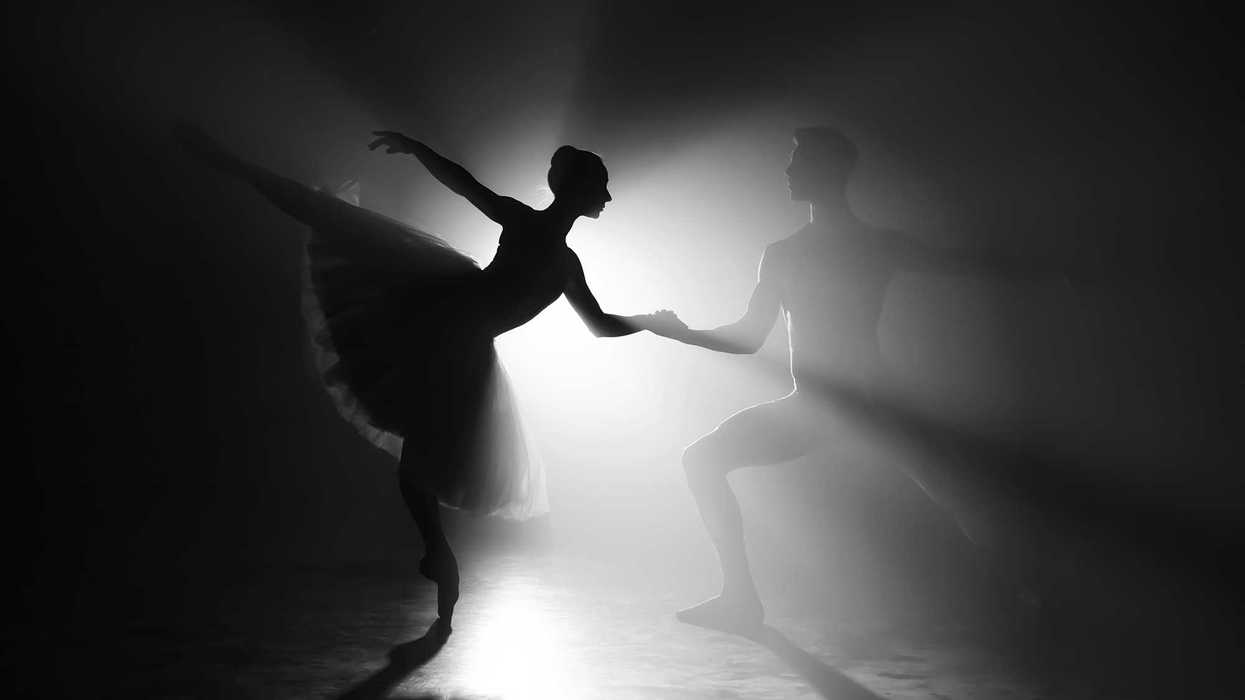
Soon enough, the lights are dimmed. I hear the first notes of the introduction fill the theater. Just as I lack an eye for ballet, I lack an ear for instrumental music. So later on, Naomi has to tell me the melancholic tones I hear right at the beginning are from the oboe, backed up by what sounds like mournful horns. The oboe sounds similar to the human voice, she explains, and when we hear it throughout the ballet, we can think of it as Odette’s voice crying out. Odette, our princess, is on stage, glittering, dreamlike, in a white tutu. The oboe is answered by a clarinet, and the dark-clad Von Rothbart, an evil sorcerer (although to me, he just kind of looks like an owl), appears. Odette runs as the horns and trumpets and trombones charge in, joined quickly by the percussion. As the full orchestra crescendos, Von Rothbart stretches out his arms and casts a spell that transforms Odette into a swan. She faces upstage and dances off stage right, the movement of her arms looking like the stroke of wings. The tiny steps she takes produce a delicate quivering in her tutu.
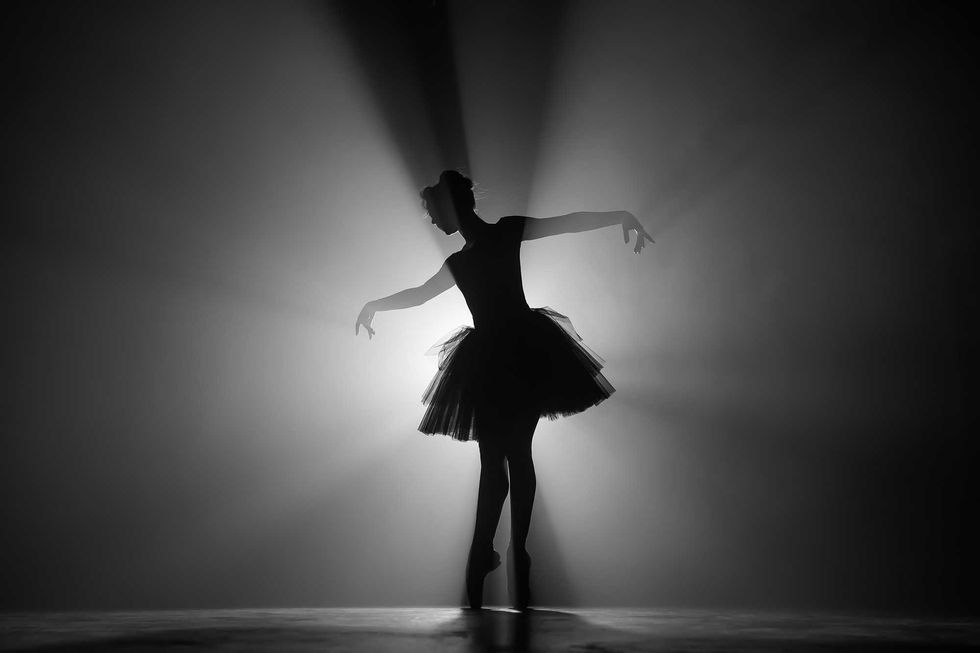 Human movement in the Imperial Tech Capital.Adobe
I’ll admit this first taste of the ballet is pretty electric, but pretty soon into the first act, my attention starts to wander. Lots of people are standing around in costumes, and there aren’t enough pretty ballerinas on stage for me to stay focused. I make a trip to the bathroom, mostly to sneak a rip or two from my Juul, though I try to do this as respectfully to the grand, old building as possible by holding in the vape for as long as I can. I resist the temptation to get a champagne sippy cup of my own on my way back in (though only after a price check).
I soon forget all about the annoyingly exorbitant drink prices as Act II transitions to the lake. One of the advantages of sitting up in the nosebleeds is that you can see the entire stage. Dozens of ballerinas, the corps de ballet, in white tutus and shining feathered tiaras enter single file against the pale, moonlit backdrop. These are Odette’s swan companions, and this is the iconic Entrance of the Swans. They repeat a rhythmic series of steps and jumps in complete unison. There is something almost martial in their utter precision, conjuring memories of the parade deck at MCRD San Diego. They snake around the stage until they fill almost the entire space. I let my eyes unfocus, and the corps de ballet becomes one shapeshifting organism, a kinetic mass that splits and rejoins and splits again like a kaleidoscope.
Is this how you’re supposed to watch ballet? Are you supposed to watch ballet in a particular way? Choose one ballerina, the hottest, and just watch her? Switch back and forth so every ballerina has an equal opportunity of being watched? Are you supposed to think at all? Or just became a Zen spectator of mental emptiness and sense perception?
With my eyes remaining unfocused, I perceive a blur of movement, like watching flowing water, as the swans transition between formations, punctuated by snapshots of gem-like clarity as their patterns take shape and layer in on top of and around each other.
I’m actually pretty invested in this, I think, feeling just a little bit gayer than I did when I first walked in. I periodically notice the glow of a few phone lights in the rows in front of me—a girl scrolling TikTok on mute here, a guy I’m pretty sure is checking his parlay on FanDuel there. About half the time, the ushers will make a dutiful attempt to scold these people, but mostly they just stand off to the side and stare—a tactic of limited use against someone gazing at Instagram Reels as if they’ve been freshly lobotomized.
I zone in and out (and sneak another bathroom Juul reprieve) as the ballet continues. Like any good fairy tale with a princess assailed by a sorcerer, there is a prince, and ours is named Siegfried. A good omen, that name, I think, when Naomi first tells it to me (she’s had to take on the Herculean task of explaining the story to me during intermissions). A dragonslayer’s name. Siegfried’s a young buck whose mother has decided it’s time for him to marry, and is holding a grand ball to present him with his options—various tempting princesses from across Christendom. He’s fallen in love with Odette, and it’s only a vow of love and the faithful keeping of that vow that can break Von Rothbart’s spell. So far, so golden. And what’s more, even though she’s a swan half the time, Odette is way hotter than the others on offer. My boy has got it in the bag.
Unfortunately, Von Rothbart has other plans. He crashes the ball with Odile, his daughter. She has been transformed into Odette’s seductive shadow, her tutu black as night. Odile and Siegfried begin an entrancing pas de deux. The piece climaxes with Odile performing 32 consecutive fouettés, whip-like spinning turns. It’s a magnetic, hypnotic spectacle—and it seals the fate of Odette. With the music incongruously joyous, Siegfried, like a total moron, falls for this and declares his love for Odile, which condemns Odette to remain a swan. Odette flings herself into the lake to commit suicide, and Siegfried follows her. The only consolation is that this (somehow) breaks Von Rothbart’s power and kills him.
After the curtain descends and the lights come back on, I see a flood of people toward the edge of the balcony, mostly the Silicon Valley types and the art queers, trapping some of the slower-moving Respectables in their front row seats and tripping over themselves to secure the most aesthetic view for the benefit of the people who will scroll their IG stories. Promptly, they face away from the stage, phones in hand, and the cameras flash over and over as poses are struck, results are reviewed, and instructions are barked at put-upon boyfriend-photographers. One girl is so eager for her selfie that she drops her phone, then spills her wine all over herself and a poor gray-haired bystander in her rush to pick it up. It looks as though someone captures the whole thing on a livestream. It’s time to head for the exits.
It’s chilly outside, and the night sky is strangely bright as the lights of the city reflect off a blanket of fog hanging above the skyscrapers. Save a passed out bum, it feels like Naomi and I are the only people in the world. As we cross Civic Center Plaza heading toward the elevators, I ponder oboes and kaleidoscope swans, white and black tutus, and failed dragonslayers. Steam rises from manhole covers in the streets. “I thought Swan Lake had a happy ending,” I say. She cocks her head at me and smiles indulgently. “That’s how it’s always ended.”
We return to the ballet several more times over the years. I attend Manon only in spirit. Every parking garage in the vicinity was full, so I dropped Naomi off out front, and spent the next hour meandering in a ten-block radius looking for any street parking just big enough for an F-150. By the time I park up in a distant church parking lot that declares TRESPASSERS WILL BE TOWED, the ballet is more than halfway over, so I just wait it out. Frankenstein managed to be both boring and disturbing, the androgynous monster a distinct downgrade from pretty ballerinas in glittering white tutus. A three-part selection of George Balanchine was much better, with dreamlike Diamonds and Serenade set to Tchaikovsky, and Stars and Stripes, a bombastic and patriotic sequence set to John Philip Sousa, which, I’m still shocked to say, managed to get performed in a place like SF. Don Quixote was a good time, though I mostly remember the show being stolen by a shaggy mini-horse carrying Sancho Panza across the stage, and judging by a quick Google search, the mini-horse also seemed to be the only thing people cared to talk about on social media.
Timothée Chalamet got in some trouble earlier this year when he declared something along the lines of “nobody cares about the ballet.” I remember asking Naomi what she thought of that, expecting venom, but she surprised me. “He’s right,” she said. “You could ask a random dancer at the SF ballet what they think about the meaning of the ballet they’re doing, of who and what their character really is, and most couldn’t tell you. All the people freaking out are just virtue signaling.” There’s been something of a surge of “balletcore” and “ballet aesthetic” on social media, she tells me, but it’s meaningless, hollow. She has harsh words for all the equally hollow parade of people who took the Oscars as an opportunity to attack Chalamet to create some clapback TikTok fuel. She tells me how, for Frankenstein, the opening performance was a closed social night for “influencers”—the art as mere content. “Ballet is dying.”
A feeding frenzy of people pretending to care, and making sure to Be Seen Caring. I think back on the Silicon Valley set I noticed at Swan Lake, swinging around their iPhones at the War Memorial Opera House, posing and making faces, making sure the timeline Sees them Seeing, and I think about influencer galas, and TikToks about mini-horses. What would the Marines who died at Belleau Wood, and all the other hallowed dead of World War I whom the Opera House commemorates, think of it all? Most importantly, of course, I wonder: would they think it was gay for me to go to the ballet?