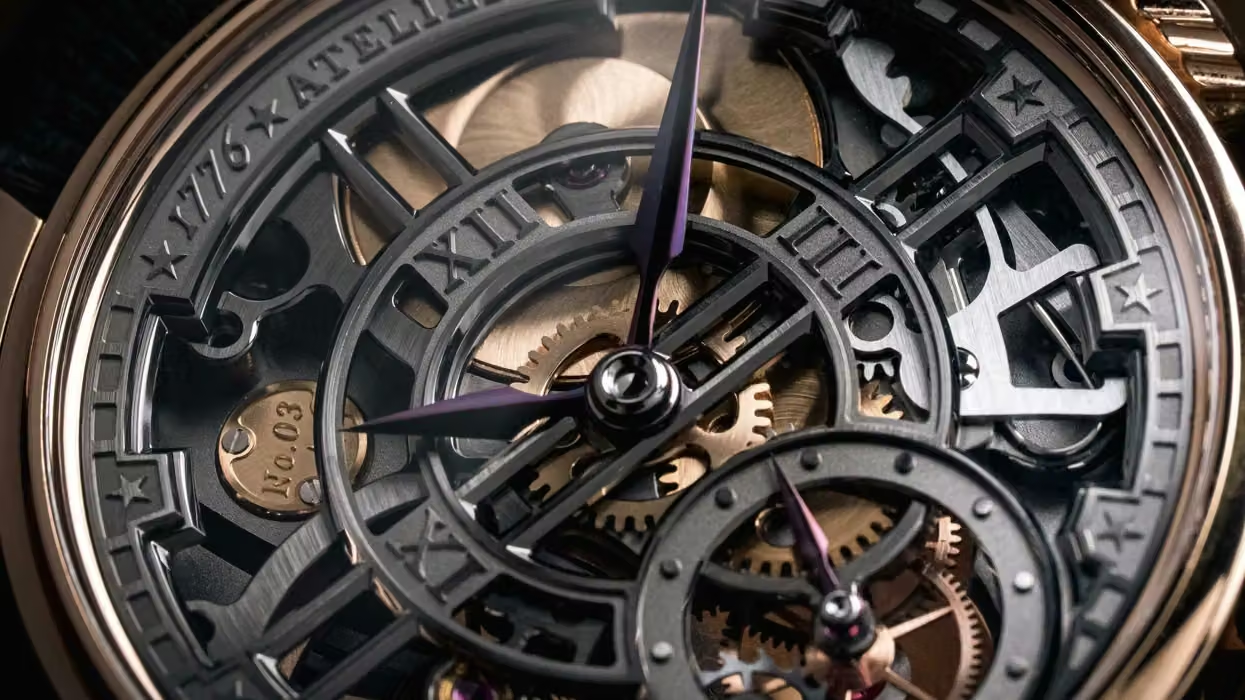
1776 Atelier
Building a mechanical watch in America in 2026 is a fairly insane undertaking. Ours is a nation that has devoted many years to making everything quicker, cheaper, disposable, and deliverable to the front door. The industrial base was reshaped by American ingenuity at scale. The assembly line, the shopping mall, the drive-through window, Amazon Prime, and the indignity of scanning our own groceries—all of it came from us.
A handmade mechanical watch belongs to another century.
Here is a tiny, expensive, anachronistic bit of machinery. Telling time is something your smartphone or your kitchen microwave manages more accurately. There are hours of polishing that go into metal pieces that most owners will never notice, and many will never see. Precisely for that reason, Zach Smith and Jason Lu decided America needed to start making watches again.
Their company is called 1776 Atelier, which sounds as if Thomas Jefferson opened a workshop in Geneva. And that is kind of the point. The company believes it’s time for America to once again take its place among the world’s renowned timepiece manufacturers.
Lu founded the company after a career in technology, though his original training was in mechanical engineering. Smith’s career path started with watchmaking school, then a job at Omega, and professional watch repair, until he discovered one of the central absurdities of the modern American watch business: knowing how to repair a watch did not make it any easier to get the parts needed to repair it.
So, like many enterprising engineers, he decided to make them himself.
Producing a replacement watch part is time-consuming, which is fine if you are restoring Napoleon’s Breguet, but less viable if you are trying to run a business in Ohio. Eventually, Smith shifted his machining operation to medical, aerospace, and technology components, industries willing to pay a premium for microscopic metal parts manufactured to minute tolerances.
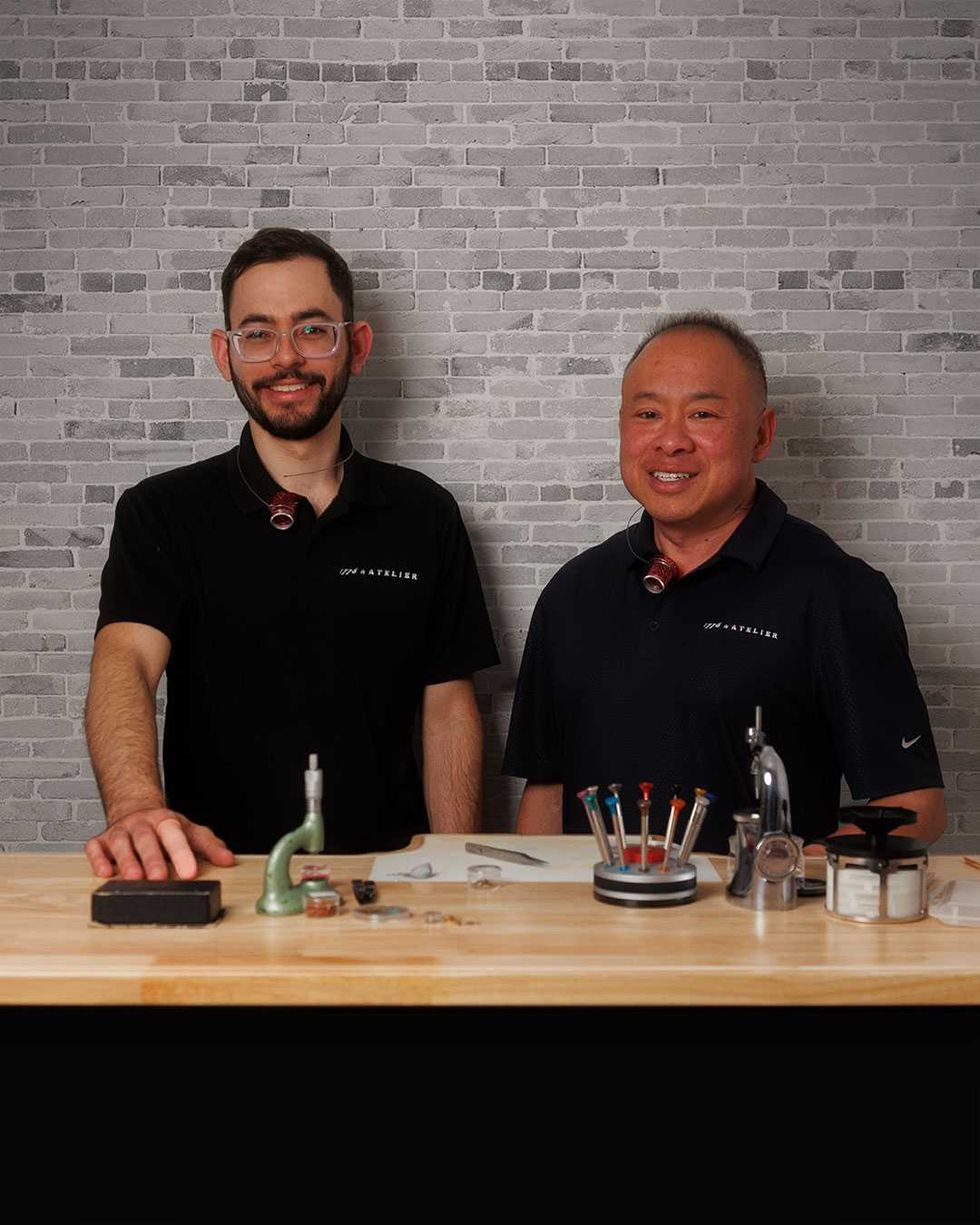 Jason Lu and Zach Smith are forging a new tradition of watchmaking.1776 Atelier
Then watches, with the siren song of ticking gears, beckoned again.
“I have all the equipment,” he says. “Back to watches, because it’s my passion.”
This is either romantic or evidence of an obsession bordering on the absurd. With watch people, it’s a distinction without a difference. Even though America was once a powerhouse of watchmaking with brands like Hamilton and Elgin, that was a hundred years ago. The prospect of resurrecting a manufacturing process as complex as high-end horology is daunting.
Smith inherited the interest from his father, a collector whose Patek Philippe world timer initially struck the younger man as proof that his dad had gone mad.
“I can’t believe you’re spending this much money on this,” he remembers thinking. Then he started working around watches and understood. “It’s just like an addiction.”
Lu contracted the disease in a different way. As a boy growing up in California, he went with his mother to a flea market and found a watch. He liked most mechanical things: cars, guns, machines. The watch cost $97, essentially everything he had saved.
It turned out to be an early Audemars Piguet Royal Oak, designed by the legendary watch designer Gérald Genta. And not any Royal Oak, but a first-series example, one of the watches that helped redefine the modern luxury sports watch and is now treated by collectors with the reverence ordinarily reserved for holy relics or fine art.
Lu had no idea.
“There was no internet,” he laughs.
For roughly a decade, he simply owned it and enjoyed it. Eventually, while interning at Lockheed Martin, he wandered into a jewelry store and had it appraised. The kid who had spent his savings at a flea market discovered that he had accidentally purchased a piece of watch history. He later sold it, a decision he admits with the chagrin of a guy who knows what early examples of Royal Oaks now cost.
By then, the love of watches had set in. He read magazines, collected watches, and developed increasingly sophisticated, and therefore increasingly expensive, tastes. A career in technology provided the means to indulge them.
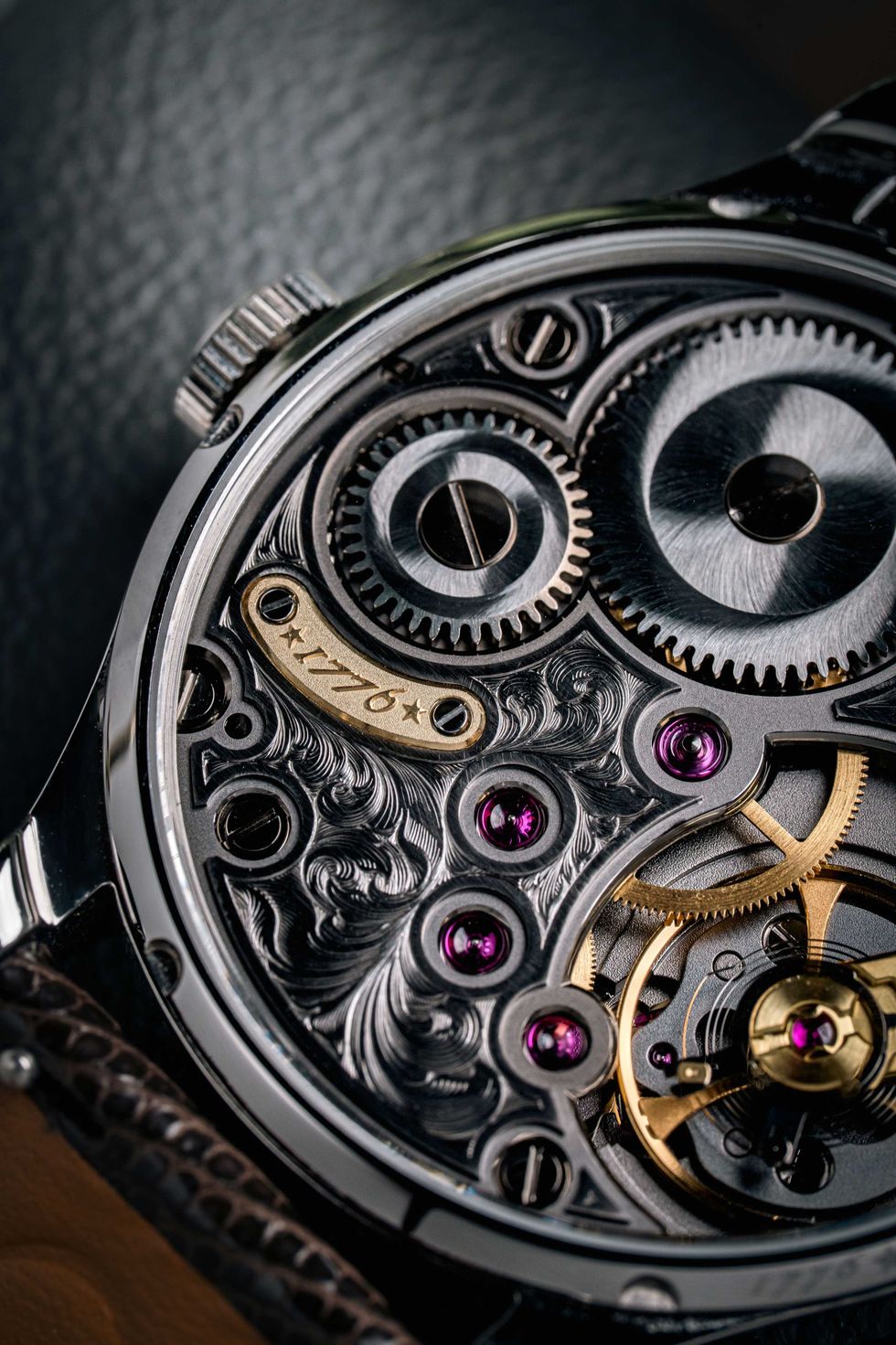 Mechanical perfection. 1776 Atelier
“The tech job,” he says, “allowed me to fund a very expensive watch-collecting hobby.”
It also made him miserable.
One day, his wife suggested that instead of bemoaning the difficulty of buying watches from independent makers, he should try making one himself. This is the sort of marital suggestion that can either enliven a middle-aged man’s existence or destroy the garage. Lu chose the former.
After tinkering with old American pocket watches, he started 1776 Atelier and discovered that making watches was considerably harder than collecting them. Lu started seeking out people who knew what they were doing. He also sought out a crash course in watchmaking that eventually took him to Germany and Switzerland, including Glashütte, the small Saxon town that is to German watchmaking roughly what Maranello is to Italian sports cars.
There he encountered Don Kornagel of DK Precision, a craftsman who works in the rarefied ecosystem surrounding some of Germany’s great watch houses. Kornagel was responsible for introducing the two Americans after Smith came to Germany to repair one of his machines.
Lu was told he should speak with this fellow from Ohio. The first telephone conversation was supposed to last 20 minutes, but it went on for hours. Eventually, Smith became a supplier, then a friend, then a partner.
“1776 really grabbed another gear,” Lu says.
The German influence remains visible in their watches. Glashütte itself is the sort of place that makes the modern luxury business appear a bit absurd. There are no enormous advertising agencies manufacturing desire in glass office towers.
Watchmaking is just what the town does. You stand in line for lunch beside employees of Glashütte Original, A. Lange & Söhne, Moritz Grossmann, and the other companies that have turned this corner of Saxony into one of horology’s holy sites.
These tiny components receive aesthetic attention wildly disproportionate to their size.
The building where Lu lived once belonged to Ferdinand Adolph Lange himself, the founding patriarch of fine German watchmaking. “You walk around the post and the stairs,” Lu says, “and it says F.A.L. on the posts.”
Imagine learning to paint in Cézanne’s studio, and you get the general idea. The German approach also leaves fingerprints on the metal. Swiss and German watches may appear superficially similar to the uninitiated, much like how all Bordeaux tastes like red wine until someone with a fuller appreciation of it explains otherwise. If you look closely, the differences emerge in the architecture, the grinding, the finishing, the bridges, the surfaces, and the way light moves across the metal.
Smith points to the German utilization of diamond paste in solarization grinding. Lu mentions grinding the flanks of bridges, an additional bit of labor that risks ruining a part in which hours of work have already been invested.
This is the weird logic of haute horology. Having painstakingly created a perfectly functional component, the watchmaker risks destroying it to make a beautiful surface that almost no one will ever properly examine without magnification.
1776 Atelier absorbed both traditions. Smith came through WOSTEP training, rooted in Swiss watchmaking. Lu absorbed much of his craft through German mentorship. Their watches are neither Swiss nor German.
They are American.
The name 1776 inevitably raises questions. Lu insists it isn’t intended as a political slogan. His minor in college was American history with an emphasis on constitutional law. Thomas Jefferson is one of his heroes. He proposed to his wife in front of the Jefferson Memorial. The name came to him while driving to his old job.
He had fallen in love with American pocket watches and wondered why a country that once produced extraordinary movements had virtually abandoned watchmaking. The United States is the largest market for luxury watches, yet serious American makers remain conspicuously rare. Why should Americans merely buy the best watches in the world? Why shouldn’t they make them?
There is an irony in the pairing of 1776 with Atelier, a French word. Lu rather enjoys this. France, after all, had something to do with the success of 1776. Benjamin Franklin’s diplomacy and French assistance helped ensure that Americans did not spend the next two centuries drinking tea beneath portraits of the king.
“Atelier means artist workshop,” Lu says. “And that’s really the way we look at what we build, as mechanical art.”
There is another reason for making the watches here, and it has less to do with patriotism than with control.
The modern watch industry makes it somewhat easy to start a “watch brand.” A person with a laptop can contract for a case, movement, dial, hands, strap, logo, and packaging, assemble the pieces, devise an origin story, photograph the resulting object beside a Porsche steering wheel, and announce himself as the latest guardian of horological tradition.
Lu has little patience for this.
“That is not horology,” he says.
1776 Atelier is attempting something far more difficult: actually crafting watches. Smith’s machining expertise makes this possible because, if a component needs to change, the company does not have to email a supplier in Switzerland and wait four months for a prototype. Smith walks onto the shop floor, changes the program, and begins cutting metal. The tolerances involved are often measured in microns.
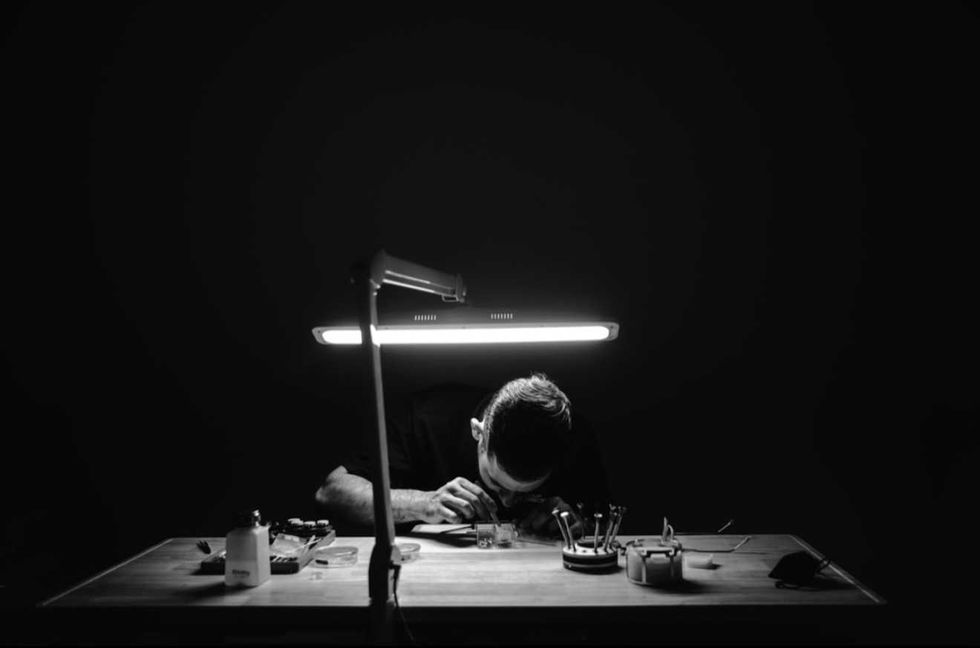 1776 Atelier
This is not the sort of manufacturing where enthusiasm and a newly purchased CNC machine are enough to master the art. Watch components are astonishingly small, and even tiny errors become major problems when the entire mechanism must fit on your wrist and run reliably for years. 1776 now makes virtually everything it can domestically. The exceptions include jewels, sapphire crystals, and mainsprings.
Then there is tantalum.
Collectors have a peculiar affection for tantalum, a dense, handsome, stubborn metal that appears occasionally in watches from companies like Audemars Piguet. It is notoriously unpleasant to machine.
Naturally, Smith decided to make a watch case from it.
He begins with a blank block of metal. A wire moving at extremely high speed generates enough heat to slowly cut the material. The crude form then moves to another machine, where it is gradually transformed into something resembling a watch case.
Tantalum likes to eat tools. Smith holds up a cutter, explaining that under ordinary watchmaking conditions, it might last between 300 and 500 minutes. Tantalum breaks tools quickly, but eventually, a gorgeous case emerges.
This also explains why watches like these cost as much as they do. The modern consumer has become so accustomed to industrial abundance that it becomes easy to mistake price for markup. With handmade objects, price frequently represents time. Someone actually had to sit there and do the tedious work. Even something as simple as a pair of watch hands can take hours to produce.
The movements contain hand-beveled internal angles, polished surfaces, ground bridges, and layered dials. These tiny components receive aesthetic attention wildly disproportionate to their size. Lu likes visual complexity, while Smith prefers a much cleaner design.
They constantly argue over design, which, in the end, is good for the watches.
“I will not release a watch that Zach does not like,” Lu says. “And Zach will not release a watch that I don’t like.”
Their design sessions often begin on FaceTime, where Smith proposes a classical idea. Lu wants something contemporary. Eventually, they arrive at an object neither would have designed alone. The inspiration comes from everywhere: vintage chronographs, old American pocket watches, 1940s crystals, Audemars Piguet, Vacheron Constantin, Jaeger-LeCoultre, and obscure details noticed only after years of looking at watches.
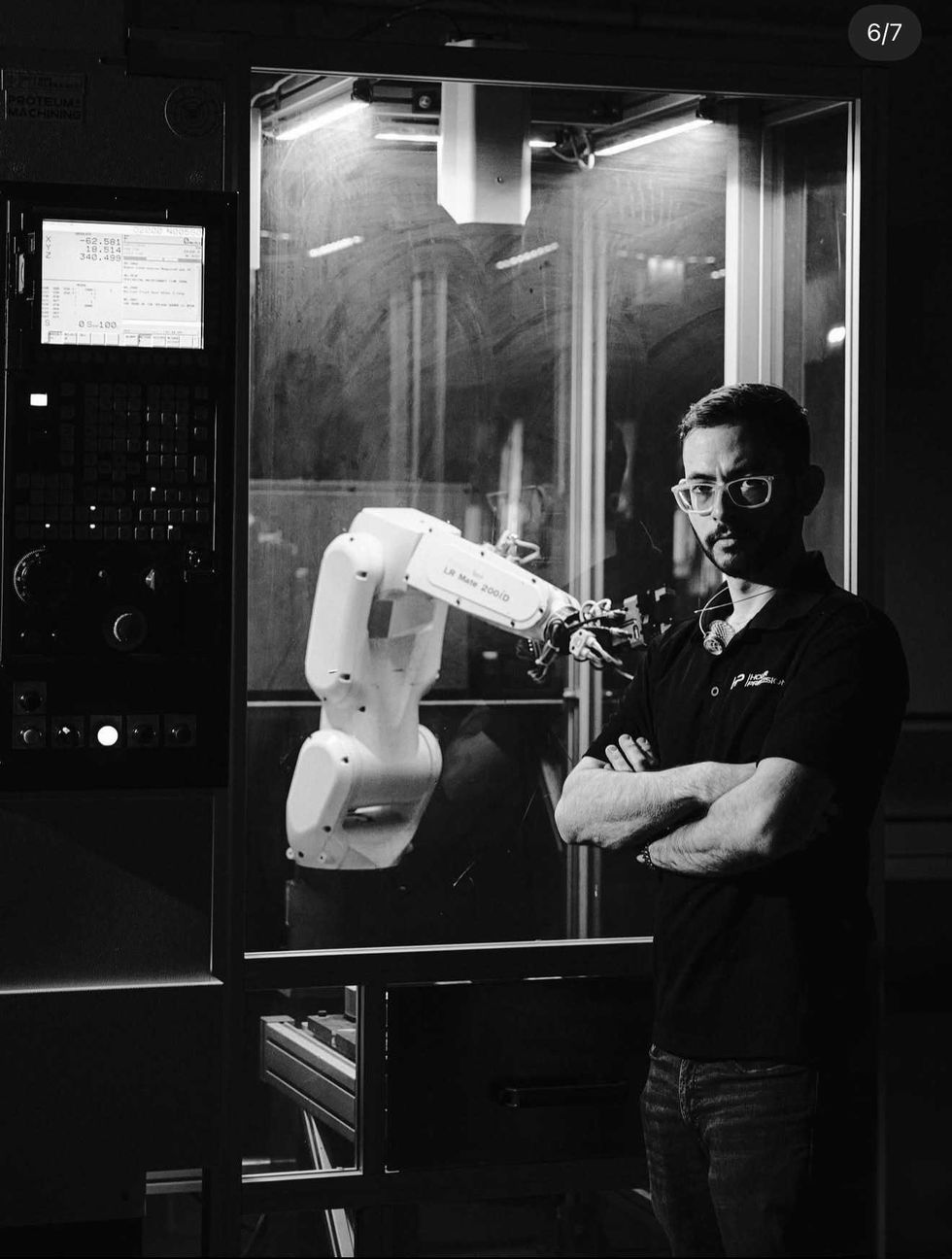 Zach Smith has built a workshop in Ohio centered around precision and craftsmanship.1776 Atelier
The result feels especially relevant now because the mechanical watch has survived its own obsolescence.
Smith himself wore an Apple Watch for years. It gave him messages, heart rate data, notifications, and all the other little digital data points we’ve decided are important for some reason. Then a jeweler pointed out the absurdity.
“You’re in the luxury watch industry, and you’re wearing an Apple Watch.”
Smith started wearing mechanical watches again and noticed something he wasn’t expecting. Calm. Without the little screen attached to his wrist beeping at him, there were no Instagram notifications buzzing against his skin, no texts demanding immediate acknowledgment, no electronic ping robbing his attention.
“You can just go outside and have nothing electronic on you,” he says. “There’s something really peaceful about it.”
Here is the real argument for a mechanical watch. Its supposed weakness is its great virtue: It does nothing except tell the time.
It does so through springs, gears, wheels, jewels, screws, and human ingenuity. It will never require a software update. It has no idea where you are. It cannot show you an advertisement or track your algorithmic preferences. It will not vibrate because somebody you barely remember from high school just uploaded photos from Cabo.
And, if made properly, it may still be ticking long after your heart does.
For Lu, this analog reality is priceless as the rest of human experience goes digital. He spent his previous career helping tech companies blaze their way into the silicon future. Now he finds himself making machines whose fundamental principles would have been recognizable to Thomas Jefferson.
1776 Atelier has no great ambition to flood the market with their watches. The company makes fewer than 200 watches a year, and Lu says the eventual goal may be to make even fewer than that. This is business heresy in America, where success is measured by the number of units one can drop onto a loading dock. But scale inherently destroys the purpose of art.
They want to know their customers. They believe buyers should know exactly who made the watch. At shows, Smith says, he enjoys talking to collectors who buy nothing just because they love discussing watches, collections, favorite references, and how the obsession started. The transaction, if it does happen, is inevitably personal.
This is the advantage the independent maker possesses over the luxury conglomerates. The giant Swiss companies can buy Formula One sponsorships, celebrity ambassadors, billboards, boutiques on the world’s most expensive streets, and unlimited advertising in glossy magazines. The little shop has the man who made your watch.
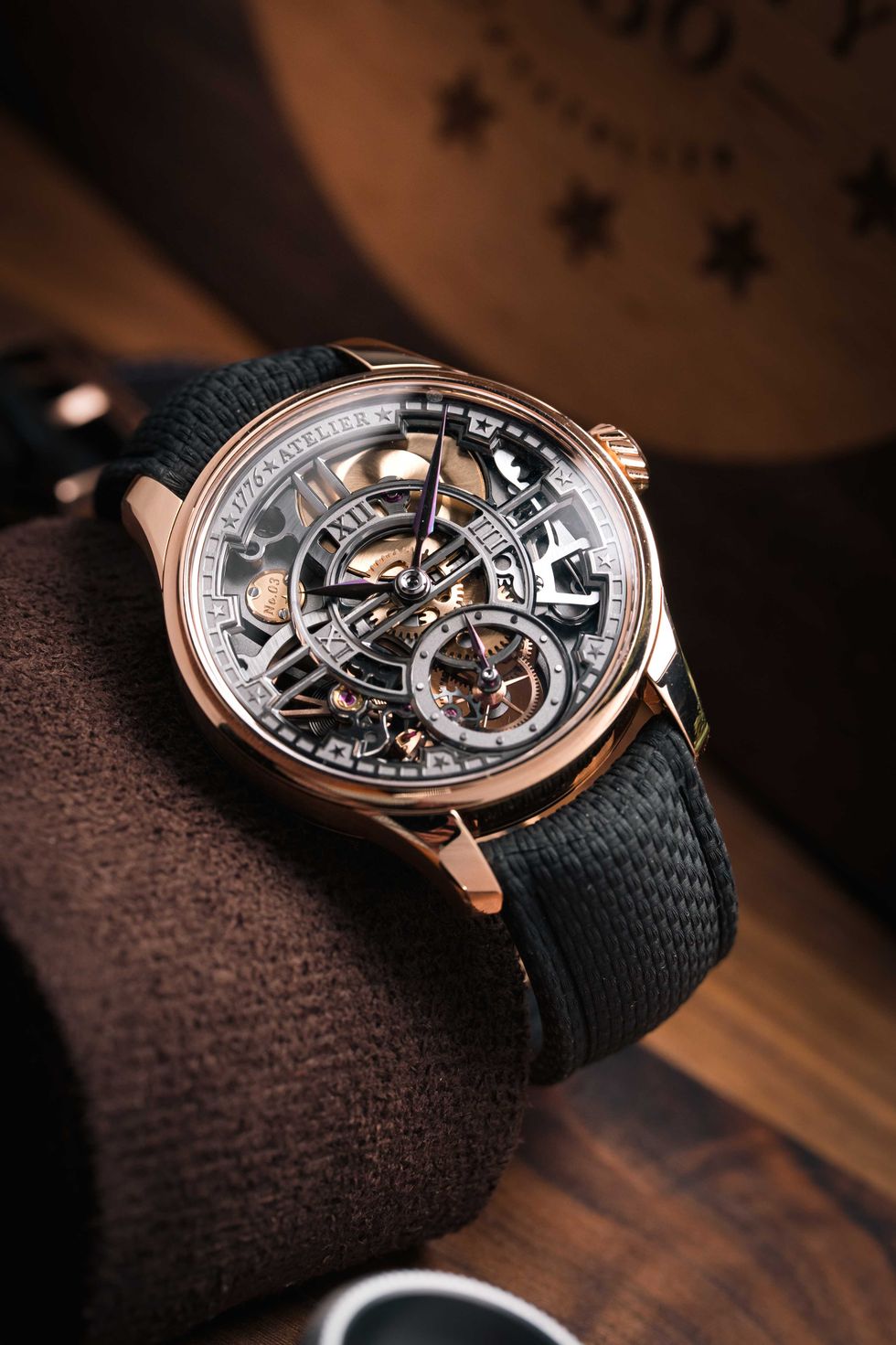 Creating tiny, mechanical works of art.1776 Atelier
Lu sees collectors as two distinct groups: those who buy watches to impress others and those who buy them to impress themselves. The independent watchmaking customer, he thinks, undeniably belongs to the latter group. There is no shortage of watches that scream wealth from across a crowded restaurant. Your Rolex Daytona or Richard Mille will be noticed. The more interesting luxury goods are becoming quieter, stranger, harder to obtain, and more closely tied to an actual artisan. When “luxury” goods are purchased by a wider variety of folks and the Chinese are getting better at making knockoffs, quiet, genuine luxury has its appeal.
As life becomes frictionless, instant, algorithmic, and synthetic, old-fashioned sweat and effort gain value. We want imperfect handmade items because a machine could make a perfect one. We still buy records even though almost every song ever recorded is on Spotify. People buy printed magazines, like the one you’re currently holding, despite having screens that can display an infinite number of words.
And some still want a watch made by two men who will argue over the shape of a bridge, destroy expensive cutting tools trying to tame tantalum, polish microscopic pieces of metal for hours, and happily discuss the difference between German and Swiss solarization grinding.
There is no compelling reason for this. For many people, there isn’t a compelling case for mechanical watches anymore. It goes against the grain in a consumer-driven world that values convenience over quality, the digital over the mechanical, and productivity over art.
Thank God there are a few American artists who disagree.