Michigan blue water. | O.W. Root
I first heard about the uninhabited dune on the west side of High Island on the back of a boat in the middle of Lake Michigan from an old man with a bald head, white beard, and a profoundly rotund midsection. He held a hot dog in his hand and was wearing nothing but underwear, wet from jumping in the lake a few minutes before.
Between bites, he casually told me that he grew up on Beaver Island, a little island with a population of about 600, stuck out in northern Lake Michigan, and that, as kids, they used to sail their boats out to the west side of High Island for the day, just for fun. “There’s a big dune out there; the beach is great. It’s the best swimming there is,” he told me.
We were on our way to the eastern side of the island to shoot photos of rusty train tracks running into the water and debris left over from a dead religious sect that inhabited the eastern side of the island in the early 1900s, when he told me about the farther-flung western side of this relatively unknown, and now totally uninhabited, island.
Hours later, we got back to the mainland, and, after the necessary rounds of straight liquor one deserves after a long day on the water, I sat in the living room, thinking about that dune and what the man on the back of the boat had said. Just over the hills that look like leafy camel humps from the east, an empty beach on a long, abandoned island, only barely photographed and documented, not found plastered all over the internet, absent all symbols or signals of human civilization. A dune I’d never seen or even heard of until that day on the boat, great swimming that was enjoyed by teenagers arriving on sailboats in the 1960s, and a shore that is still, against all conceivable odds, unknown to nearly all eight billion souls on planet Earth.
Somehow, in our ever-connected, over-photographed, and meticulously documented world, there are still places that have slipped through the cracks or were never really even known in the first place. Somehow, there are places inadvertently protected by virtue of human weakness or a lack of exploratory desire. Somehow, this western coast and this rolling dune had escaped the panopticon of technical civilization and remained as it always was for the majority of its lifetime, alone and undisturbed.
And this fascinated me—the notion, the idea, the possibility of places still forgotten or still too hard to reach.
The smoke from the Canadian wildfires had turned the normally pristine skies above northern Michigan a filthy orange for the past 10 days, but on a humid Sunday morning in early July, I was hoping and praying for a break in the suffocating smoke. Any bit of blue to make photographs appear more like they were capturing our living Earth and less like depictions of Mars would do. And somehow, by the grace of God, or perhaps just the changing winds from the south, the orange faded to yellow, then to white, and finally, thankfully, blue. Heading west from Charlevoix, on the ferry to Beaver Island, the dingy, suffocating canopy dissolved behind us, and the skies turned as blue as they ought to be on a summer’s day in the north.
I was staring at those spots hidden by branches and the hazy shade, but I didn’t go there. Only my camera did.
Our boat landed in St. James at 10:30 a.m. Captain Mike Weede, waiting for me with an old red truck, assured me there was no need for a seat belt as I hopped in, and drove us about three minutes down Main Street before pulling off into a gravel lot poking out into Paradise Bay. We hopped out, I grabbed my camera bag, and loaded onto his boat, The Resolute. Weede showed me the brats he would be grilling for us later on the back of the boat.
Nearly one year after I met the old man who grew up here, I was back on the same boat (though he wasn’t here this time), leaving the port at St. James for the far western side of the empty island I had been thinking about for the last 12 months.
Weede brought us out of Paradise Bay, heading north around the crook of the island where the original lighthouse still pokes up into the sky, keeping watch. After clearing the point, we turned left and headed west around the northern end of the island, where we chugged loudly and rather slowly past summer houses peeking out of the sticky woods to our south and Garden Island to our north.
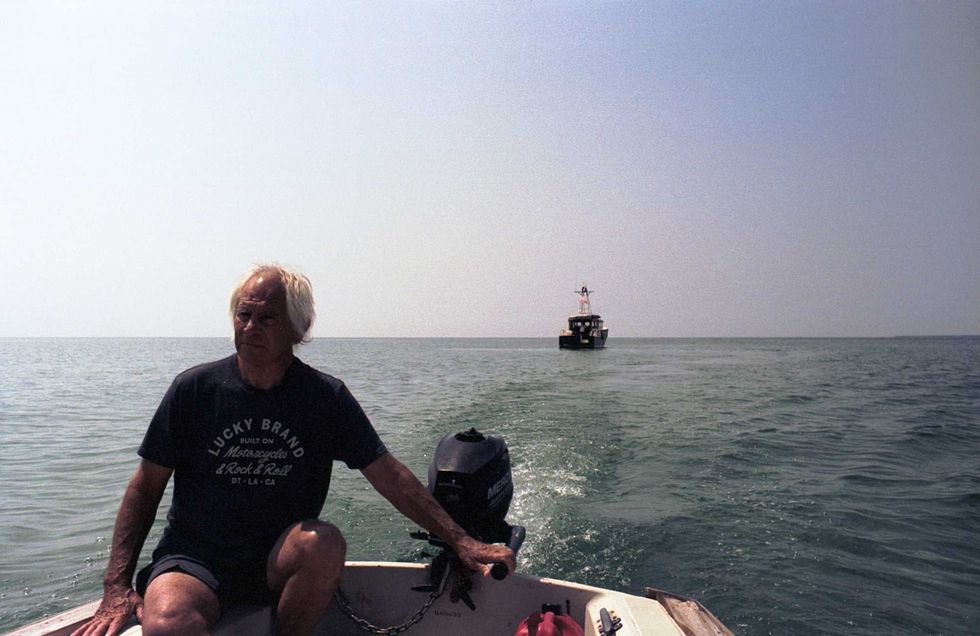 Captain Weede steers the motor towards the dunes.O.W. Root
At one point, when only American Indians were here with their long canoes, Garden Island was the most populous island in the Beaver Island Archipelago, though today it, like almost every other island, is uninhabited and barren. There are no windows to be seen on the shore. No docks, no streetlights, no kayaks. It appears to us on our passing boats as nothing more than a tightly woven collection of bushy trees rising above a thin line of gray, rocky sand hovering over the blue water below. Garden Island is home to biting flies, coyotes, and mosquitos more than anything—or anyone—else. Man is not welcome on Garden Island like he is used to being welcomed in more civilized corners of the earth.
We pushed on for a while, coming around the western tip of Beaver, leaving Garden Island behind to the east, looking northwest at both Whiskey and Ojibwa Islands passing through a pair of binoculars. The further west we went, the more menacing the flies became. Some consider mosquitos to be the most annoying insect in the Northern Hemisphere, but they are most certainly not; biting flies are worse—much worse. They hurt more, snap harder, and their bites scratch for longer. They are quicker, too, and they only buzz around your legs where you aren’t looking. Killing one is damn near impossible. Striking dead a lackadaisical, blood-drunk mosquito is comparatively easy.
At the helm of the ship in the cabin, they were the worst. The combination of dead air with no wind and our boat being out in Lake Michigan without any shore near made for a prime feeding ground for them. After lathering my legs from ankle to knee with a few thick layers of a greasy bug repellent that came in the form of a deodorant stick, I climbed out onto the deck, grabbed hold of the railing above the cabin, carefully worked my way around the edge of the boat, and finally up near the bow where the wind was too strong for the devilish little biters.
From the bow, the green, rolling slopes near the center of High Island came into view. Trout Island, a privately owned isle with a single home and a grass landing strip cut through the wood for an airplane, could be seen to the north. The strip runs all the way across the small island, and when viewed from exactly the right angle, it appears as if there are two symmetrical land masses separated by a perfectly straight line cut through the water. It’s not clear until you are very close that it is, in fact, a single island.
Somehow, in our ever-connected, over-photographed, and meticulously documented world, there are still places that have slipped through the cracks or were never really even known in the first place.
Steadily, with our rumbling engine, skiff tied to the back bouncing in our wake, and an irritating swarm of flies in tow, we made our way around the northern corner of High Island and started heading south toward the western dune.
It’s exhilarating knowing you are about to see some thing or some place you have never seen before. You feel it when your plane takes off and when you hand the border guard your passport. You feel it when you are behind the wheel on a dirt road in the mountains near the cabin you’ve rented for the week. But that’s all civilization, even if the tarmac at JFK is an absolute form and the road to the cabin is only just so. Coming south down the coast of the western side of High Island, looking through a 200 mm lens at the boulders near the northern point, seeing with my own eyes this place, this completely empty place, this place you can only access with a boat and enough time and enough desire. This place where no one lives and almost no one knows of, this place I had thought about for 12 months prior—it was emotional in a way I can’t exactly explain. It feels odd or embarrassing to claim that seeing an empty shore might raise your heart rate or force you to stop yourself from smiling so you don’t feel like a fool.
We kept trolling south until finally the part that appears as a pixelated splotch of yellow on Google Earth came into view from the port side of The Resolute. Brogan, the deckhand who accompanied Weede and me, despite having spent every summer on Beaver Island and having sailed all over and around the other islands, had never seen the west side of High Island until we came around the northern point early Sunday afternoon.
Finally, we dropped anchor. Weede and I loaded onto the skiff. He jerked at the fraying starter rope, pulling it hard a few times, as all older, outboard motors ritually demand, and the old dog fired up with puffs of gray exhaust. Leaving Brogan behind on the boat, we buzzed toward the bay with no official name below the dune we came to see. The water is so clear this far north and this remote. You show pictures of it to people who’ve never been up this way, and they think it’s the Caribbean or some other place that’s far warmer and far more swarmed with tourists and photographers. I could see the sandy bottom of Lake Michigan through the moving aquamarine water. Leaning a little over the edge of the boat, I dipped my left shoulder and let the cool freshwater flow over my fingers as we neared the shore.
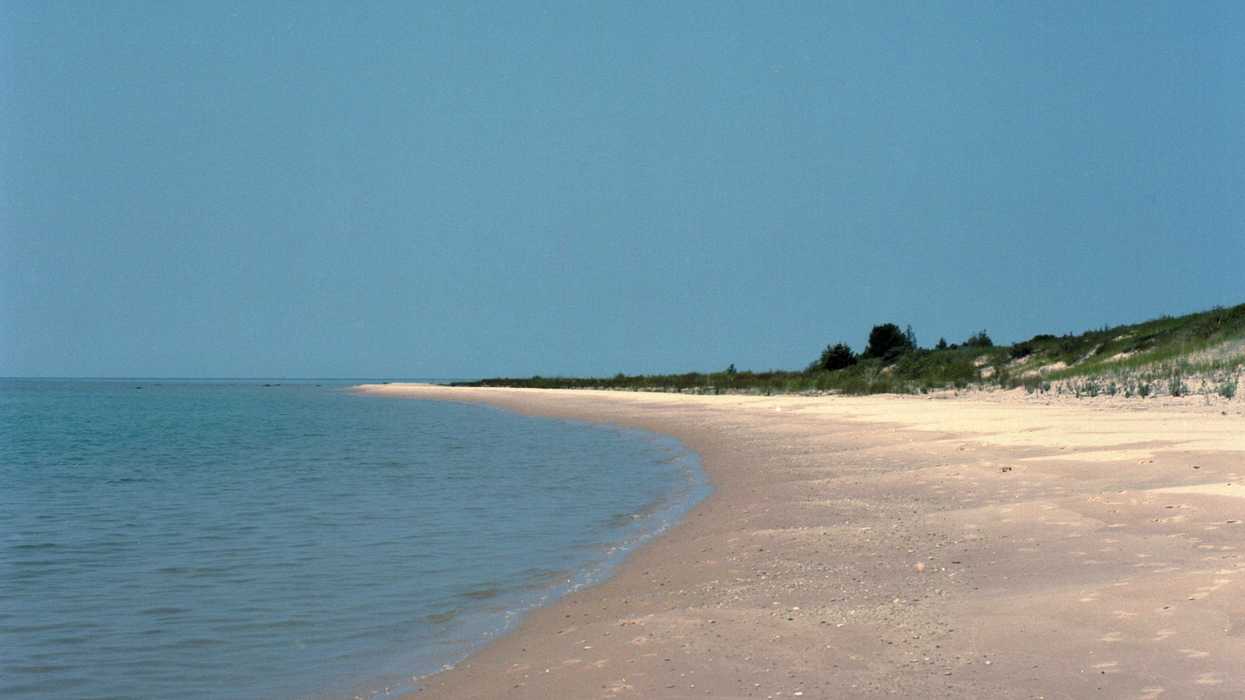
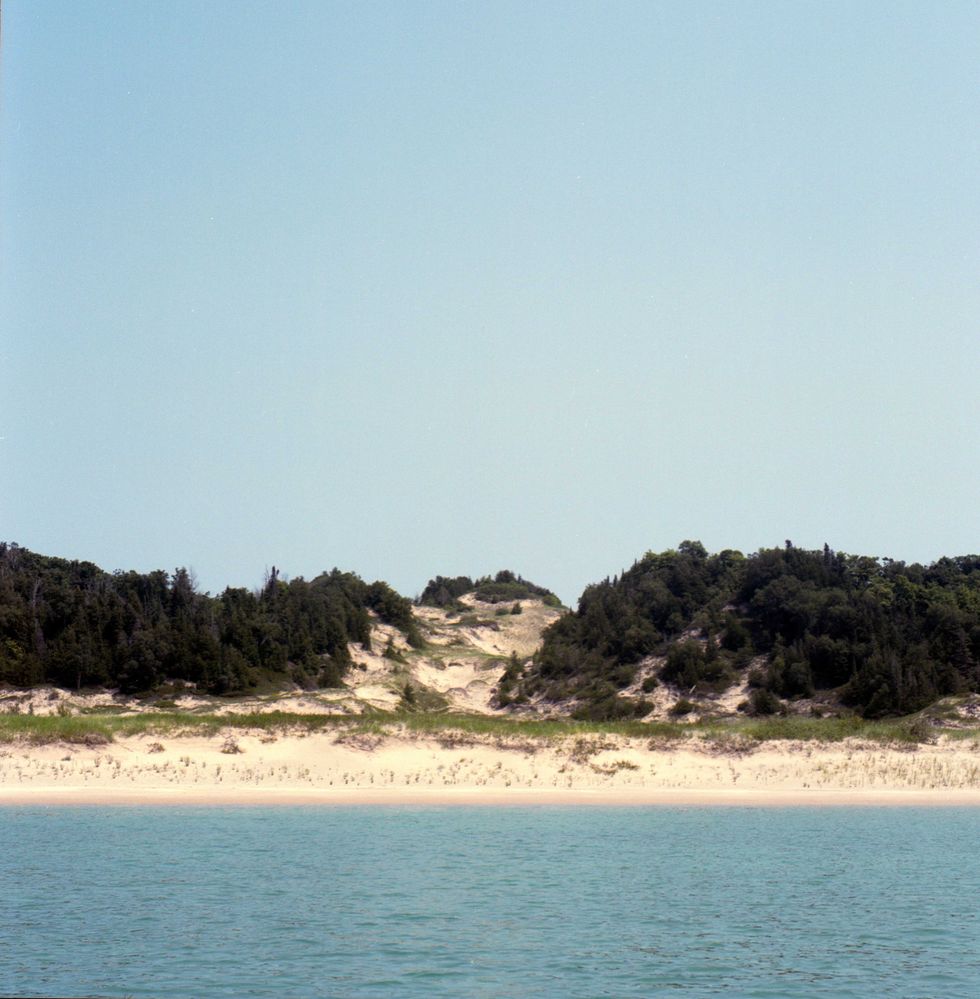
The little boat drifted up against the sand, and we hopped into the water and walked a few feet up onto the dry beach. The old man was right about it here. There are no large rocks, no seaweed, no logs of driftwood, no strong waves in the protected bay. Only little pebbles, soft, lapping water against the shore, golden sand, and dune grass beginning about 25 feet off the water. Without any human intervention, maintenance, or cultivation, it is perfect today, just like it was when the old man was young.
We walked inland over scrubby earth littered with dune grass, shrubs, wild flowers, and white stone, eventually reaching the base of the dune. Weaving up to the top of the hills, we saw, as we approached from the east, a sloping dune with little wave-like dips of sand and dune grass split the thick, dark green woods in two. At my feet was a turtle shell turned over, its belly facing the sky. I had no idea how long ago the turtle had died, but there was no carcass to be seen by the time I found the shell baking in the summer sun. Why is it that a lifeless shell of a turtle that once slowly marched across these pebbles is so perfectly poetic and almost too on the nose to not be glaringly obvious for the setting of an uninhabited island? Is it a testament to the fact that it might have been removed long ago if there were civilization here? Or that it might have been collected if there were tourists on the beach? Or is it merely an aesthetic complement to the fact of abandonment and desolation?
 O.W. Root
No one buries a dead turtle, but they might remove one. But there’s no one on High Island to do the burying or the removing, and I obviously did neither myself. Leave no trace, as we say. So I have no reason to believe that, as of this very moment, while I write this or as you read this, that turtle shell is anywhere else than right where I stood and photographed it on the west side of High Island at the foot of the dune.
Our world today is so thoroughly documented and described that there is a dreadful, latent feeling we all intuit even if we can’t articulate it properly. We all secretly suspect there are no longer any places to get lost, be alone, discover for oneself, or just be as we are in a place as it always was. The map today is finite, and we know where it all is, and we are all there on our smartphones, on Google and Instagram, together, in the cloud, bored. This is, I believe, a reason some go clinically insane in our strange times. Insane in the little ways and insane in the big ways. In our time, the suspicion creeps up on us that we are animals in a cage and the cage is all known and all is explored, so what else is there for any of us to do other than waste away the time we have in the totally known, without adventure, without mystery, without exploration, without surprise, and without wonder?
And it’s the possibility of the opposite of that which we hope for, even if we don’t have the language to say it or even know it consciously for ourselves. Somewhere that might not be entirely known, some place that isn’t all over the internet, somewhere that is secret or at least still out there and a little mysterious in some way other places aren’t. Someplace where there is something to wonder about.
No one watches the sunset from the western dune on High Island. It happens every night unobserved.
Standing on the scarcely tread ground of High Island, the water to my back, my eyes fixed on another dune cutting up and through the woods to the south, I scanned the shade under the trees and imagined what was there. Watching the tree line on the hill above, the leaves swaying back and forth, I thought of the birds. All the land in front of my face was untamed. No roads, no electrical wires, no cars, no humans, no trails, no markers, no warnings, no signs, no civilization. As far as the land goes, until it ends where the water begins, there is nothing but uninhabited mystery. Under the broken pine branch, in the swampy pond, on top of the balding peak, there is mystery. No matter how small it may be, there it is. Untouched, unknown, undocumented. It doesn’t take exploring every corner of those woods to appreciate the meaning pregnant in that single scene.
There were people who lived on High Island 100 years ago. They were members of the House of David sect. They lived on the eastern side. They left the train tracks behind and some fading debris that has been in the process of being devoured by nature since they left. Any trails they once had on that side have been subsumed by the forest and are no longer discernible in any meaningful way. How many places on High Island have never been touched by human feet? It’s impossible to know, but there are certainly some. Perhaps there are a few places in the shady spots under the trees by the dune to the south. I was staring at those spots hidden by branches and the hazy shade, but I didn’t go there. Only my camera did.
Yes, of course, there are places in the national parks out west or in the northern stretches of Canada and Alaska which have almost certainly remained untouched by human hands and photography. But there is something about an island that communicates the message more clearly. Maybe the island is a more potent form of separation, which makes the meaning easier for us to comprehend, even if the truth is the same in thousands of other places, whether on water, rock, sand, soil, forest, desert, mountain, or plain. There are still places left to explore.
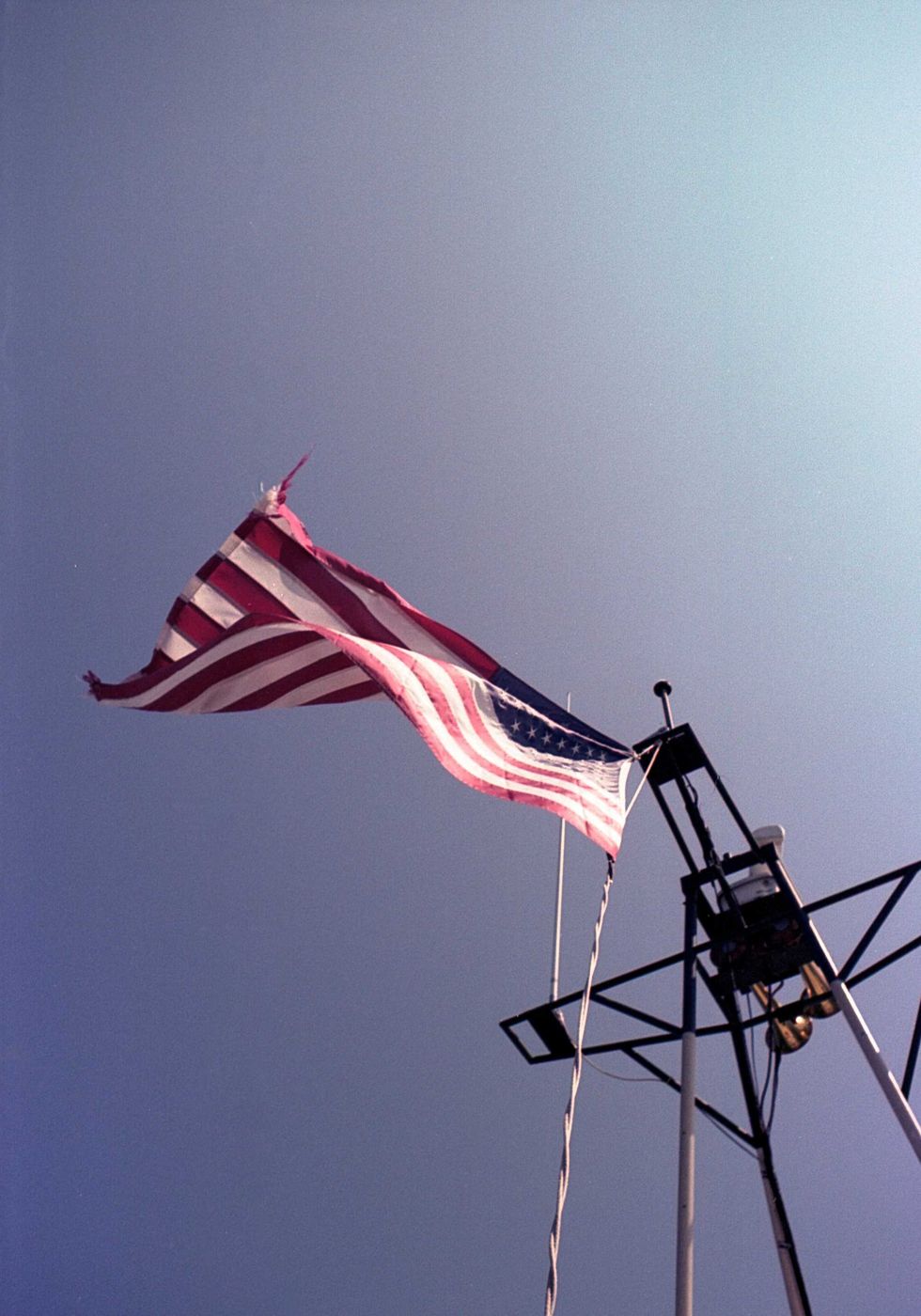 The flag waves proudly on the very edge of the country.O.W. Root
I’ve shot photos all over the world, in all different places, with all different kinds of people and things, but the feeling I experienced adjusting the aperture, focusing the lens, and then snapping the shutter on the shore at High Island was different from anything I’ve felt anywhere else. It was thrilling, precious, and, for lack of a better word, real. After winding the roll of 120 film and taping it shut, before asking Weede to hold my Mamiya C3, I loaded another roll in front of the dune. Taking photos that aren’t just replicas of other photos taken by other photographers but new photos entirely—photos that aren’t already all out there—has the same message—there are still places left to explore—in photographic form. And to take the photos as film photos—real photos, captured on a negative rather than an SD card—that is something heavier, more timeless, or perhaps just more real.
Days pass too quickly. The skiff was waiting, and it was time for us to leave the island. We climbed into the little boat and shoved off from the shore. Weede ripped on the starter again a few times, though it sprang to life more quickly now, and off we buzzed back toward Brogan and The Resolute. I watched the shore shrink, and the dune get hazier in the afternoon light, and wondered if I’d ever return. I would love to say I will, but I don’t know. I would love to spend my summer days there, on the beach with the boat pulled up, not a single sound other than the lapping water at my feet and sounds from the woods at my back. No motors, no music, no voices; the island as it was before me, before the old man on the boat, before the settlers, and even before the Indians; the island as it always was. To watch the sunset over Lake Michigan from the top of the dune as it falls under the horizon in the west. To see the sky turn red, to hear the breeze and nothing else. No one watches the sunset from the western dune on High Island. It happens every night unobserved. And what a tragedy that such a scene isn’t taken in by man! And thank God it isn’t! There are still places uncivilized and unsaturated.
The west side of High Island isn’t that far away. It’s in Lake Michigan within the territorial boundaries of the United States of America. But it’s not easy to get there. And that’s why it’s still something most other places long ago ceased to be. You’re never going to walk on that empty shore, or see the shady spots under the unexplored and unmarked woods with your eyes, or know how quiet the waves are in the bay without any official name, or see the overturned turtle shell I saw that will be there years from now waiting for you to never come.
A shore and a dune in a quiet corner of the world that has somehow slipped between the cracks and is still lost.