Some occasions still call for showing up in person. | Wes Fraser
Something is rotten in America. Despite overwhelming abundance, a pervasive sense of doom has grown in the American subconscious. Trust in major institutions is at historic lows. Young people, especially men, are increasingly dropping out of society. Fertility has steadily declined over the past two decades. More and more people report feeling sad and isolated. Deaths of despair have become a common occurrence. Yet no cause to which people point seems to fully explain the vastness of our problem.
Some say it’s the inflationary nature of our money or the flaws of our quasi-capitalist economy; some say it’s a spiritual crisis. In reality, it’s a combination of factors. Inflation and the cost of living make doing just about anything in the real world an expensive proposition. Private equity firms aren’t content with merely healthy profits. Their growing power often means absurd growth targets that push employees to the brink and customers to their wits’ end.
Meanwhile, we are monitored and surveilled at all times, whether by Flock cameras, private surveillance systems, or strangers with smartphones. What were once small indiscretions are now punished severely. The job market is often impenetrable, especially to young men. The dating scene is every bit as opaque and potentially dangerous.
In his 1994 novel Whatever, Michel Houellebecq observed that economic liberalism, defined by endless struggle, has extended to every facet of life, even the erotic. Thirty years on, every aspect of life is managed in spreadsheets.
 A swimmer cools off beneath the trees. Some pleasures still come free.Wes Fraser
Increasingly, it feels the only winning move is to not play at all.
Entertainment is cheap and plentiful. Televisions seem to be the only item running counter to inflationary pressures. And Grand Theft Auto VI, after more than a decade in development, promises to deliver a simulation of everything a fulfilling life needs: relationships, jobs, even fitness. For many, their parents’ couch is the safest and most rewarding destination imaginable. If life has become an endless competition devoid of meaning, you might as well be comfortable.
In the 19th century, Friedrich Nietzsche predicted a Last Man addicted to comfort, health, and mediocrity, shirking greatness and risk, whom Nietzsche called the “most despicable man,” comparing him to an ineradicable flea. The Last Man prefers an email job: “One still worketh, for work is a pastime. But one is careful lest the pastime should hurt one.” The Last Man has lost all sense of wonder: “‘What is love? What is creation? What is longing? What is a star?’—so asketh the last man and blinketh.” The Last Man thinks small, and in great enough numbers, makes the entire world smaller.“ ‘
We have invented happiness,’ say the last men, and they blink.”
A band of modern-day Nietzscheans, most notably Bronze Age Pervert (BAP), has recognized this shrinking of the world and prescribed a return to vitalism, which means embracing a sort of reckless excellence that leaps into action, laughs at danger, and throws caution to the wind. The BAPists criticize Christianity as a fundamentally feminine force that has slowly sapped the vitality of men.
To illustrate the vitalist mindset, BAP recounts the tale of Hippocleides, who competed for the affection of the daughter of a powerful Greek tyrant. Just as he was about to win her hand in marriage, he gets drunk at a party with the tyrant and dances upside down on a table. The disapproving tyrant tells Hippocleides that he has danced himself out of a marriage. He simply replies, “Hippocleides doesn’t care,” and goes on dancing.
This call for a return to pagan values has sparked concern among Christian commentators, including Rod Dreher. He recently told Jeremy Boreing, “The church, broadly speaking, is in a fight now with vitalism, a general philosophy that worships strength and excellence—the pagan virtues. If the Christian churches don’t figure out how to speak to that hunger young men have—a legitimate hunger—for being able to do something, for being strong, then they’re going to lose. This sort of moralistic, therapeutic, feel-good Christianity is not going to cut it.”
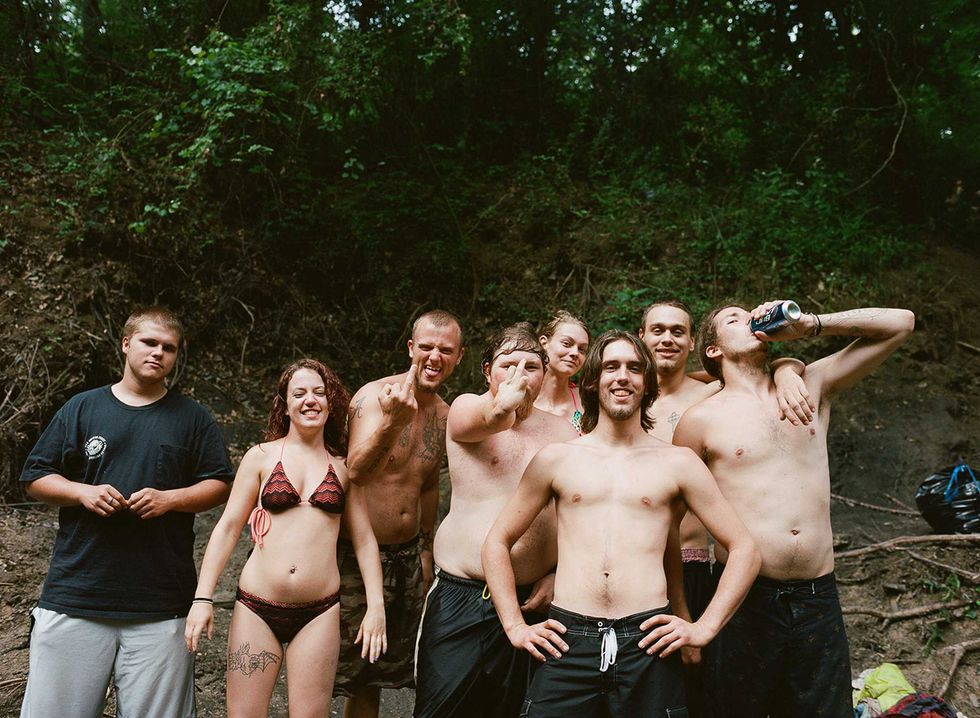 A swimming hole has its own social register. Admission requires knowing where it is.Wes Fraser
BAP and Dreher’s prescriptions couldn’t be more opposed, but they see the same problem. However, they’ve been looking to the Bronze Age when they should have been looking at the county fair.
America already has a strong subculture of vitalists. We call them rednecks. BAP and Dreher probably wouldn’t be caught dead partying with them, but if you’ve ever had a wedding called off because you got drunk and danced naked at a party, you might be one.
What exactly is a redneck? You know one when you see one, but forming a precise definition is surprisingly tricky. The term originated as a derogatory term used by 19th-century Southern aristocrats to describe working-class whites, who had red necks from working in the sun. Comedian Jeff Foxworthy, who rose to fame in the 1990s from his “you might be a redneck” stand-up routine, defined a redneck as someone with a “glorious lack of sophistication.”
But there are plenty of unsophisticated people who aren’t rednecks. And there is more to being a redneck than merely being white and working-class. There are black rednecks, and working-class whites who are decidedly not redneck. Nor are rednecks necessarily Southern; you can find plenty in California, Michigan, New York, and all over the world—the 2010 documentary Happy People follows remote Russian trappers who can only be described as rednecks. Nor are rednecks necessarily poor. The recently departed Ted Turner was one of the richest men in the world, and happily embraced his many critics calling him a redneck.
Rednecks are less an ethnicity and more an embodiment of an ethos. Perhaps the most distinctive trait is that a redneck has an equal appreciation for both nature and machine. The modern world’s stance on nature seems to fall into one of two camps: The impulse to preserve it from all human activity versus the technocratic impulse to pave over it. The redneck strikes a middle path: Nature isn’t a museum to be preserved but something to be tamed and enjoyed.
The redneck appreciates both the tree and the chainsaw. He marvels at the majesty of a 12-point buck before shooting and gutting it. He loves the forest, even more so when he’s tearing through it in an off-road vehicle. As Jeff Foxworthy put it, “Peace and quiet sounds a lot like a diesel engine.”
Rednecks love the outdoors, and for that reason they actually spend time in it. And because they spend time in it, they don’t romanticize it. Trees are great . . . until they fall on your house, so you’d better cut them down before they do. Camping is great, cheap fun, even more so with a hardshell camper with air conditioning. And of course, you need a big truck to haul the thing. Spend any time with raccoons, and you soon realize they aren’t cute “trash pandas”—they’re evil, vindictive little monsters that will do unspeakable things to livestock. Briars will rip up your skin and your clothes, but a squirt of triclopyr will make them disappear fast.
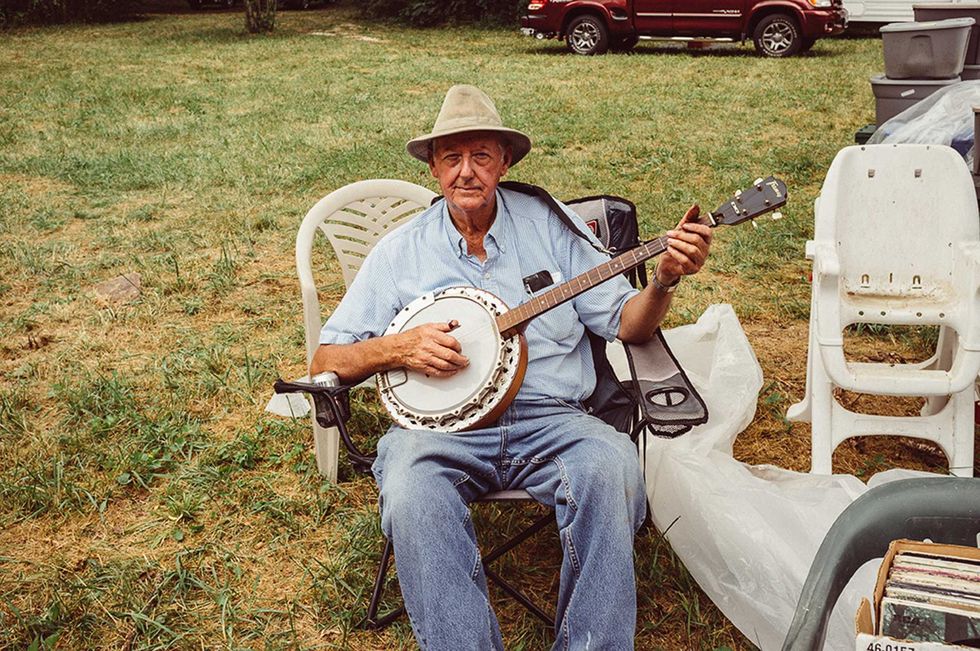 One banjo, one folding chair, and no shortage of material.Wes Fraser
Rednecks love their stuff, but they’re not overly attached to it, which is why you might see one cheering on a tornado that destroys everything he’s ever worked for or laughing when his new ATV sinks into a mud pit. The stuff rednecks love—bows, campers, fishing poles, guns, off-road vehicles, pickup trucks, tractors, zip lines, and anything Yeti makes—isn’t just pointless status symbols like a Rolex watch, but gateways to adventure and family memories.
That’s why if you ever drive through the South, you might be puzzled to see a rusty, single-wide trailer with a brand-new $80,000 truck in the driveway. The trailer does its job just fine, and like Hippocleides, the redneck has no one to impress.
Sure, rednecks can be as prone to status games as anyone and, as the song goes, you do see the occasional Rolex on a redneck’s wrist. But redneck tastes don’t tend to change, even when they get rich. One rich redneck I know, who made a fortune in septic tanks, still drinks cheap beer despite dropping $100,000 cash on an RV. I know another rich redneck whose most prized possession is a wall of hatchets and axes hanging in his shed.
And that remains true because rednecks are ultimately men and women of action. Rednecks have little patience for paper credentials or complex theories if you can’t do anything with them. Your fancy Sitka camo doesn’t mean jack if you can’t put meat in the freezer. A doctorate in electrical engineering is worthless if you can’t wire a shed. Rednecks don’t care how much your boots cost if they don’t have a little mud on them.
Rednecks embrace the saying, “If it’s stupid and it works, it ain’t stupid.” Because rednecks emphasize action over theory, this often leads to comical resourcefulness. Scroll Jeff Foxworthy’s Facebook page, and you’ll see endless examples of redneck ingenuity. Old cars transformed into hunting stands. Dead push mowers converted into mobile fire pits. I’ve seen more than one car with a window air conditioner hanging out the back window. I had a truck window that kept falling into the door. A buddy helped me open the door panel and then gorilla-taped the window into its mechanism. Hasn’t had a problem since. Another time, I was leaving a friend’s place, and a creek crossed what served as their driveway. A rock caught my car’s bumper and ripped it off. A few zip ties later, it was as good as new. As Larry the Cable Guy said, “Get ‘er done!”
A recent viral tweet proclaimed, “A retard in motion is always better than a genius at rest,” and rednecks perfectly embrace that philosophy too. You can laugh at these examples, but it takes a certain sort of genius to solve problems with the scraps lying around a barn. Likewise, rednecks are often geniuses with mechanical and electrical projects. A buddy of mine rebuilt a Mustang from an empty shell into a working car.
And their talents don’t necessarily stop at the workshop door. A friend’s father was a mechanic by trade and wore overalls every day of his life. But he also held a master’s degree in English. After he died, it turned out he had left behind reams of poetry written over the years.
Don’t confuse a lack of pretension with stupidity. If you do, you may be a victim of a decades-old propaganda campaign to paint rural people as stupid—one exemplified by the “rural purge” of the late 1960s and 1970s, when CBS canceled a slew of highly successful shows aimed at rural audiences.
 The resiliency and ingenuity of Southern Americans is a thing of beauty.Wes Fraser
I recently met actor Nick Searcy, of Justified fame, who recounted an encounter with a director who asked him to drop his Southern accent because it made him sound stupid. The North Carolina native extracted a sheepish apology when he explained that it was his real accent. Speaking of Justified, Walton Goggins agreed to appear on the show only if his Southern character was portrayed as the smartest man in the room.
But just as rednecks don’t overly romanticize nature, I don’t want to overly romanticize redneck culture. We do plenty of stupid things and have our share of stupid problems. Drugs and deaths of despair are rampant, largely because the factory and manual labor jobs we excel at have been offshored to cheaper countries. We can be overly impulsive and unnecessarily violent. Many redneck households have led the charge on the dissolution of the family, with some redneck women having children by multiple men in order to maximize child-support payments. Vice President JD Vance laid all of this out in his bestselling memoir, Hillbilly Elegy.
Nietzsche contrasted the spirit of the Greek god Apollo with Dionysus. Apollo represented form, order, and restraint. Dionysus, the god of wine, represented a sort of free-spirited madness. A version of the Apollonian spirit dominates modern managerial society. We measure, insure, regulate, and optimize. Things are safe, but little progress is made. Risk is not tolerated. On paper, things work well, but we are effectively dead inside.
An overly Apollonian culture such as ours leads to spiritual death, as depicted in movies like Office Space and Fight Club, whose protagonists drown in misery despite being comfortable and successful. Already apparent in the late 1990s, this malaise has only accelerated today amid falling marriage and birth rates, and many young men opting out of society altogether. What these two very different movies correctly concluded is that life without a touch of Dionysus isn’t worth living. Sometimes, it’s good to shovel some dirt or to take a punch to the face.
While too much of the Apollonian leads to a quiet, pitiful death of the spirit, an overdose of the Dionysian contributes to an equally tragic fate. Perhaps the best redneck example of Dionysus running amok is the infamous White family of West Virginia, portrayed in the documentaries The Dancing Outlaw and The Wild and Wonderful Whites of West Virginia.
To understand the Whites is to understand the economics of West Virginia and also to understand our nation’s current malaise. In many ways, West Virginia more resembles an African country than an American state because of the way out-of-state mining companies have profited from its rich coal reserves while many West Virginians live in crushing poverty. Miners wreck their bodies for meager pay while the owners make enormous profits.
 Dixie Forever.Wes Fraser
Those sorts of fatalist economics have resulted in a sort of Dionysian spirit among families like the Whites. If your only real economic opportunity means dying in a mine or dying a slow death above ground from black lung, then why not take the bull by the horns? In economic terms, this leads to a high time preference: Living for today because tomorrow might not come.
D. Ray White, the family patriarch, wanted to save his children from this fate, so he studied the welfare system to maximize benefits for his family or, as they call them, “crazy checks,” supplemented by drug dealing and other cash businesses. D. Ray might have saved his children from the mines, but he didn’t save them from an overabundance of Dionysian fatalism. D. Ray himself was killed in a 1985 shootout. Many of his descendants have suffered equally tragic fates and long jail sentences.
Perhaps no scene better captures the Whites’ Dionysian excesses than Bertie Mae’s birthday party in The Wild and Wonderful Whites of West Virginia. D. Ray’s widow looks on in horror as her descendants do drugs and dance naked. Hippocleides doesn’t care, and neither does Jesco White.
Of course, self-respecting West Virginians cringe at the mention of the Whites, who serve as a reminder of the excesses of the Dionysian spirit. At their best, rednecks perfectly balance the Apollonian with the Dionysian. The same man can be framing a house on Friday, drunkenly jumping into a lake on Saturday, and sitting in a pew on Sunday.
Religion in most of its forms offers society a healthy dose of Apollonian order, tempering Dionysian madness, something that the New Atheists of the 2000s failed to realize. But again, all things must be in balance. For the church to serve its role as a containing force, there must be something to contain in the first place.
Nietzsche had disdain for Christian ascetics, but the ascetics are practically the opposite of the Last Man, willingly enduring struggle for a higher cause. And when considering the stylites, a particular sort of ascetics who would spend many years on top of a pillar, one can’t help but picture a hunter sitting for hours in a deer stand on a crisp, fall morning.
Vitalism and Christian faith are not opposed but complementary. To have the courage to take bold action, foolish or not, you have to have faith that things will ultimately work out somehow. It was Stonewall Jackson who best exemplified redneck bravado when he wrote, “My religious beliefs teach me to feel as safe in battle as in bed. God has fixed the time of my death. I do not concern myself with that, but to be always ready whenever it may overtake me. That is the way all men should live, and all men would be equally brave.”
That same faith-based courage has inspired generations of rednecks to fight for America, whether in Germany, the Pacific Islands, Korea, Vietnam, or Afghanistan. It can also quickly morph into bravado and lead to moments of “Hold my beer, watch this!” But for religion to act as a containing force, it must have something to contain in the first place; otherwise, it’s merely an empty shell, a hearth without a flame.
So where has that spark gone?
The reason we have lost the fire that must be contained is that we take ourselves too seriously. In our modern pride, we think that if we can monitor, measure, and enforce, we can prevent every bad outcome.
As Thomas Sowell said, “There are no solutions, only trade-offs.” We’ve become so obsessed with safety and efficiency that American life is becoming increasingly intolerable. And we do so because we live in fear, not faith, and because we have enough hubris to believe that we can and should control every outcome. Every risk becomes something to stamp out, even as we stamp out everything that makes life worth living.
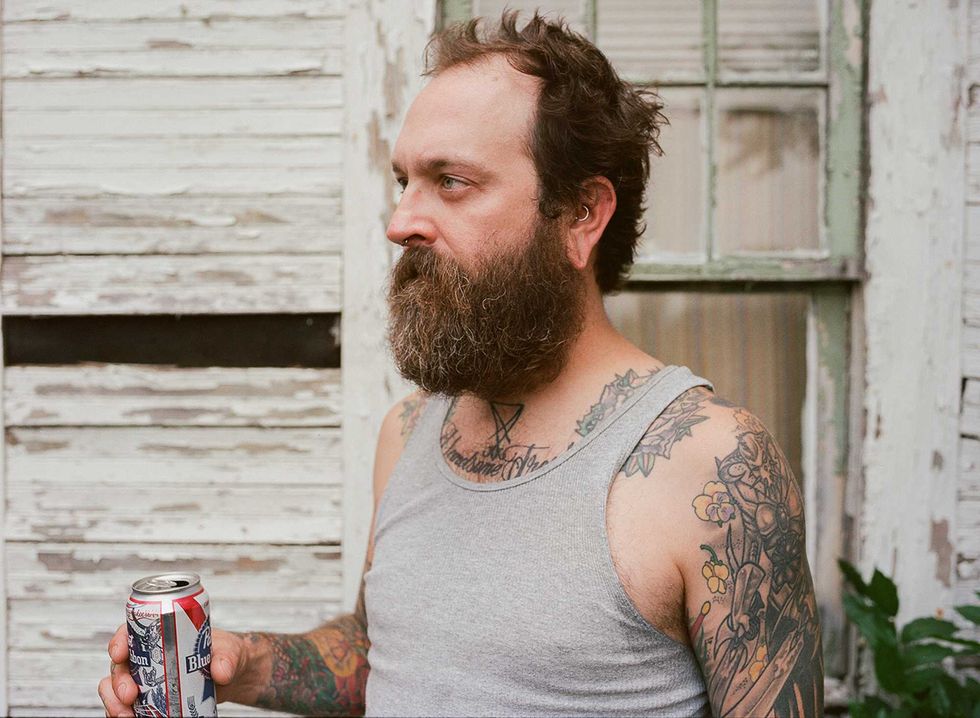 A cold PBR on a summer afternoon is always a good call.Wes Fraser
Perhaps the key to rediscovering America’s vitalist spark is to embrace the most Christian of virtues: humility. To embrace the notion that we won’t live forever or even be young for all that long. To understand that if a tornado is coming, there’s not much you can do but hunker down, cheer it on, and get ready to clean up the mess.
And if we, as a country, truly want to clean up our messes, that’s going to mean that the managerial class is going to have to swallow some of that humility and get out of the way of the people who actually get stuff done, even if it’s messy and imperfect, with an understanding that life itself is messy and tomorrow is not guaranteed. That attitude can seem fatalistic, but it’s what built this country in the first place.
Even if we can’t turn things around as fast as we would like, we can at least learn to be happy despite the rough edges. Some of the happiest kids you’ll ever see are playing in a kiddie pool outside a trailer. We can learn to stop being so miserable even if things aren’t as good as they should be. Enjoy today for what it is and care less about what the neighbors think. Rip across that field, jump in that mud puddle, sit in a cold kiddie pool on a hot day. Step away from the computer and wander into the woods. Don’t do anything too stupid and throw away tomorrow, but live for today.
Or, as Jeff Foxworthy might put it, embrace “a glorious lack of sophistication.”