Grae Stafford
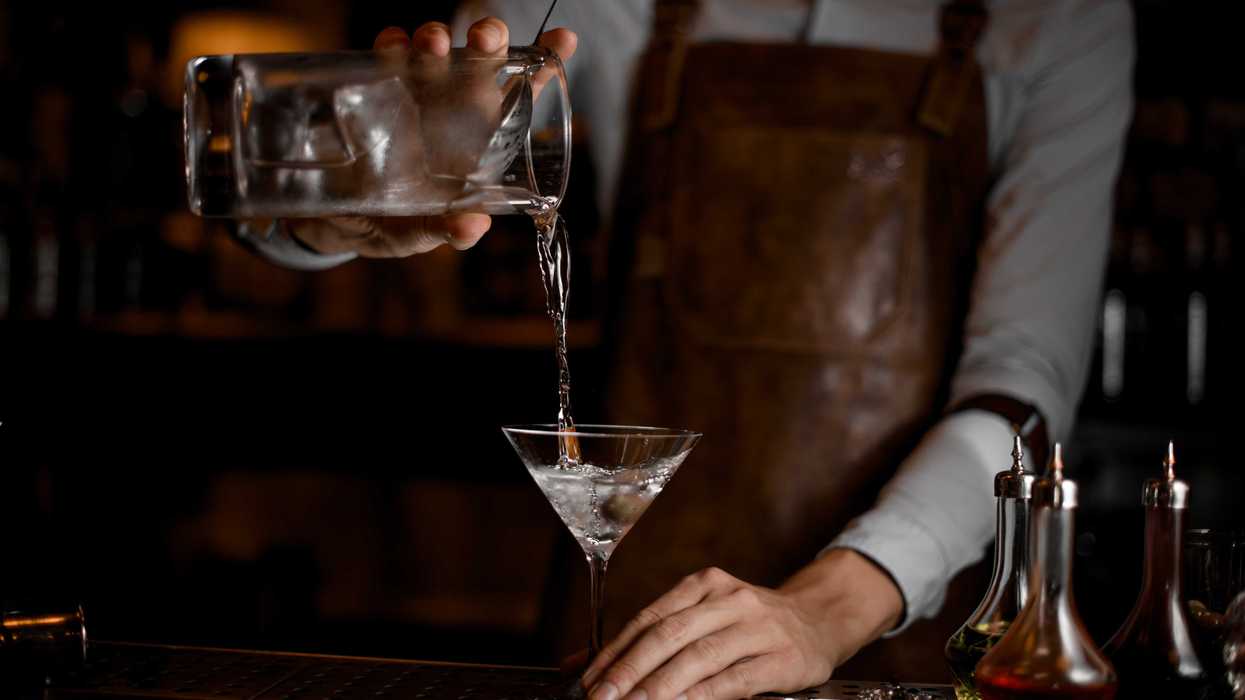
Il Salviatino is a stunning villa built on the hills overlooking Florence around the time that northerner Cristoforo Colombo was charting his first trip to the Americas. Today, it’s a hotel, and the bartender, if you can find him, makes a beautiful Gibson martini complete with house onions.
It’s nearly impossible to find a good martini in Italy, and the job’s made harder by the difficulty of finding a hotel staffer when you’d like one; Italians tend to nap around the time Anglos tend to get thirsty. After I enlisted a housekeeper and then rejected his ruby-colored, sweet-vermouth attempt, he let me behind the bar to make my own. It was a heavy pour, and now, drink in hand, I was free to turn my attention to the ancient city spread below. My true mission that evening hadn’t even begun. I was searching for the world-famous bistecca alla Fiorentina.
There are probably many places to find a beautiful Florentine steak, three fingers thick, cooked in olive oil and its own fat until a simple, salted crust forms, the filet and sirloin sliced at your table while the plate sizzles, brushed with fresh rosemary. Acqua al 2, the great DC and Annapolis restaurant, has its primo location on a narrow stone street just a few blocks from the Cathedral de Santa Maria del Fiore, but I was feeling adventurous. This was ill-advised.
Our first attempts brought no cheer. They were booked solid. Tired after a solid week of walking, we settled for a dark entrance to a “steak house” where the black-suited doorman behind a velvet rope both promised us a table and foreshadowed what we were about to endure. Inside, barely dressed women and over-perfumed men yelled over pulsing club music, and the expensive menu touted cuts from the U.S. alongside overpriced wines. This simply wouldn’t do. Our waitress was angry with this decision, my wife was hungry (and a little embarrassed), and I was buzzed but still determined to enjoy Italy’s storied bistecca.
And so we walked until we found a brightly lit, open-windowed place. They served cheap pastas, affordable wines, and steak—Florentine-style. Old-time country music from men like Hank Williams Sr. and Marty Robbins played on the radio. The beef was raised on American ranches.
I remember the story, the honkytonk music, those eclectic pictures and old guitars hanging from the walls, as well as having this very American realization: When it comes to steak, nothing beats home. That’s unsurprising, I suppose. Even the word “bistecca” is just a local play on “beefsteak.”
That doesn’t mean the old ways are always appreciated in their homeland. On a summer train ride up the Eastern Seaboard, I was warned it had been a tough decade for the iconic Peter Luger’s. They’d lost their Michelin star in 2022. Three years earlier, they’d been the target of a New York Times review so bitter it could only have been written by a lover scorned. “COTE is what all the Wall Street bros say is the best in New York,” a friend advised, pointing me toward a chic Korean steakhouse in Manhattan over the 19th-century Brooklyn institution I was barreling toward.
But no, sir. I’d be crossing that rusty, old bridge, parting the musky, overweight sea of haughty Hasids and homosexual hipsters who give modern Williamsburg its distinctive character, and walking into the busy bar that serves as both the restaurant’s vestibule and a more casual setting for those who hadn’t waited eight days for a dinner reservation later than 4:15 but earlier than 9:15.
 Murray's
The Teutonic tastes of the German immigrants who once dominated this neighborhood still reign at Luger’s. The floor, chairs, tables, and walls are similar shades of dark wood, brightly lit by simple, golden chandeliers. Waiters in black bowties and white aprons hustle about, and the dining room is not much quieter than the bar. At Peter Luger’s, waiting tables is a career, not a summer job. Cold martinis arrive on the table just minutes after they’re ordered, and after the appetizers (tomatoes and onions in house dressing, thick-cut bacon) and sides (creamed spinach and smashed German potatoes), the menu remains spartan: two types of fish, lamb, or steak for one, two, three, or four. Porterhouse. Prime.
The meal is delicious and exactly what we’re looking for: a men’s night out with good laughs, classic dining, a glass of brandy, then a cigar next door to close out a memory. We even take a selfie to let our wives know their men are safe and headed home (after a quick pint).
You won’t ever find me waiting in line for the new “it” chef, sampling the latest French-Polynesian street-food venture, or eating anywhere with “fusion” in its description. My interest in Michelin stars begins and ends with watching Chef’s Table. My favorite cocktail bars specialize in cold martinis and whiskey, neat, and if a country’s food has been introduced since Ellis Island closed up shop, I’m more than likely to decline.
Perhaps that explains why I’m so in love with the American steakhouse. And not just any place that sells prime steak and proper cocktails at a premium, but the real ones; those dark and hallowed rooms with heavy curtains, leather chairs, mahogany, and history. They do not need to be the fanciest; they need to have character. They need to capture a time before social media numbed our tastes and flattened our culture down into 10-second clips—and before that new valley-girl-meets-Compton accent replaced our regional dialects.
When it comes to steak, nothing beats home.
These are the places your family may have celebrated holidays or even birthdays with great-grandparents. They’re where men have gathered with their friends for decades to lay plans, make deals, celebrate wins, or just catch up over a boozy lunch. The walls sometimes bear the faces of regulars still on top of their game, alongside those who’ve permanently left the restaurant doors for the next life.
An old chophouse isn’t just a restaurant; it’s an anchor to a time when Americans shared a distinctly American reality. They are to us what the bistro is to the French, the pub to the English. They are distinctly American places, filled with new faces and old, and stand in opposition to the placelessness of global modernity. They are something real you can grasp, and cannot easily replace. Outside Peter Luger’s, Keen’s, or Murray’s doors, the world has changed beyond recognition. Inside, it remains solid and familiar, even foundational. There is no final gasp of Americana here.
 Murray's has been an icon for decades, for good reason. Murray's
These are islands of heritage, and though they are in every city, they are too swiftly passed over for the latest in Nepalese tapas and cocktails you read about on some blog.
Fifteen years of traveling for work comes with its share of downsides, but the cities that don’t top the family destination list are often the best places to find an old-fashioned, wood-paneled American steakhouse with overstuffed leather seats.
Every city you’d recognize has one. There’s the 801 Chophouse beneath the glistening 801 Grand tower in Des Moines. A few miles east of downtown Columbus, in a thoroughly residential neighborhood, there’s The Top, where 1950s illustrations still decorate the menu. It’s so dark you can barely see your company. Just the way it ought to be.
Is it a cold night in Manchester, New Hampshire? You can find a seat at the bar at the Hanover Street Chophouse, where I first met then-New York real-estate magnate Donald J. Trump. He was the only politician not afraid to be seen at a steakhouse, and he posed for pictures with two young boys in their navy, gold-buttoned blazers before regaling our table with feigned concern for then-Senator Marco Rubio, who had malfunctioned on stage during the evening’s debate. The future president ordered his steak well-done within earshot of a British war correspondent, who asked us if this tidbit was newsworthy. We assured her it was worth a laugh. It was worldwide news within a day.
The Rust Belt of northern, post-industrial cities is a daisy chain of classic steakhouse tradition. Detroit’s London Chop House, a true underground gem, has served as an escape from the Motor City streets for 90 years. Murray’s red neon sign declaring them “the home of the silver butter knife steak” was a welcome respite even amidst the chaotic streets of 2020 Minneapolis. Get the French onion soup before sharing their 28-ounce sirloin with a side of au gratin.
Further west in Pierre, South Dakota, five minutes from the Missouri River, is Mad Mary’s Steakhouse and Saloon. Local rancher Mary Etzkorn started it after a contentious divorce from the late owner of the nearby Cattleman’s Club. “You can come in a tuxedo, or you can come right out of the field, and everybody feels comfortable,” Etzkorn told me when I last visited in 2020. Her mother, Mary Lou, was in the kitchen, and her daughter, Ashlee, was at the hostess stand.
Cambridge, Massachusetts, has Frankie’s—a local establishment my family has visited after Catholic wakes my whole life, as well as my late papa’s favorite, Brighton’s Stockyard. Massachusetts is even home to the faded suburban classic Ken’s Steak House, where, I recall from my days as a youth, the bartenders slung many Grasshoppers and Harvey Wallbangers for their ancient regulars.
Take the train south from Massachusetts to Grand Central, walk a few blocks, and you’ll spy the hunter-green trim of the original Smith & Wollensky, where the late night grill serves the best steakhouse burger you can find. Head toward the Empire State Building and make a stop at Keen’s. Founded in 1885, two years before Peter Luger’s, its most famous dish isn’t steak at all, but the mutton chop—it’s worth every penny.
Outside Peter Luger’s doors, the world has changed beyond recognition. Inside, it remains solid and familiar, even foundational.
When my friend asked the standup bass player at Washington, D.C.’s Prime Rib if he knew any Sinatra, the fellow chuckled and played a few songs, only sharing later that he’d been hired by Ol’ Blue Eyes himself after the star had heard him play with the White House Marine Corps band. Its Washington location sadly closed this year; it was one of the last restaurants in the city that would provide a jacket if a gentleman somehow forgot his—a requirement sorely needed today.
If you’re looking to get a little rowdier at lunch, The Palm is a Washington institution, where you’ll be as likely to bump into an old Virginia governor as Roger Stone, Scooter Libby, or the boys of the Bullshot Club. The Daily Caller was founded at one of its tables.
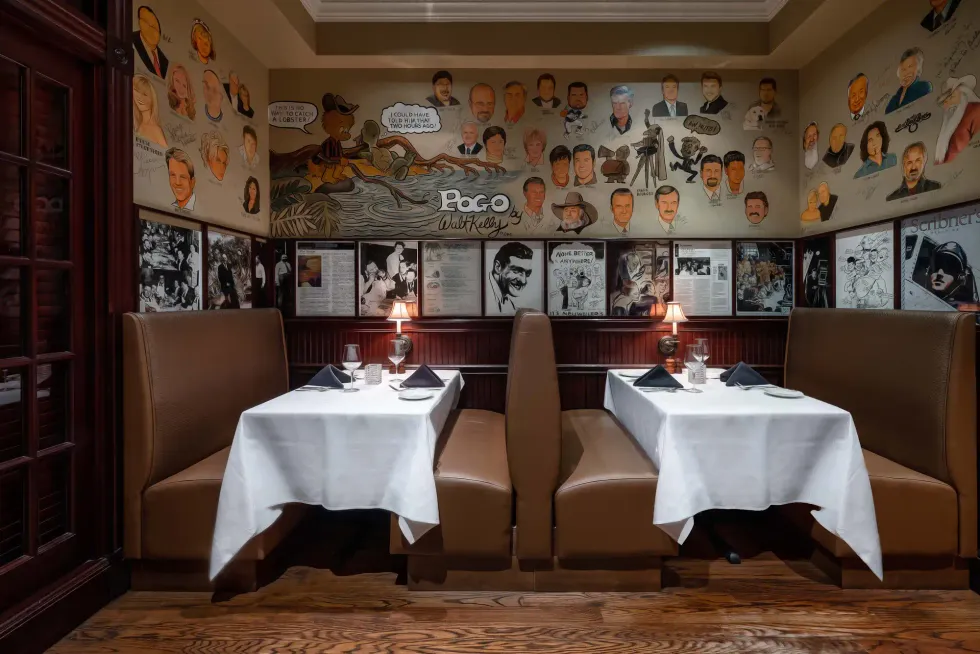 To its credit, The Palm eschews modern sensibilities.The Palm
In Florida, Miami’s Joe’s Stone Crab bills itself as a seafood restaurant, but it is also one of the finest old-time steakhouses in the country. On the Gulf of America, you cannot skip Tampa’s Bern’s Steak House, an icon that hosts a cavernous wine cellar and an entire floor dedicated to the dessert course. Get the apple pie.
And in between and out west, you’ll find Nashville’s Sperry’s Restaurant, where country stars have dined for 50 years, Charleston’s Hall’s Chophouse, Annapolis’s Lewnes’ Steakhouse, and Dallas’s Pappas Bros. and Bob’s Steak & Chop House.
It’s hardly an exhaustive list. My travels have yet to take me to the Buckhorn Exchange in Denver or Pat’s of Louisville, to Mary’s Tiny Cove in Cincinnati, the Golden Ox in Kansas City, Bavette’s Bar & Boeuf in Chicago, or the venerable St. Elmo’s of Indianapolis. Before I join the century of regulars who’ve passed on, I hope I’ll darken their doorways.
The poncy internationalists from Michelin don’t even publish a guide on most of these cities. Los Angeles’ 10-year-old Gwen held one star in 2025, and Peter Luger’s held its own until 2022, but no true American steakhouses retain their praise. That, it seems, is reserved for restaurants the guide describes as “vegetarian,” “contemporary,” Japanese, Colombian, Peruvian, Middle Eastern, Indian, or what have you.
The critics prefer fads over classics, fashion over institution, modernity over tradition. Bucking the trend they work overtime to establish is what brings us back for steakhouse mushrooms, creamed spinach, mashed potatoes, thick onion rings, oysters on the half, firm shrimp in a spicy cocktail sauce, towers of seafood, bone marrow, au poivre, blue cheese crumble, or a simple steakhouse butter. These are proper dinner rituals. And we need them now.
You’ll find a careful adherence to ritual on American cattle ranches, where it all begins. While the American West lives strong in our imaginations, some of the top beef in this country is raised right in the scenic hills of Maryland’s horse country, just between the Elkridge-Harford and Greenspring Valley Hounds fox hunting clubs. The farm is 60 miles north of D.C., and just 20 miles north of Baltimore, but by the time you cross the one-lane, 140-year-old truss bridge over Gunpowder Falls, round the corner, and see the black fences of Roseda Farms, you might as well be on a different planet.
Edward A. Burchell Jr. met us at the door of the farm store when we pulled in, late from two cities’ rush-hour traffic jams, just as the sun began to set. A heavy storm had just passed; the pastures were peaceful again, and the cows grazed contentedly beneath a rainbow. Ed’s father, Edward A. Burchell Sr., had started Roseda 30 years earlier, naming it after himself and his wife, Rosemary.
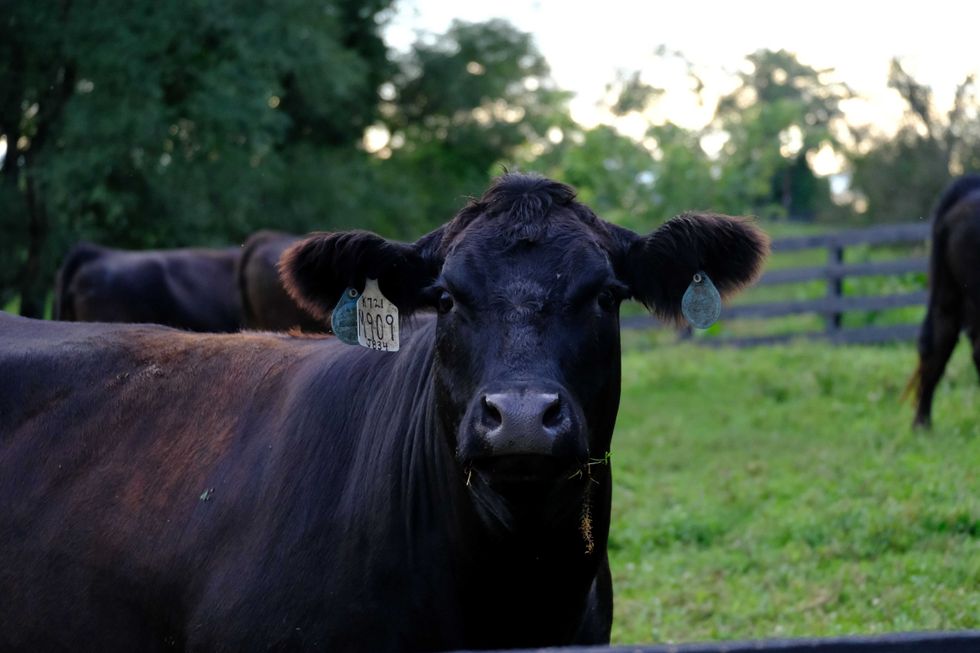 Great steak comes from happy cows.Grae Stafford
In the early 1990s, Edward Sr. had already sold his company. In his semi-retirement, he met a man named Dean Bryant on the Eastern Shore. Bryant had his master’s degree in animal science from Purdue University and had been recruited to run the Black Angus herd for the University of Maryland’s famous research institute.
Ed’s proposition to Bryant sounds simple enough, if overlooked by too many: “Can we produce genetics that would make beef more consistent, tender, and juicy?” It turns out you can, Bryant explained, “because the Black Angus herd has the deepest data on carcass characteristic traits that you can manage.” In other words, if you focus on factors such as marbling, carcass age at harvest, and corn-feeding practices, and then breed accordingly, you can improve the genetics of the herd.
What started out as a hobby and dinner packages for friends and family slowly, quietly became the largest producer of local beef in Maryland—and a top producer for the mid-Atlantic, with cow-calf operations and feeder operations in southern Pennsylvania, Maryland, and Virginia. In this area, you can find Roseda Farms at the local butcher and Wagshal’s, as well as at fine-dining restaurants or the burger menu at the comedy club on the highway.
“One of our proof positives is we’re two-times the industry average on kosher, and we’re five times the industry average on prime,” Ed Jr. proudly tells me. Then, at the harvesting plant, they dry-age the entire carcass—even those cuts that go into their burgers and hot dogs.
COVID is just the kind of thing that would have sunk an operation like Roseda, if not for a deal Ed Sr. had made nine years prior with his partner, Bill Ruppersberger, a fifth-generation family processor out of Baltimore City. That ability to control the herd from before birth through processing is rare in American cattle, and it was made easier for ranchers this year by President Trump.
In 2020, when restaurants and schools shut down, farmers and ranchers who relied on the steady clip of business suffered greatly. The machinery of whole processing plants was designed around wholesale orders. Millions of animals were culled, and families and businesses were crushed. Old Line Custom Meat Company’s rare farm-to-retail operation gave them the systems and adaptability they needed to survive rapidly shifting market trends.
There is no final gasp of Americana here.
“When most people first look at it, they’re very underwhelmed because it’s small,” Ed Jr. says of the one-story market Dean’s wife, Marcia Bryant, runs from the property. “We have four full cases. We have a freezer. And last year,” he adds, his voice swelling with pride, “that store did $2 million in sales.”
“It’s like a train. Roseda Farms is the engine. All the genetics start here, the intellectual capital is here, our bulls are here, our purebred herd is here. Roseda partnered with 30 to 35 cow-calf operations and feeder operations in southern Pennsylvania, Maryland, and Virginia. When it’s time to harvest, those cooperative farms are like the cars on a train connecting the engine to the caboose, which is Old Line Custom Meat Company—the harvest and processing plants in Baltimore City.”
That kind of operation takes decades to build. And thank God they did it, because for my money, Roseda Farms raises the best steak a man can cook. And you can order your cuts any way you like.
This farm is a welcome respite from the factory farming we’ve grown accustomed to. Here the quality of the meat will always be paramount, and the difference is clear as soon as you take a bite.
And cooking steak at home is even more essential than enjoying it on the town. That’s how a father nourishes his family and raises his children to love the things he loves. It can seem daunting without a 1,000-degree broiler and a fancy white coat, but with the right beef, the right equipment, and a little know-how, you can confidently cook a thick-crusted, perfectly seasoned, medium-rare steak as perfectly as the top chef in the country, right in the comfort of your own kitchen.
I know because I learned it over years of trial and error. If you can believe it, I didn’t like steak as a kid. When I was young, it was often cooked the old way—“all the way through”—the way Trump grew up eating it (and still prefers it). That all changed during my senior year of high school, when the Acton Police Department descended on our little backyard grill-out and, unlawfully hammered, I grabbed a cheap cut of New York strip off the grill before hopping in a getaway car. It was the best thing I’d ever tasted, and it was only the next morning when we saw the back seat covered in blood that we realized why it was so damn good. It was rare. Very rare.
Since then, I’ve spent years studying the craft, changing my recipes and methods over and over again, and trying everything shy of a sous vide (cooking beef in water is effeminate). My father and I have poured years of research into the best cuts and methods. I’ve settled on medium-rare as the perfect crowd-pleaser for most cuts.
But it was my haphazard quest for that proper Florentine steak that convinced me there is a way to do it at home as well as any steakhouse I’ve ever visited. So let me tell you.
First, what you need:
A thick cut of bone-in, prime, dry-aged beef, three fingers thick. We’re not doing individual servings here; we’re serving family-style. Without 1,000-degree broilers, this is necessary to attain a crust as thick as the professionals without overcooking the beef. And no child or guest will ever complain about a beautiful cutting board presenting proper, sliced, and seasoned steak at the center of the table. When you order your cut, you’ll want to aim for half a pound per person. Leftovers are great in omelets or sandwiches, but there will rarely be any.
A cast-iron pan big enough to hold the whole cut in any position you put it. Keep the pan well-seasoned. If yours is beat up, the internet can walk you through fixing it in an hour or less with just a little effort.
Your stove. Gas is vastly preferable to electric, but either can work in a pinch. Red meat, whether steak or burger, should not be cooked on a grill. Those ugly flare-ups in the bed of the grill are your meat’s flavor going up in flames and singeing your meal. That fat is your meat’s best friend. Keep it close.
A proper thermometer. I use ThermoPro because they’ll replace your prongs when they inevitably fail from heat, no questions asked.
Tongs, salt, fresh rosemary, and some beef or bacon fat.
Your first step is to salt the steak. You don’t need big fancy rocks at this stage; little crystals are best. You can be generous. We’re curing the meat. It will take a while. Some men go overnight, but two hours is fine. While it’s dry-brining, keep it on a wire rack in your refrigerator.
Next, bring your beef down to room temperature. Good meat should be cooked starting from this temperature. With a two-to three pound steak, give it an hour to thaw.
When you’re ready to go, turn the gas on the cast iron. Go low on the heat: It’s fire—the pan will get plenty hot. Now wait six minutes. You shouldn’t so much as cook an egg on cast iron until it’s been on the flame that long.
Now drop a little beef or bacon fat in there. You don’t need much, because a proper, well-marbled, bone-in cut will bring plenty of its own. Fat beats butter or olive oil in making a crust because it won’t burn, it will only melt, at the temperatures we’re cooking at.
Now, place your steak on its edge in the pan. Use the fatty side. Let it stand there. This is one of the reasons you need a thick piece—the other is that thinner pieces will overcook before you can give them their proper steakhouse crust using home cooking technology. Give it a few minutes. Let the fat crisp, curl, and brown in the crackling heat. Take a video, send it to your friends. Show them how awesome you are.
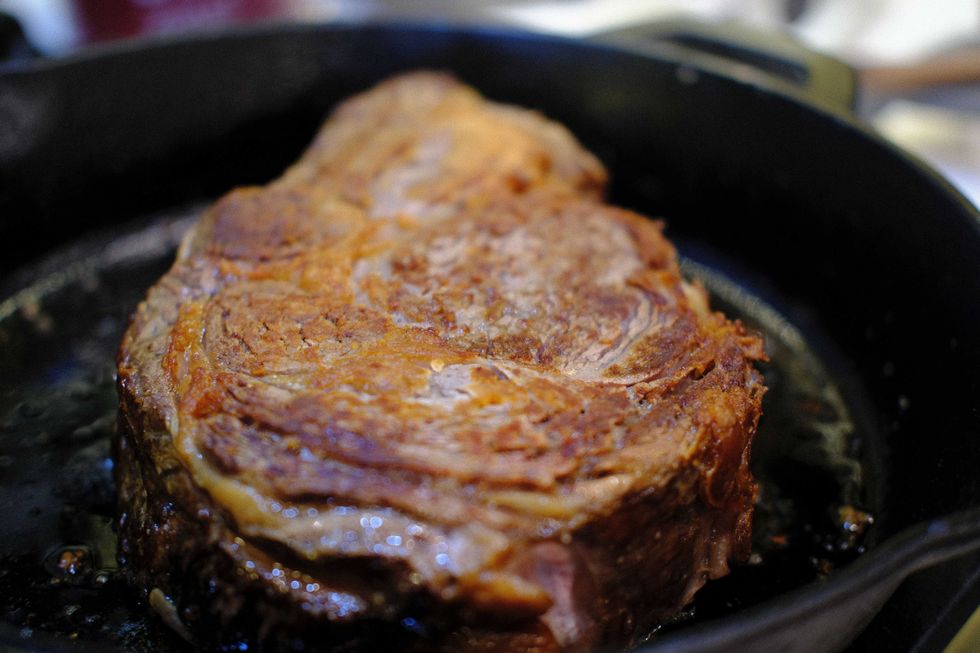 Ribeye sizzling on the cast iron.Grae Stafford
You’ll notice I did not season the steak after taking it from the refrigerator. There’s no need, though you can add some pepper if you like. I don’t until I’m finished, because pepper can burn in the cooking.
After the fat from the side has rendered into the pan, you’re good to go. Cook the steak, flipping every few minutes and not worrying about that old one-flip rule the grill-boys use. That law has no authority here. Every flip, run fresh rosemary through the fat and brush the top and sides of the steak. The sides and bone are easily overlooked but important for presentation. Use the rosemary (or a brush, if you’d prefer) to put sizzling fat on the parts that are harder to cook, tempering the white bone.
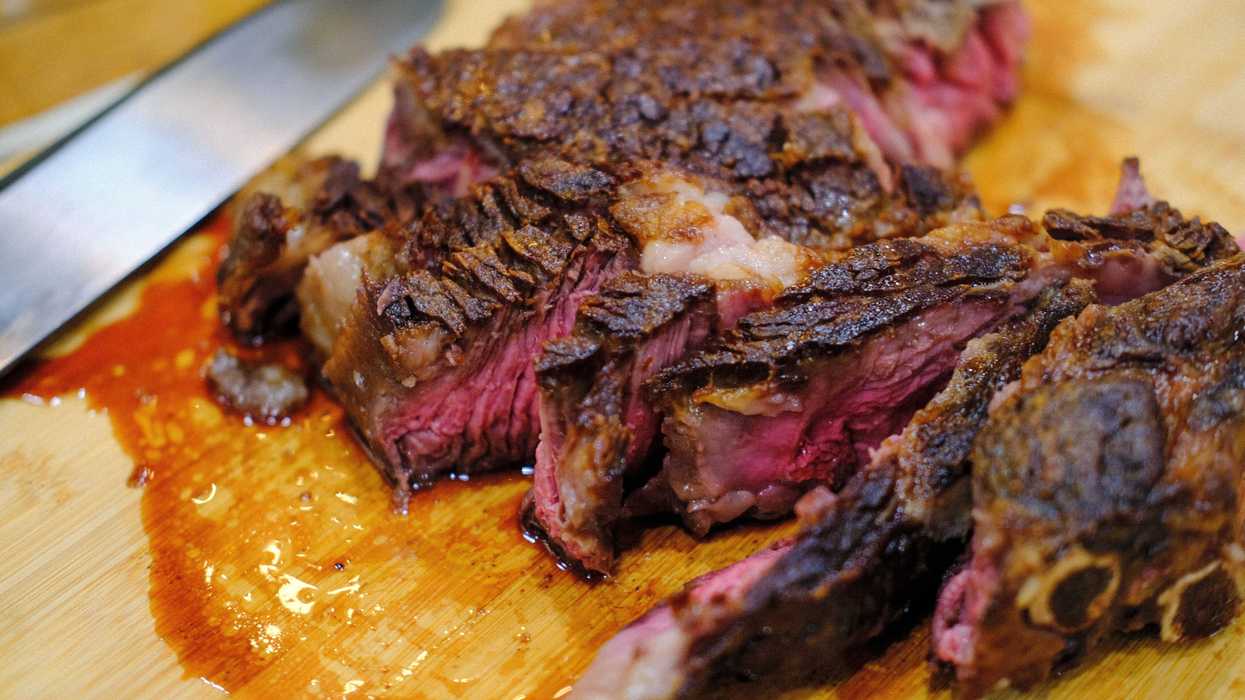
A thick cut might take 30 minutes or more. And here’s where the thermometer is necessary. While a veteran can sometimes tell by feel, you’ll lose that ability with the incredible crust you’re creating. Chart your target carefully. Depending on the crowd, I pull between 115 and 120 degrees at the center. Then, place the steak on the wooden board and let it rest for 10 minutes. Work on the steakhouse sides, pour the wine, talk to your pals—do anything but begin slicing until the meat is fully rested.
Once it is, cut off the bone, and then slice across the grain into cuts your family can have on their plates. Garnish it how you will, sprinkle it with pepper or a little salt, sit back, and wait for the praise.
You brought a three-pound piece of this country and its heritage home—grown by our cattlemen and ranchers, processed in our countryside and cities, delivered in our trucks and along our rails—and you prepared it for your friends and family.
If you serve good wine, light a few candles, put some Glenn Miller Band on the radio, and craft a good cocktail, when your guests take a bite, feel that crunch, and taste that beef, they’ll wonder for a moment why you don’t open a steakhouse of your own.
You can smile at this point. You’re happy they’re enjoying themselves, and the kids are loving the meal, but you’ve learned everything you know from those ancient masters. Theirs is a bone-in American tradition, and we are simple pilgrims, bringing a little piece of that old faith back home.