CFOTO/Getty Images
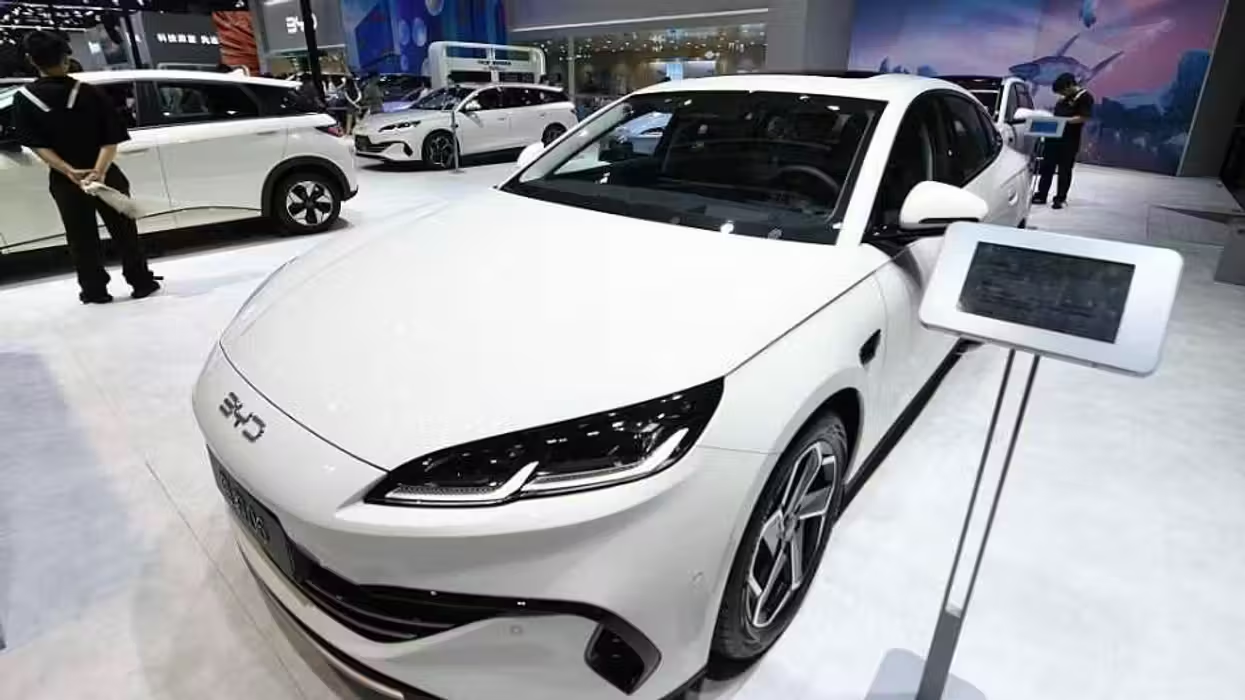
If you've spent any time on YouTube, you've probably seen videos of Chinese electric vehicles loaded with giant touchscreens, premium interiors, advanced driver-assistance systems, and impressive range — all selling overseas for the price of an entry-level compact car.
This week, Washington made sure they're likely to stay that way.
History suggests consumers usually benefit when new competitors arrive.
The official explanation is national security. But that's only part of the story.
On July 15, the Senate Commerce Committee advanced the Connected Vehicle Security Act of 2026, bipartisan legislation introduced by Ohio Republican Sen. Bernie Moreno and Michigan Democrat Sen. Elissa Slotkin. The bill would permanently codify and strengthen Commerce Department restrictions on connected vehicles, software, and hardware from China and other designated foreign adversaries. It doesn't just target cars wearing Chinese badges; it targets the telematics units, cellular modems, GPS modules, and other connected technology that allows modern vehicles to constantly send and receive data.
Supporters argue that's necessary because today's vehicles collect enormous amounts of information, including location data, driving behavior, camera feeds, microphones, and wireless communications. Given China's national security laws, which require companies to cooperate with government intelligence requests, lawmakers say allowing Chinese-connected vehicles onto American roads creates unacceptable risks.
Those concerns deserve to be taken seriously.
But the legislation also blocks what could become the biggest source of price competition the American auto industry has faced in decades.
RELATED: This used-car odometer scam is everywhere — and impossible to detect
 CBS Photo Archive/Getty Images
The average new vehicle now sells for close to record prices. Even compact crossovers routinely exceed $35,000, electric vehicles often cost much more before incentives, financing has become more expensive, insurance premiums continue climbing, and used-car prices remain stubbornly high. Americans can watch BYD, Geely, MG, Chery, XPeng, and other Chinese brands selling well-equipped vehicles overseas for thousands less than comparable models available here — sometimes for nearly half the price — and naturally wonder why they can't buy them.
Washington's answer is national security.
Fair enough — but if protecting Americans' data is the goal, why does the conversation stop with China?
Modern vehicles already collect extraordinary amounts of information about their owners. Domestic automakers know where many vehicles travel, how they're driven, and when they're serviced, while connected-car data has already found its way to insurers and third-party data brokers. Congress appears highly motivated to prevent China from collecting that information, but it has shown far less urgency about limiting who else can.
There's also an economic reality. Keeping Chinese competitors out protects existing manufacturers from the kind of price competition they've largely avoided. Over the past decade, automakers have steadily abandoned affordable entry-level cars in favor of SUVs and pickups with much higher profit margins. Introducing dozens of lower-priced competitors would put pressure on those margins — which is exactly what competition is supposed to do.
History suggests consumers usually benefit when new competitors arrive. Japanese automakers forced Detroit to improve in the 1970s and 1980s, while Korean manufacturers evolved from budget brands into respected global competitors. Better quality, stronger reliability, and lower prices followed. Whether Chinese manufacturers would have had the same effect is now a question Americans may never get to answer.
Even if finished Chinese vehicles never reach U.S. dealerships, much of the global battery supply chain still runs through China. The country dominates battery mineral processing and many of the components used in electric vehicles assembled around the world, including those built in North America. America is trying to reduce its dependence on China while remaining heavily dependent on Chinese manufacturing for some of the industry's most important technologies — a contradiction that won't disappear simply because imported vehicles are banned.
The Connected Vehicle Security Act may ultimately prove to be good national-security policy. But Americans deserve an honest conversation about its economic cost as well.
Restricting Chinese vehicles limits competition, reduces consumer choice, and almost certainly helps keep vehicle prices higher than they otherwise might be. If lawmakers believe those trade-offs are necessary, they should make that case openly, because the people paying the price won't be members of Congress or auto executives.
They'll be the families walking into dealerships wondering why their next vehicle costs thousands more than they expected.
National security matters. Consumers deserve the full picture, including what those protections may cost them every time they shop for a new car.