Meriwether Academy
The 29-year-old educator wants to build a different kind of boys' school, combining classical learning, outdoor survival skills, martial arts, and male mentorship.
We all understand the terrible state of our leftist-run education systems, whose main goal is to turn normal young people into progressive activists.
The good news is that many parents have had enough. Homeschooling is on the rise. Charter schools are booming.
I want the parents of our students to know that this man won’t just teach my son science or literature; he’ll be a role model for my son.
In some cases, brave, intrepid souls are even attempting to build entirely new kinds of schools, from the ground up.
I recently met with one of those brave souls, Warren Steury of Nashville, Tennessee. At age 29, Steury is the founder of Meriwether Academy, a school where “young men have the opportunity to experience a rich and rigorous classical and outdoor education.”
While the school itself is still in the planning stages, Steury has already established himself as a central figure in conservative intellectual circles in Nashville, through his Classic Book Study groups and adult workshops.
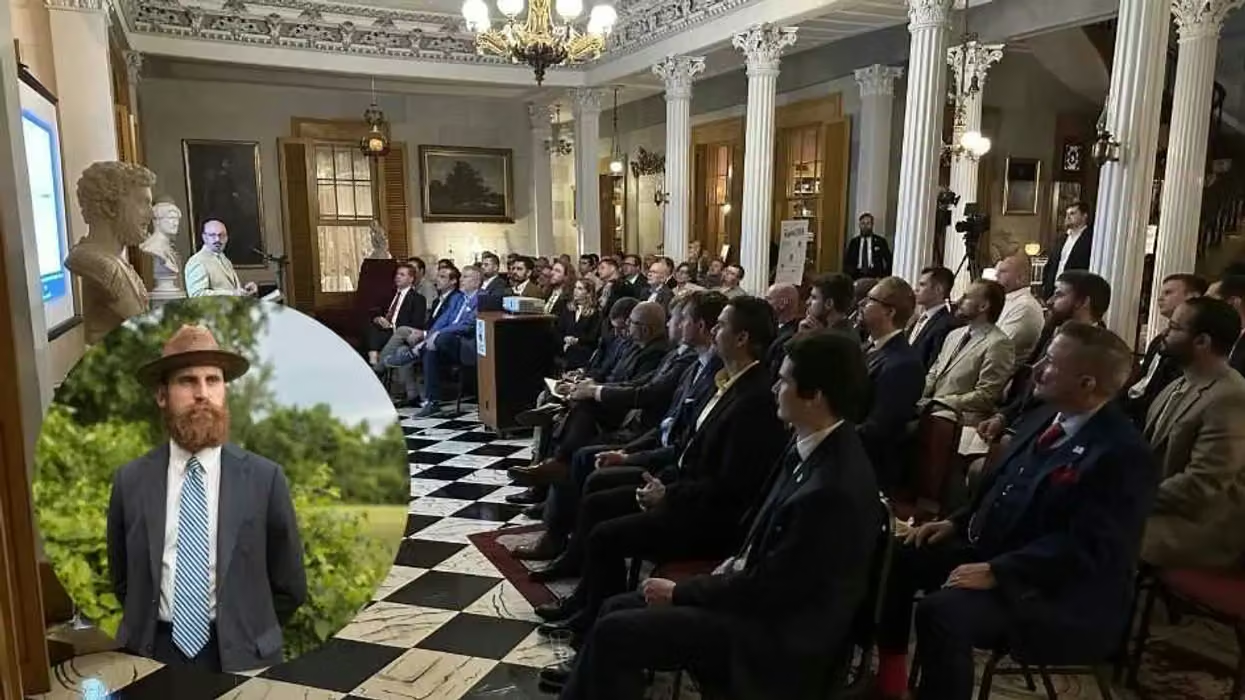
Recently, he was part of a four-man team that brought Peter Thiel to Nashville to present his Antichrist lecture series.
I was able to talk to Steury recently about his views on education, his current projects, and the future of Meriwether Academy.
Blake Nelson: What was your own education like?
Warren Steury: I grew up in North Carolina. I was a public school degenerate. I was doing what most boys do, which was rebelling against all forms of order and discipline.
I was sent to a program in the mountains, against my will, at 16 years old, where I lived out of a backpack for three months. I was making fire with rocks and sticks.
Then I was transferred to a disciplinary boarding school that was also in the mountains of North Carolina, on an old Scout camp. It was a boys’ school. It was the mountain of misfits.
BN: Was that an effective way of dealing with a kid like you?
WS: It was certainly better than me sitting in some fluorescently lit institutional room. My whole reason for building these schools was thinking about what periods of my childhood had the most impact on my character.
I saw that year in the woods, hiking, camping, living in the forest as having an instrumental effect on who I was. All the other years in public school were essentially a blur.
BN: What’s the thought process of creating a new kind of school?
WS: One question I work on answering is: Does this school need to exist, or is there another school that’s offering the same thing that you’re thinking of?
Like what is truly going to distinguish this school from others? My answer is that we have a pretty unique program with the classically inclined education, the heavy outdoor model, and then the martial arts.
BN: Are there other schools that have inspired you?
WS: One of my personal favorites is St. Dunstan Academy in Virginia, which is a very cool new Anglican boys’ school.
They got their hands on 200 acres in the mountains. They’re building the campus from scratch. They just put up their Great Hall, which is a 33.5-foot-tall, massive timber-frame structure.
The students are learning how to build. The students are literally building the campus.
BN: What will you look for in your teachers?
WS: Life experience. So much of academia is essentially this pipeline where you go to college, you study something, and then you immediately become a professor in that subject. And then you’re speaking from this vacuum, this fake world that you’ve been in.
A good teacher should be a role model, a mentor, a guide, in ways that expand beyond teaching calculus. I want the parents of our students to know that this man won’t just teach my son science or literature; he’ll be a role model for my son, and even if my son forgets the math, this man will make an impression on my son’s life that will influence him for the better.
BN: I enjoyed attending your Classic Book Study Group (Plutarch’s "Lives"). When did you start doing book study groups?
WS: I was 18, when I started my first book club with some friends. It was the "Celestine Prophecy." It was like five of us in Boone, North Carolina, when we were in college.
I always enjoyed book clubs and hosting dinners for my friends. And sometimes making it more formal and paying a speaker to come in.
BN: I noticed the Plutarch study group is men only.
WS: We want to do events for guys. It’s a different conversation. It’s nothing against women. You need male spaces, and you need female spaces, and then you need spaces that are shared. A healthy society needs all of those. I think that there is a coordinated attack on male spaces in America for the purpose of weakening or discouraging the culture.
BN: I liked a recent article you had on the Meriwether website, about the role of a father in a boy’s life.
WS: It’s so important to have that masculine guiding force in a young child’s life. We know with the Spartans, the boy was with his mother for the first nine years, and then the man came and took the boy and threw him into training, and that’s where he was made a man. So we shouldn’t expect mothers to be able to raise men on their own.
Fatherlessness is a massive societal issue, and is completely detrimental to the health of the child, but also to the nation as a whole. Whereas the mother provides emotional sustenance, the father has to toughen him up. He has to bring an energy that’s very different from the mother. Aristotle talks about this, how the family should be. It’s important to have both of those.
BN: Meriwether Academy co-hosted the recent Peter Thiel lecture series. What was that like?
WS: We threw it together in two weeks. I think people need to have more faith in themselves and their friends. A group of like three or four guys who are aligned can pull off some really cool stuff.
I feel like we’re quick to assume these things are more complicated than they are, when in reality, four guys who had this idea can go to work on it.
BN: You can just do things!
WS: You can just do things. There aren’t that many laws. The laws of physics. The laws of God. Other than that, it’s all made up.