Chip Somodevilla/POOL/AFP/Getty Images
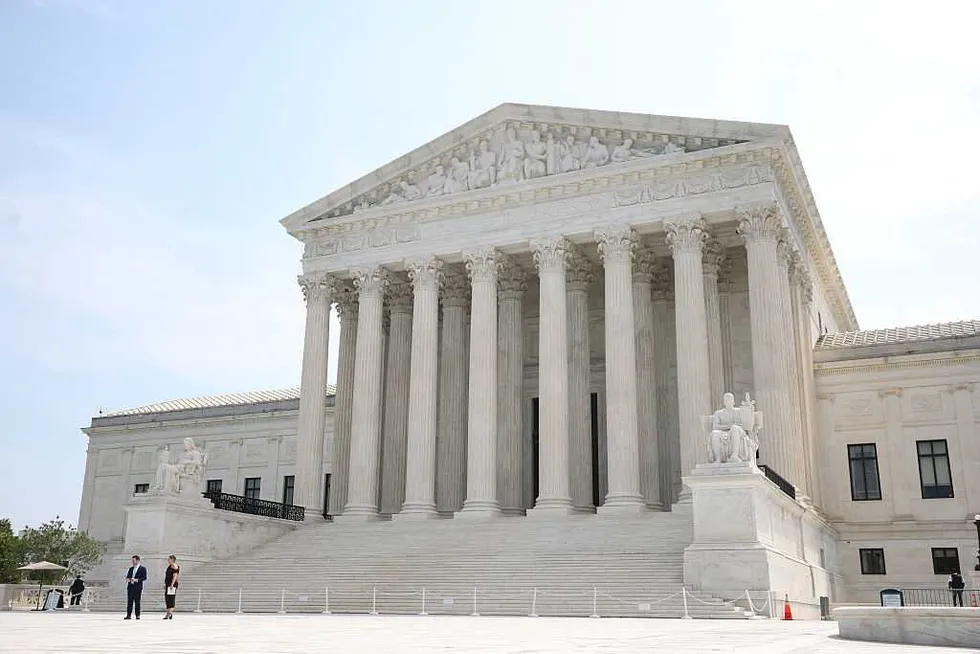
The U.S. Supreme Court will let the Trump administration make the case this fall that a pair of Obama judges erred in their 2024 ruling regarding the detention of criminal noncitizens.
Carol Williams Black is a Jamaican male who entered the United States in 1983 and subsequently obtained legal permanent residency.
'No substantive-due-process right to a bond hearing.'
Black was captured in 2019 by U.S. Immigration and Customs Enforcement, which determined both that the Jamaican was removable under federal immigration law due to his criminal conviction for sexual abuse and endangerment of a child and that he should remain in detention until his removal.
Keisy G.M. is a man in his late 30s from the Dominican Republican who entered the U.S. in 2011, obtained permanent residency, and has since lived in New York. In light of G.M.'s 2015 guilty plea to second-degree assault, ICE arrested G.M. in 2020 and got the ball rolling on his deportation.
Both foreigners — Black, who was detained for seven months, and G.M., who was detained for 21 months — filed legal complaints alleging that their detentions without bond hearings amounted to violations of their due process rights.
A panel consisting of a pair of Obama-appointed circuit court judges — Hong Kong-born Denny Chin and Susan Carney — reviewed the criminal noncitizens' cases and held in 2024 that "the constitutional guarantee of due process precludes a noncitizen's unreasonably prolonged detention under [8 U.S.C. § 1226(c)] without a bond hearing."
The Trump administration urged the U.S. Supreme Court in January to review whether the court of appeals erred in holding that due process requires bond hearings for criminal aliens detained under Section 1226(c) like Black and G.M., and whether there is a point at which such detention becomes "unreasonably prolonged."
RELATED: A real nation knows who is in and who is out
 Kevin Dietsch/Getty Images
The administration also asked the high court to review the appellate court's holding that due process requires placing the burden on the government to justify continued detention by a heightened standard.
"Section 1226(c) detainees have no procedural-due-process right to a bond hearing on matters that are 'not material' to the 'statutory scheme,'" attorneys for the government noted in their petition. "And where, as here, detention bears a reasonable relation to legitimate immigration purposes — such as 'preventing deportable criminal aliens from fleeing' or 'continu[ing] to engage in crime' while their removal proceedings are pending ... — Section 1226(c) detainees have no substantive-due-process right to a bond hearing either."
The government's attorneys noted further that the U.S. Supreme Court must provide clarity on the matter, especially since the Eighth Circuit Court "disagrees with the Second and Third Circuits about whether a Section 1226(c) detainee has a due-process right to a bond hearing when his detention becomes 'unreasonable,'" and the Second and Third Circuit courts disagree about "how to determine when Section 1226(c) detention has reached that point."
The American Civil Liberties Union lawyers who are representing the criminal noncitizens unsuccessfully begged the high court not to grant review.
The ACLU lawyers claimed in an April brief that the Trump administration was advancing "an extreme theory"; that the disagreement between the lower courts was little more than a "shallow split"; and that "these cases are strikingly poor vehicles" because Black has left the country and G.M. was released from detention in 2022.
Cecillia Wang, an ACLU lawyer who represents both criminal foreigners, said in a statement obtained by Reuters, "The court of appeals got it right, and we will defend our fundamental due process principles at the Supreme Court."
"The Constitution protects all of us, regardless of immigration status, from being locked away without due process," Wang continued. "[U.S. Immigration and Customs Enforcement] cannot detain immigrants — separating families and cutting people off from their communities — for months or even years on end without a bond hearing."
The U.S. Supreme Court agreed on Monday to take up the case but could ultimately dismiss it as moot.
The court is reportedly expected to hear arguments in the case in its next term.
Like Blaze News? Bypass the censors, sign up for our newsletters, and get stories like this direct to your inbox. Sign up here!