Tim Graham/Getty Images
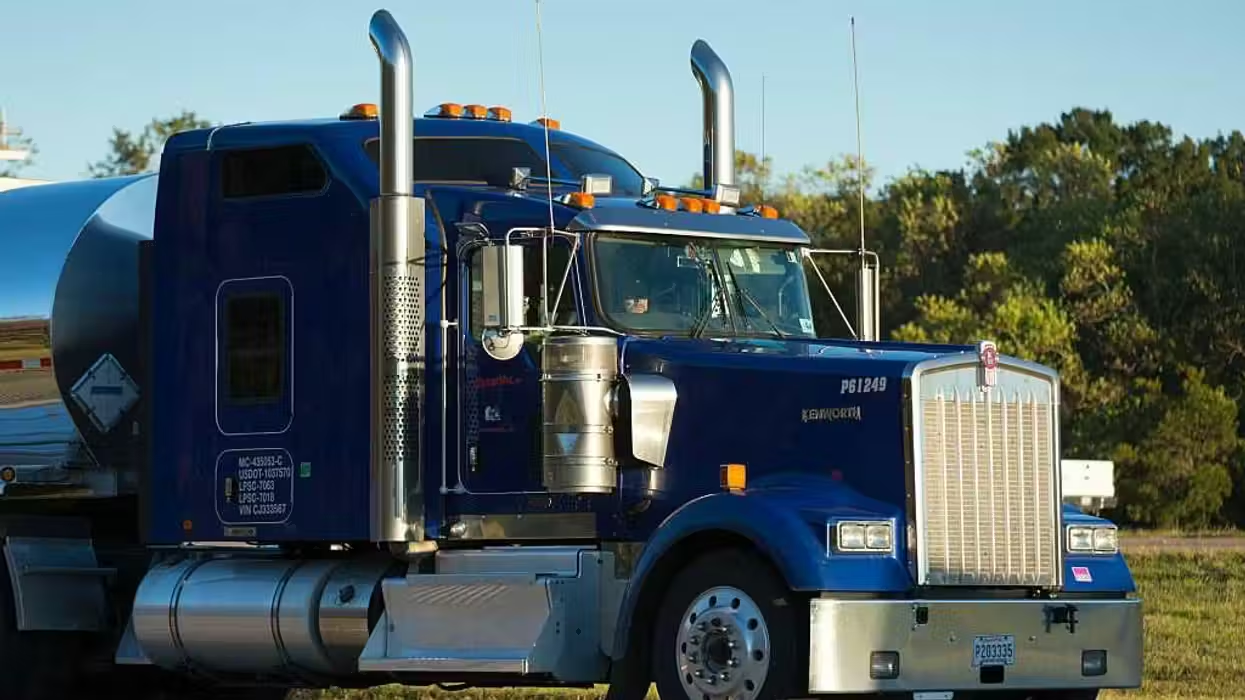
A battle over America's roads is unfolding in the Supreme Court, where demands for accountability clash with efforts to deregulate the industry, as the national spotlight remains on accidents caused by non-domiciled, non-English-speaking truck drivers.
The court's ruling could have major implications for the more than 150,000 Americans injured and the over 5,000 killed in large truck accidents each year, by potentially stripping or safeguarding the legal recourse available to victims and their families.
'Remove any legal accountability for brokers, and you remove the incentive for them to care.'
SCOTUS heard oral arguments on March 4 in the case of Shawn Montgomery v. Caribe Transport II, which involves a December 2017 collision between two semi-trucks: one operated by the plaintiff, Shawn Montgomery, and the other by an individual employed by Caribe Transport II, a small motor carrier hired by broker C.H. Robinson Worldwide.
The complaint explains that Montgomery was parked on the shoulder of Interstate Highway 70 in Cumberland County, Illinois, when another truck rear-ended his vehicle at high speed, resulting in severe and permanent injuries, including the amputation of Montgomery's leg.
Montgomery's lawsuit was filed against the driver, the carrier, and C.H. Robinson. He accused C.H. Robinson of "negligent hiring," citing Illinois common law. His case reached the Supreme Court after a lower court moved to dismiss it, arguing that the Federal Aviation Administration Authorization Act bars state-level negligence suits against brokers — third-party providers that connect shippers with carriers without owning trucks or hauling freight themselves — for their carrier selections.
The ongoing case has caught the attention of those in the trucking industry who are concerned that a SCOTUS ruling in favor of C.H. Robinson would set a precedent that prevents crash victims and their families from seeking legal recourse against brokers.
While President Donald Trump's administration has been receptive to concerns about reforming the nation's broken trucking industry, the U.S. position in the Montgomery v. Caribe case indicates a potential shift.
 Luke Sharrett/Getty Images
Trump's Department of Justice submitted an amicus brief supporting C.H. Robinson, arguing that the FAAAA preempts any state law related to the "price, route, or service" of a broker. This, the DOJ claimed, includes how brokers select carriers. Although the rule carves out a safety exception allowing states to enforce such laws, the U.S. government contended that the exception does not apply to this case.
The U.S. argues that brokers are already required to select an authorized motor carrier, which means that the carrier has met the Federal Motor Carrier Safety Administration's "rigorous safety standards." Allowing such lawsuits against freight brokers would "require brokers to second-guess federal registration decisions and independently evaluate the safety history of the carriers they select."
"A judgment for petitioner on that claim would thus necessarily impugn Caribe's overall operations, thereby undermining FMCSA's determination that Caribe satisfies federal registration requirements, including rigorous safety requirements," the U.S. amicus brief reads.
American Truckers United, an advocacy group, warned that if SCOTUS agreed with the U.S. government's argument and ruled in favor of the respondent, it could allow freight brokers to have "blanket immunity" when selecting unsafe and high-risk carriers, leading to a "race to the bottom."
ATU filed its own amicus brief, urging SCOTUS to side with Montgomery.
"If brokers are immunized from tort liability, they will have an unrestrained incentive to hire the cheapest motor carriers available for every load, regardless of poor safety records, regulatory non-compliance, defective equipment, and other red flags. Low-cost, low-quality carriers will completely displace safe carriers in the market," ATU wrote.
ATU noted that many carriers maintain only the minimum required liability insurance, which covers just a small portion of the cost for crash victims and their families. The group also pointed out the FMCSA's lack of resources to keep up with the "chameleon carrier" crisis, explaining that when carriers lose their operating authority due to noncompliance, they "dissolve, reincarnate themselves under new identities, and reenter the market."
A separate amicus brief filed by the Institute for Safer Trucking on behalf of Montgomery wrote, "The reality of the compliance-review scheme is bleak. FMCSA is apparently unable to conduct compliance reviews of carriers within a reasonable time. More than ninety-four percent of all active interstate freight carriers remain 'unrated' as of 2023."
The FMCSA has previously admitted its limitations. In a 2023 Advance Notice of Proposed Rulemaking, the FMCSA stated that it "has resources to issue safety ratings to only a small percentage of motor carriers each year," adding that the agency's rating "does not necessarily reflect the current safety posture of a motor carrier."
FMCSA officials said that "they do not have the resources to vet all for-hire carriers that apply for new operating authority," according to a 2012 Government Accountability Office report.
The Truck Safety Coalition, a network of victim and survivor volunteers, also filed an amicus brief supporting Montgomery that referred to freight brokers as “gatekeepers in determining who hauls freight on the roadways and who doesn’t.” The TSC stated that the industry has exploded in recent decades, from just 70 brokers in 1975 to over 28,000 today.
Rena Leizerman, from the Law Firm for Truck Safety and co-counsel for Montgomery, told Blaze News in a statement, “Broker negligence lawsuits aren't filed in every crash. They get filed when there's evidence that a broker hired someone with a known, serious safety history and chose to look the other way.”
“C.H. Robinson argued to the court that it should be completely off the hook for negligence. No exceptions. Not even if it knowingly hires a carrier with no insurance. Not even if the carrier isn't legally registered to operate. Not even if it already knows the carrier has a dangerous record. Zero accountability, no matter what,” Leizerman’s statement continued.
“Brokers make money on the gap between what shippers pay them and what they pay the carrier. The wider the gap, the more profit. So they push carrier rates down, and carriers survive by cutting costs — driver screening, safety training, equipment upkeep, insurance — until the day everything goes wrong.
“Remove any legal accountability for brokers, and you remove the incentive for them to care. Safe carriers, the ones who invest in doing things right, end up getting underbid by carriers who skip basic safety. It's a race to the bottom, and it's the rest of us sharing the road who pay the price,” she added.
Dorothy Capers, chief legal officer at C.H. Robinson, also provided a statement to Blaze News.
"A single, uniform federal framework is essential to keeping interstate commerce safe, efficient, and consistent with Congress' design," Capers said. "Allowing a patchwork of state tort laws to regulate broker services would undermine that system, increase uncertainty, and disrupt the flow of goods Americans rely on every day."
 Al Drago/Bloomberg/Getty Images
The stakes of the pending Montgomery case are already playing out in the nation’s courtrooms.
On May 24, 2024, a semi-truck driver allegedly blew through a stop sign on U.S. 84 in Texas, killing 28-year-old Tiana Moore and her mother, Tanya Maria King. Moore’s family sued the driver, the carrier, and the freight broker that had hired the carrier.
When the case was about to go to trial, the broker, citing the ongoing Montgomery case before the Supreme Court, requested and received a stay, leaving the family in limbo.
Moore's father, David Moore, spoke to Blaze News about the tragic accident. He expressed his goal of raising awareness to inspire policy changes and help the American public understand how regulations affecting the trucking industry impact lives nationwide.
"The impact that it's really had on our lives, and even this ongoing process, it's been, obviously, the most difficult thing that I've ever had to deal with — and not just me, but my family," David Moore said.
Ultimately, the Moore case was closed a short time later when the parties reached a confidential settlement. While in this instance the family was able to reach an agreement outside the courtroom, the Supreme Court’s decision in the Montgomery case will determine whether crash victims and their families retain or lose a major avenue for accountability in the future.
SCOTUS is expected to give a decision in the Montgomery case by June.
The Department of Transportation deferred comment to the Department of Justice, which stated it had no further remarks beyond its amicus brief.
Legal counsel for Caribe Transport II did not respond to requests for comment.
Like Blaze News? Bypass the censors, sign up for our newsletters, and get stories like this direct to your inbox. Sign up here!