
Photo (left): Hum Images/Universal Images Group via Getty Images; Photo (right): MEHMET ESER/Middle East Images/AFP via Getty Images
Military officials, defense analysts, and critics have issued numerous warnings in recent years about the state of America's military readiness.
While the Trump administration has taken steps to address some of the problems identified by scrutineers, there is at least one outstanding issue that could impact America's ability to wage a protracted ballistic war against its adversaries, namely its depleted stores of critical munitions.
'I don't want our adversaries to think for a second that we don’t have enough resources.'
Two U.S. military officials recently told the New York Times that the Department of War presently lacks the requisite forces and munitions for an extended bombing campaign against Iran.
One of the officials suggested that the American forces presently positioned in the region could continue strikes in the region for only seven to 10 days.
Christian Brose, the president of the American defense firm Anduril, similarly suggested earlier this week in a piece for the Wall Street Journal that "in a conflict with China, the U.S. would run out of critical munitions in days, according to the results of war games."
Amid such chatter and mounting concerns over what America's stockpiles might look like in the wake of a lengthier conflict with Iran, Pentagon spokesman Sean Parnell said in a statement to Politico, "The Department of War has everything it needs to execute any mission at the time and place of the president’s choosing and on any timeline."
RELATED: Nukes by the numbers: A problem we can’t wish away
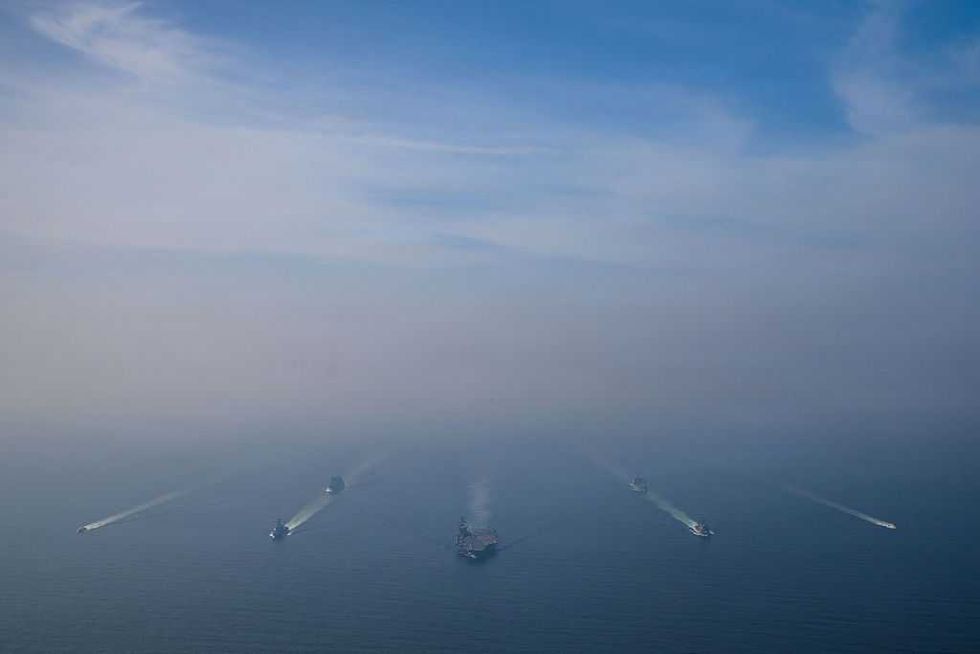 Handout photo by Mass Communication Specialist 1st Class Jesse Monford/U.S. Navy via Getty Images
The Pentagon's confidence notwithstanding, some American officials and analysts are worried about how America's stockpiles will look after a potential conflict with Iran.
After all, by arming Ukraine for its ongoing war with Russia, bombing Houthi terrorists in Yemen, vaporizing numerous alleged Venezuelan drug-runners, and helping to protect Israel — which has its own sophisticated albeit depleted missile defense system — from regional threats, the U.S. has reportedly burned through a great many Patriot missiles, Standard Missile-3s, and Terminal High Altitude Area Defense interceptors.
According to American Enterprise Institute fellows Mackenzie Eaglen and Todd Harrison, the U.S. expended over 150 THAAD anti-ballistic missile interceptors defending Israel in June 2025 during its 12-day conflict with Iran.
That's reportedly nearly 25% of its total number of THAAD interceptors and reportedly three times the average annual procurement since 2010.
Each THAAD interceptor is valued at approximately $12.7 million.
The AEI duo noted that during the same conflict, the U.S. also launched over 80 Standard Missile-3 interceptors.
According to a December report by the Center for Strategic and International Studies, the SM-3 missiles fired last June — which range in cost from around $9.6 million to $27.9 million — represented nearly one-fifth of the military's stockpile at the end of 2025.
"If the Iranians can deplete 25% of America’s THAAD stocks and a significant portion of our SM-3 magazines in a few days, the Chinese can and will exhaust them in a few hours," wrote the AEI duo, who proposed that the military "regain its ability to compete at scale."
American forces in the Red Sea have also expended a significant number of munitions battling Houthi terrorists in recent years.
Stars and Stripes reported last month that Navy forces had fired over 200 missiles and 150 artillery rounds in response to Houthi attacks since November 2023.
Vice Admiral Brendan McLane, commander of Naval Surface Forces, told Stripes that over the past 15 months or so, the Navy had fired 120 SM-2, 80 SM-6, and 20 Evolve Sea Sparrow and SM-3 missiles.
SM-2 and SM-6 missiles roughly cost $2.1 million and $3.9 million each, respectively.
While Rep. Ken Calvert (R-Calif.) acknowledged to Politico that munitions scarcity was "not a secret," he indicated that assembly lines for air defenses such as THAAD systems and Patriot interceptors have been "set up, and they just have to maximize, with double or triple shifts."
"I don't want our adversaries to think for a second that we don’t have enough resources," Calvert added. "We do."
Like Blaze News? Bypass the censors, sign up for our newsletters, and get stories like this direct to your inbox. Sign up here!