© 2026 Blaze Media LLC. All rights reserved.
Everyone knows Big Food is poisoning Americans ... but most have no idea the dark reason why
July 11, 2026
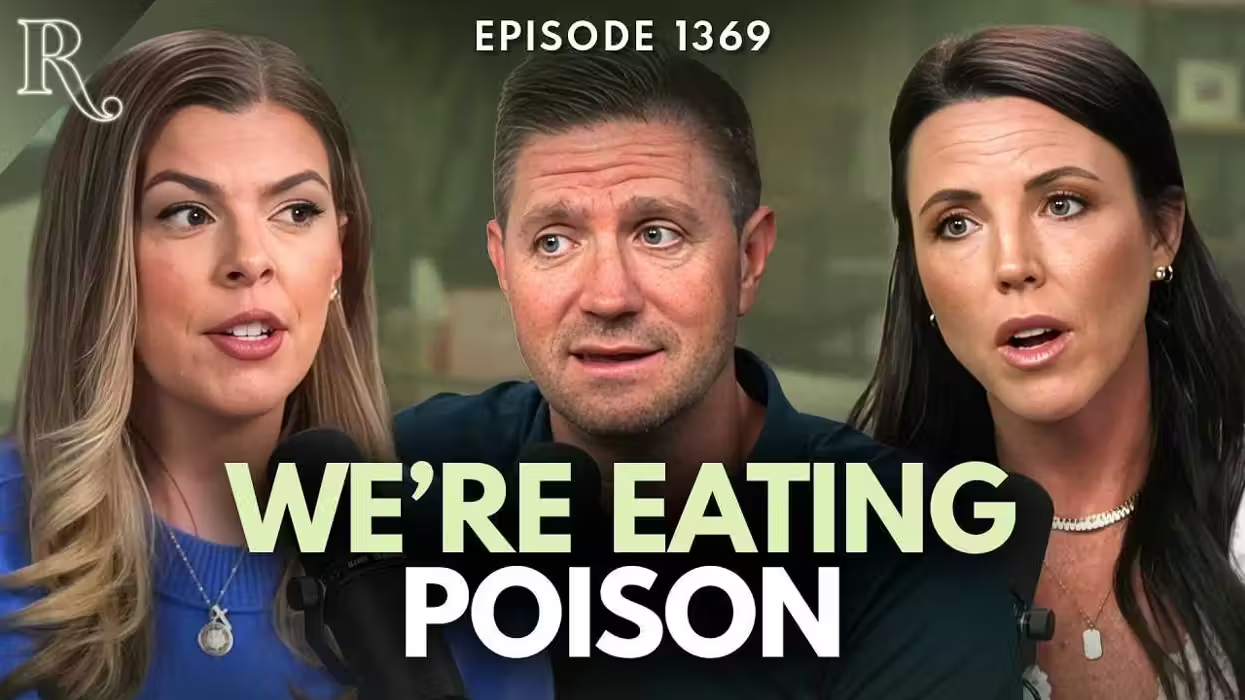
Allie Beth Stuckey interviews Ashley and Patrick Sullivan — the filmmakers exposing how the system behind our toxic food supply really works.
It’s no longer a secret that most of the food Americans eat is detrimental to their health. From chemical pesticides and GMOs to artificial additives, preservatives, and dyes, much of the common foods available today are loaded with junk known to cause health issues — even serious ones, like cancer and disease.
Few, however, know that Big Food is largely owned by tobacco companies. On this episode of “Relatable,” Allie Beth Stuckey sits down with Ashley and Patrick Sullivan, the creators of the documentary “Breaking Big Food,” which pulls the curtain back on how the tobacco industry hijacked our food system and sparked a major health crisis.
“In 1985, R.J. Reynolds, the maker of Camel cigarettes, purchased Nabisco for about $5 billion. In 1988, Philip Morris, the maker of Marlboro cigarettes, purchased Kraft Foods for about $13 billion,” Patrick explains, noting that “these are just two of the examples of Big Tobacco buying up” big name food companies.
“By the 1990s, Big Tobacco actually controlled about 40% of the food supply in America,” he adds.
Ashley explains that the reason for the push to control Big Food stemmed from the government’s decades-long anti-smoking campaign that resulted in a sharp decline in U.S. adult smoking rates — and a whole lot less cigarette sales.
“[Tobacco companies] saw number one, the industry that they were in was going down in flames and maybe saw an opportunity in the food industry to go in and say, ‘We are the addiction people, let's figure out how to apply what we know to processed foods,”’ she says.
“How did that actually affect the ingredients in the products at these companies?” Allie asks.
Patrick says it began with the most rudimentary of business questions: “How do we get our customers to buy more of our products?”
Science provided the answer.
“The tobacco scientists became food scientists, and they began studying how do we tickle the pleasure centers of the brain with potato chips and candy and sodas, and they found this sort of perfect mixture of fat, salt, and sweet that makes it so no one can eat just one,” he explains.
They also found ways to save money by using preservatives to expand the shelf life of food products and making cost-effective ingredient swaps, like “switching from cane sugar to high fructose corn syrup.”
Companies used crafty marketing strategies, Ashley notes, to distract the public so it didn’t notice the significant changes that were being made to food ingredients.
“Let's color this with red dye 40 and make it look really pretty. Let's do these fun ads. Let's target children, make it fun for them to want to purchase these foods,” she says.
“Let's put a toy inside of the cereal. Let's give a free gift with a Happy Meal,” Patrick adds.
Then the government inverted the food pyramid, recommending high portions of grain over any other food group. That wasn’t because humans thrive on a grain-rich diet but because of the “lobbying efforts on the behalf of grain producers,” Patrick notes.
To hear more of this fascinating interview about how America’s food system became poisoned, watch the episode above.
Want more from Allie Beth Stuckey?
To enjoy more of Allie’s upbeat and in-depth coverage of culture, news, and theology from a Christian, conservative perspective, subscribe to BlazeTV — the largest multi-platform network of voices who love America, defend the Constitution, and live the American dream.
Want to leave a tip?
We answer to you. Help keep our content free of advertisers and big tech censorship by leaving a tip today.
News, opinion, and entertainment for people who love the American way of life.
BlazeTV

BlazeTV Staff
News, opinion, and entertainment for people who love the American way of life.
@BlazeTV →more stories


Sign up for the Blaze newsletter
By signing up, you agree to our Privacy Policy and Terms of Use, and agree to receive content that may sometimes include advertisements. You may opt out at any time.
Related Content



© 2026 Blaze Media LLC. All rights reserved.
Get the stories that matter most delivered directly to your inbox.
By signing up, you agree to our Privacy Policy and Terms of Use, and agree to receive content that may sometimes include advertisements. You may opt out at any time.