TIMOTHY A. CLARY/AFP/Getty Images
Google wants users to manifest a community garden, not a bombed-out hospital in Gaza.
The latter became all too possible as Google Earth's naive new update was accidentally primed for manipulation.
'We take misinformation seriously.'
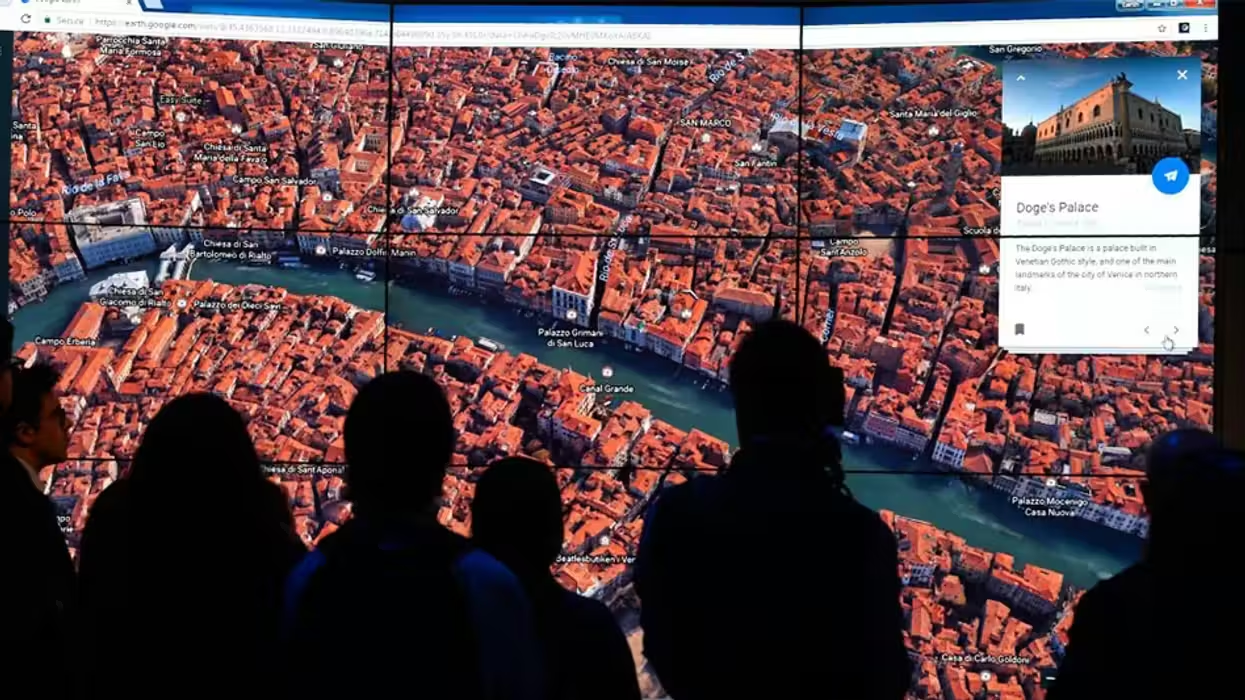
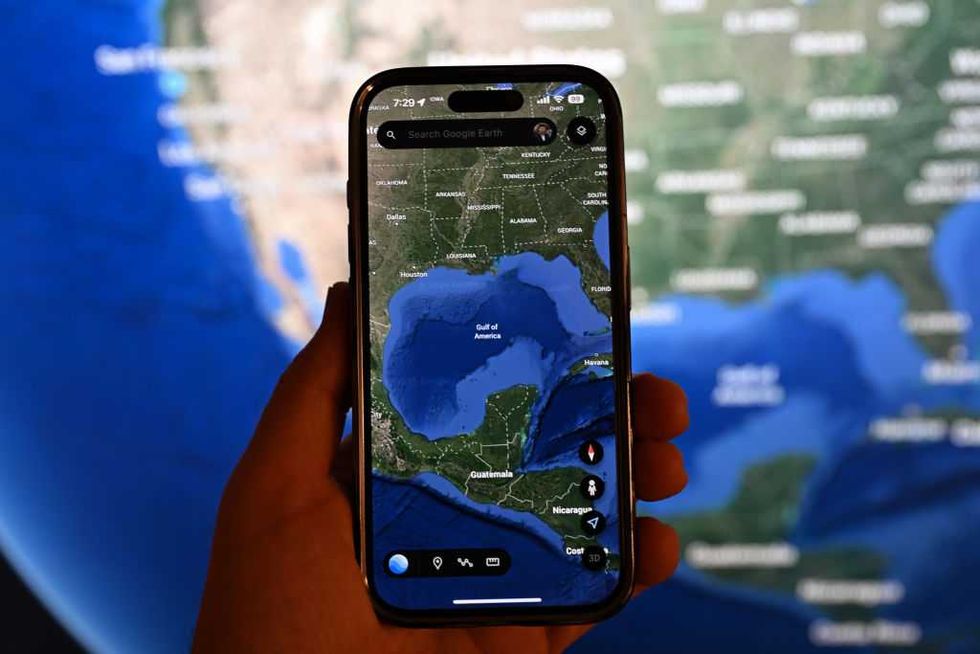
On Thursday, Google announced the ability to "transform any place" on the map using Google Earth and generative AI called Nano Banana 2.
"Have you ever looked at an empty lot in your neighborhood and imagined a community garden, or wondered what your city looked like a century ago?" Google asked in a blog post.
The tech giant revealed that any of the satellite, aerial, or 3D imagery available on Google Earth can now be manipulated with AI to create custom images.
"Type whatever you want to see," the blog reads.
One researcher, Henk van Ess, decided to take that seriously and see what the app was willing to do.
"Nothing was refused, nothing was softened, and nothing suggested I try a different prompt," van Ess wrote in an article titled "How to plant a nuclear plant in Iran."
"Refugees at a border, a nuclear plant in Iran, a fatal crash on an Amsterdam street, a hospital with a bomb crater in Gaza," nothing was off limits to the user. Van Ess even showed a video of him generating an image where "refugees swarm the streets" in Mexico.
Soon, users had portrayed a plane hitting Freedom Tower, a crater caving in Iceland, and a collapsed Eiffel Tower, among other catastrophes.
RELATED: Don't be fooled: This Apple privacy feature won't protect your identity
 Tayfun Coskun/Anadolu/Getty Images
Google responded to the researcher, saying, "We take misinformation seriously — every image created with Nano Banana in Google Earth includes the SynthID digital watermark, so if someone is unsure about an image, they can ask the Gemini app or use Lens in Search to see if the image was Al-generated."
Van Ess ran one of the videos he created through Hive, AI detection software not run by Google. It came back with a 1% chance of being an AI-generated video and a 0% chance of being a deepfake.
The writer said this wasn't necessarily Hive's fault, given that it was scanning a real video that he had taken, but therein lies the issue with such content. It is very unlikely that an AI-generated video would be scanned right from its source and therefore be easily detectable.
RELATED: Apple and Google told to take down these illegal — and exploitative — apps
 Kim White/Bloomberg/Getty Images
Google also provided its AI prohibited-use policy, which lists types of usage that would constitute crimes surrounding explicit content, abuse, or violation of intellectual property rights.
On its face, van Ess' content did not seem to violate Google's terms, but the company eventually acquiesced. On Friday, Google updated its blog to say that it was "rolling back" the feature while it works on "implementing stronger guardrails."
Google directly stated that it saw people sharing screenshots of imagery "that appear to violate our policies," while assuring readers that generated images didn't appear in the "main Google Earth experience" and were also watermarked as being AI-generated.
Like Blaze News? Bypass the censors, sign up for our newsletters, and get stories like this direct to your inbox. Sign up here!