© 2026 Blaze Media LLC. All rights reserved.
With shrinking enrollment and ballooning expenses, public school districts across the country are not only facing massive budget deficits but are also quickly losing the goodwill of the public.
Here in Texas, districts like Houston and Austin are seeing huge budget shortfalls. Around the country, school systems are on the path to bankruptcy yet have done little to cut spending.
So many meetings, conferences, and email exchanges could be phased out, leaving more time to actually teach students.
Many district leaders and their respective school boards seem to believe that these enrollment drops are nothing serious or that they can blame someone else for the problem and absolve themselves of responsibility. Consequently, instead of making significant spending cuts, they go on draining rainy-day funds or spending money they don’t have.
Worse still, the bulk of these expenses do not go toward hiring more teachers, but instead go toward administrative staff, extracurricular programs, curriculum and technology specialists, and countless office workers with undefined roles working in office buildings that the district inexplicably owns and maintains.
In the rare instances that cuts are made, it is mostly the teaching staff — that is, the actual people in the classroom working with students — who are affected.
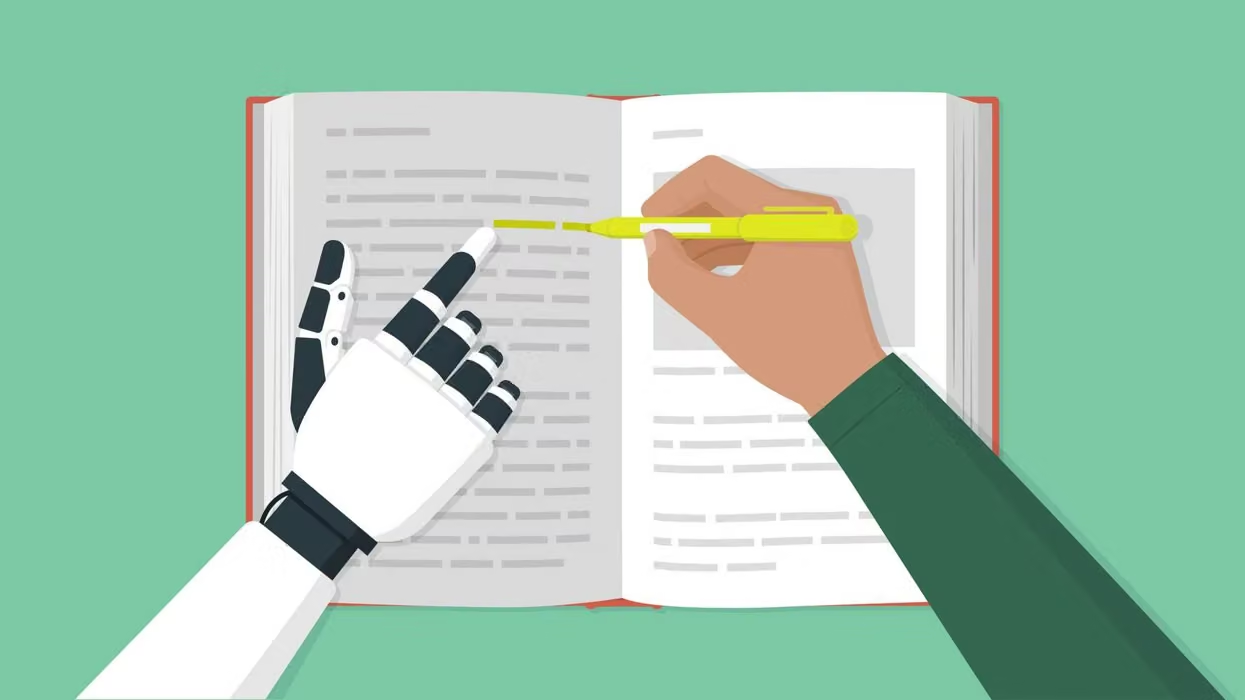
Realistically, can anything be done to prevent these districts from imploding in spectacular fashion? Speaking as a teacher currently in the trenches, this might be a place where AI can reduce costs while boosting instructional quality.
I’m not talking about replacing teachers with AI-enhanced educational software, turning classrooms into computer lounges, and replacing principals with bored babysitters making sure the kids continue vegetating in front of their screens.
According to a recent essay in the New York Times, this is the bold new idea at Alpha private schools: “At Alpha, there are no traditional teachers, few books, and little paper. All of the academic lessons are delivered via apps, and students can earn lavish prizes for completing their work. Adults are present, but only as motivational guides.”
Predictably, this approach to education has mixed results. While the stronger students usually cruise through content and perform well on their standardized tests, the weaker students who need more help will often experience delays in their progress and opt out of the program altogether.
More importantly, it neglects the most important aspects of schooling: socialization and humanization. Education is as much about results as it is about relationships. Teachers do not merely dispense information to compliant drones who mentally download this information through note-taking and worksheets. Teachers are supposed to design their instruction around the needs of their students, govern their classes equitably, and connect the content of their subject to the world outside the classroom.
RELATED: The forgotten colleges that could restore hope to American education
 Crisserbug/Getty Images
When this learning is outsourced to a computer and mediated through a screen, everything is reduced and flattened — of course, the superficial people in tech will mistake this for efficiency.
Separated from the outside world, students engage with material through drill-and-kill pedagogy, working through assessments that offer practice on state standards. While this works well enough for math instruction, it becomes far less effective in the sciences or humanities.
With all this said, there still might be a key role for AI in public education. While it can’t replace teachers, it can replace many of the people around them. And if used properly, it can also enhance the work that teachers do.
In terms of cutting down bureaucratic bloat, all districts, even solvent ones, could use a DOGE-style audit to identify useless positions, departments, and redundancies. There are countless individuals in a school district who could permanently disappear without anyone noticing. Many of them are collecting paychecks and later pensions for irrelevant work, but no one notices them because they are usually hidden.
Case in point: Years ago, I had a question about one of my paychecks. I sent out emails to the dozen HR people listed on the district website to see who could answer my question. When no one replied, I took a half-day off and drove over to the administration building to see if I could talk to someone face-to-face. Apparently, I went to the wrong administrative building and had to drive to the other one a mile away.
Once there, the receptionist directed me to a hallway on the fourth floor to look for a person who knew about paychecks. After wandering about for 10 minutes, I finally found someone who directed me to yet another person who finally had the answer to my question.
RELATED: AI doesn’t know you, but a good physician does
 Moor Studio/Getty Images
Most public teachers have a story like this. Some random thing prompts them to take a journey through their district’s Kafkaesque bureaucracy, and then they realize just how many useless people are on the payroll. Today, most queries could be answered in a few seconds with a chatbot. Moreover, most duties done by non-teaching staff, like setting up schedules, organizing information, compiling data and documentation, and making presentations, could be done with AI.
Just as importantly, the people who work with students could accomplish far more with AI support. So many meetings, conferences, and email exchanges could be phased out, leaving more time to actually teach students. So many roles requiring specialized training and higher salaries could either be removed entirely or replaced by those with general experience and aptitude.
In such a system — which would resemble something like Singapore’s exceptional educational program — good teachers would be rewarded with more respect, authority, and income while administrators would function as their subordinates. Good teachers are far less replaceable than administrators, so they should be encouraged to stay in the classroom and help more students.
Like any large organization, most school districts have grown into something so unwieldy and chaotic that enacting meaningful reform is next to impossible. Those with the authority to do so are usually too incompetent and complacent to do anything, and those with competence and wherewithal to do something lack the authority. Meanwhile, taxpayers funding public schools tend to focus their ire on the people they can see and ignore the true source of the problem.
It may be difficult to imagine an alternative to the current dysfunction, but it can be done. And if done right, it will be a good thing for everyone involved.
Want to leave a tip?
We answer to you. Help keep our content free of advertisers and big tech censorship by leaving a tip today.