bagira22/iStock/Getty Images
My husband has bipolar disorder. I know firsthand that the medications he takes do not merely improve his quality of life — they make our family life possible.
I am thankful for the drug companies whose products and innovations help keep my family together. But that does not mean I trust Big Pharma.
The pharmaceutical industry’s incentives are often at odds with the people it treats.
The pharmaceutical industry has helped create a culture in which Americans are taking more prescription drugs than at any point in history. Last year, more than two-thirds of Americans reported taking a prescription drug daily, and 26% said they take four or more.
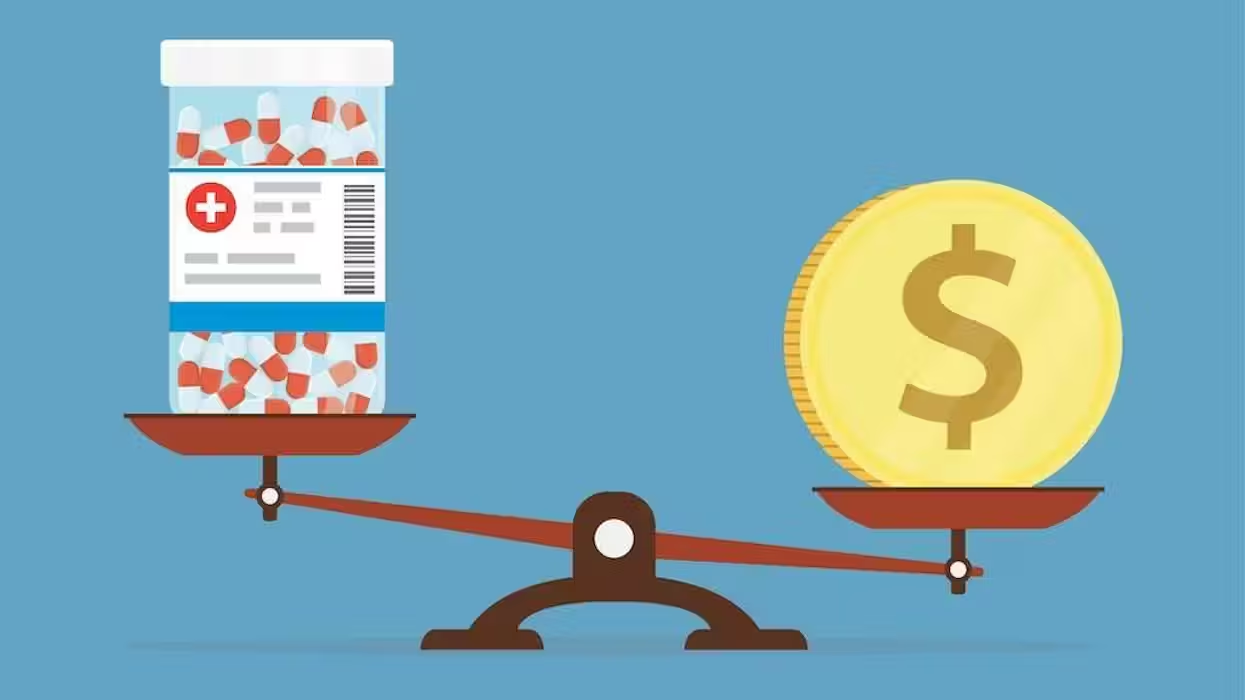
No wonder the average price of prescription medications in the United States has risen by about 37% in the last decade. Many of the most popular brand-name medications have doubled in price over the past 15 years.
One study found that prescription drug prices in the United States are nearly three times higher than prices for the same medications in 32 comparable countries. Family health insurance premiums for employer-sponsored plans jumped 26% from 2020 to 2025, outpacing wage growth and inflation.
A quarter of Americans recently reported having difficulty paying for their medications. About 19% said they had skipped or rationed doses because of the cost. Research indicates that medical expenses are now the leading cause of personal bankruptcy in this country, surpassing job loss.
I understand that high prices help fund the astronomical cost of clinical trials that test and bring new drugs to market. But Americans have also seen pharmaceutical companies acquire the rights to off-patent drugs and raise prices overnight. They have watched insulin prices climb for years even though insulin is relatively cheap to produce.
Let’s face it: The pharmaceutical industry’s incentives are often at odds with the people it treats.
The same industry that helps my husband is increasingly keeping medications out of reach for many families.
Drug prices would not be so high if Big Pharma did not spend between $13 billion and $14 billion a year on direct-to-consumer advertising. They would not be so high if the pharmaceutical and health sectors did not consistently spend more on federal lobbying than any other industry.
Those efforts shape the laws and policies that allow current drug prices. The industry clearly views them as worthwhile investments.
Americans spent 12.7% more on pharmaceutical drugs last year than they did in 2024. A significant share of that increase came from popular GLP-1 weight-loss drugs such as Ozempic and Wegovy. Roughly 12% of American adults are currently taking one of these drugs, and that number is expected to rise significantly in the coming years.
I am not saying people should not take these medications. That is not for me to say. But I am deeply concerned that, culturally, we increasingly treat medication as the first line of defense for nearly every challenge before seriously exploring other options.
RELATED: Want to live to 100? Don’t expect Big Pharma to help.
 lucigerma/iStock/Getty Images
That concern comes from firsthand experience.
As someone who has battled addiction, I am acutely aware of the power substances can hold over a person’s life. That experience has left me worried about others who may develop dependencies on drugs.
I remember how the opioid crisis destroyed entire communities and caused a staggering number of deaths after companies such as Purdue Pharma aggressively pushed OxyContin while downplaying its risks. That epidemic continues today with synthetic opioids such as fentanyl.
Is it any wonder some of us remain skeptical of pharmaceutical companies’ motives?
As a parent, I do everything in my power to ensure that my children do not become unnecessarily dependent on medications. I want them to understand that any drug they take should be used carefully and for its intended purpose.
I acknowledge the value of medicine. I deeply respect what the health care industry can do. My own family depends on it.
But respect should not require blindness.
The pharmaceutical industry should remember the families paying the bills, rationing the doses, and wondering whether the medications they need will remain within reach.
Innovation deserves reward. Exploitation does not.