Daniel Stein via iStock/Getty Images
I don’t often argue with internet trends. Most of them exhaust themselves before they deserve the attention. But a certain kind of AI-generated nostalgia video has become too pervasive — and too seductive — to ignore.
You’ve seen them. Soft-focus fragments of the 1970s and 1980s. Kids on bikes at dusk. Station wagons. Camaros. Shopping malls glowing gently from within. Fake wood paneling! Cathode ray tubes! Rotary phones! A past rendered as calm, legible, and safe. The message hums beneath the imagery: Wouldn’t it be nice to go back?
Human nostalgia, as opposed to the AI-generated kind, eventually runs aground on grief, embarrassment, and the recognition that the past demanded something from us and took something in return.
Eh ... not really, no. But I understand the appeal because, on certain exhausting days, it works on me too — just enough to make the present feel a little heavier by comparison.
And I don’t like it. Not at all. And not because I’m hostile to memory.
I was born in 1971. I lived in that world. I remember it pretty well.
How well? One of my earliest, most vivid memories of television is not a cartoon or a sitcom. No, I’m a weirdo. It is the Senate Watergate hearings in 1973, broadcast on PBS in black and white. I was 2 years old.
I didn’t understand the words, but I sort of grasped the tone. The seriousness. The tension. The sense that something grave was unfolding in full view of the world. Even as a toddler, I vaguely understood that it mattered. The adults in ties and horn-rimmed glasses were yelling at each other. Somebody was in trouble. Before I knew anything at all, I knew: This was serious stuff.
A little later, I remember gas lines. Long ones. Cars waiting for hours on an even or odd day while enterprising teenagers sold lemonade. It felt ordinary at the time, probably because I hadn’t the slightest idea what “ordinary” meant. Only later did it reveal itself as an early lesson in scarcity and frustration.
The past did not hum along effortlessly. Sometimes — often — it stalled.
I remember my parents watching election returns in 1976 on network television. I was bored to tears — literally — but I remember my father’s disappointment when Gerald Ford lost to Jimmy Carter. And mind you, Ford was terrible.
This was not some cozy TV ritual. It was a loss of some kind, plainly felt. Big, important institutions did not project confidence. They produced arguments, resentment, and unease. It wasn’t long before people were talking seriously about an “era of limits.” All I knew was Dad and Mom were worried.
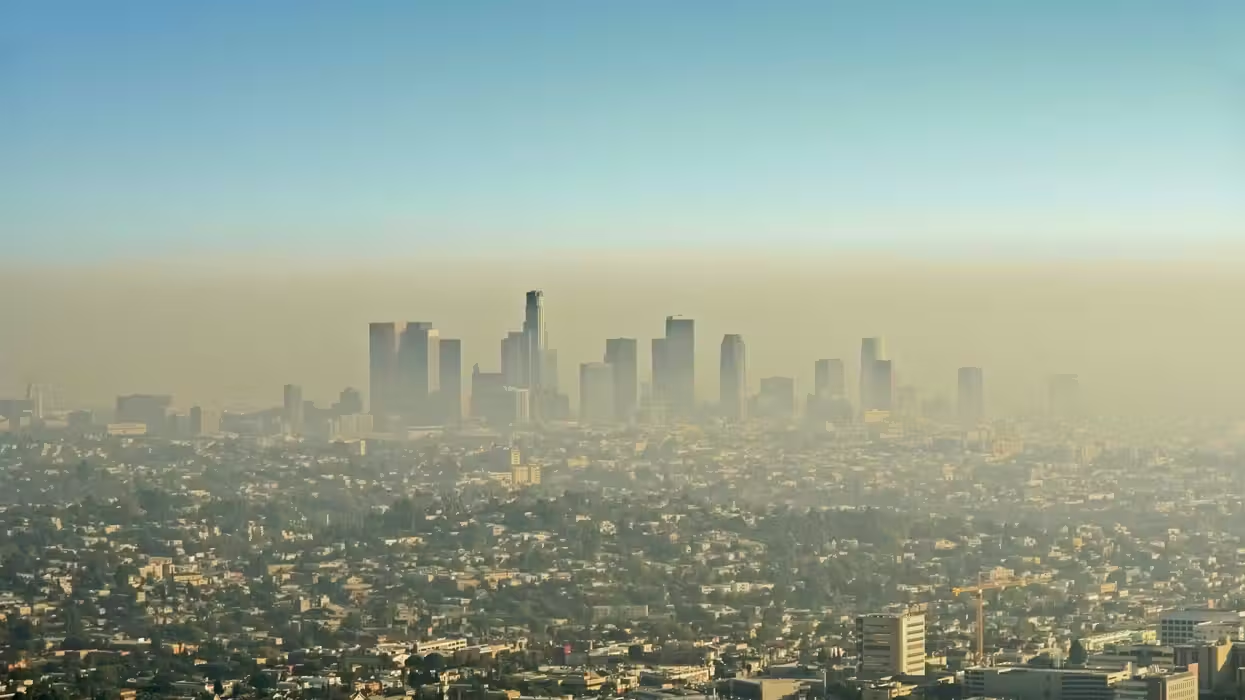
I remember a summer birthday party in the early 1980s at a classmate’s house. It was hot, but she had an awesome pool. I also remember my lungs ached. That day, Southern California was under a first-stage smog alert. The air itself was hazardous. The past did not smell like nostalgia. It smelled like exhaust with lead and cigarette smoke.
I don’t miss that. Not even a little bit.
Yes, I remember riding bikes through neighborhoods with friends. I remember disappearing for entire days. I remember my parents calling my name when the streetlights came on. I remember spending long stretches at neighbors’ houses without supervision. I remember watching old movies on Saturdays with my pal Jimmy. I remember Tom Hatten. I remember listening to KISS and Genesis and Black Sabbath. That freedom existed. It mattered. It was fun. But it lived alongside fear, not in its absence.
I don’t remember the Adam Walsh murder specifically, but I very much remember the network television movie it inspired in 1983. That moment changed American childhood in ways people still underestimate. It sure scared the hell out of me. Innocence didn’t drift into supervision — it collided with horror. Helicopter parenting did not emerge from neurosis. It emerged from bona fide terror.
And before all of that, my first encounter with death arrived without explanation. A cousin of mine died in 1977. She was 16 years old, riding on the back of a motorcycle with a man 11 years her senior. She wasn’t wearing a helmet. The funeral was closed casket. I was too young to know all the details. Almost 50 years on, I don’t want to know. The age difference alone suggests things the adults in my life chose not to discuss.
Silence was how they handled it. Silence was not ignorance — it was restraint.
RELATED: 1980s-inspired AI companion promises to watch and interrupt you: ‘You can see me? That’s so cool’
 seamartini via iStock/Getty Images
This is what the warm and fuzzy AI nostalgia videos cannot possibly show. They have no room for recklessness that ends in funerals, or for freedom that edges into life-threatening danger, or for adults who withhold truth because telling it would damage rather than protect.
What we often recall as freedom often presented itself as recklessness ... or worse.
None of this negates the goodness of those years. I’m grateful for when I came of age. I don’t resent my childhood at all. It formed me. It taught me how fragile stability is and how much of adulthood consists of absorbing uncertainty without dissolving into it.
That’s precisely why I reject the invitation to go back.
The new AI nostalgia doesn’t ask us to remember. In reality, it wants us to withdraw. It offers a sweet lullaby for the nervous system. It replaces the true cost of living with the comfort of atmosphere and a cool soundtrack. It edits out the smog, the scarcity, the fear, the crime, and the death, leaving only a vibe shaped like memory.
Here’s a gentler hallucination, it says. Stay awhile.
The problem, then, isn’t sentiment. The problem is abdication.
So the temptation today isn’t to recover what was seemingly lost but rather to anesthetize an uncertain present. Those Instagram Reels don’t draw their power from people who remember that era clearly but from people who feel exhausted, surveilled, indebted, and hemmed in right now — and are looking for proof that life once felt more human.
RELATED: Late California
 LPETTET via iStock/Getty Images
And who could blame them? Maybe it was more human. But not in the way people today would like to believe. Human experience has never been especially sweet or gentle.
Human nostalgia, as opposed to the AI-generated kind, eventually runs aground on grief, embarrassment, and the recognition that the past demanded something from us and took something in return. Synthetic nostalgia can never reach that reckoning. It loops endlessly, frictionless and consequence-free.
I don’t want a past without a bill attached. I already paid the thing. Sometimes I think I’m paying it still.
AI nostalgia videos promise relief without effort, feeling without action, memory without judgment.
That may be comforting, but it isn’t healthy, and it isn’t right.
Truth is, adulthood rightly understood does not consist of finding the softest place to lie down. It means carrying forward what we’ve lived through, even when it complicates our fantasies.
Certain experiences were great the first time, Lord knows, but I don’t want to relive the 1970s or ’80s. I want to live now, alert to danger, capable of gratitude without illusion, willing to bear the weight of memory rather than dissolve into it.
Nostalgia has its place. But don’t be seduced by sedation.
Editor’s note: A version of this article appeared originally on Substack.