Michael Blackshire/Chicago Tribune/Tribune News Service via Getty Images
If Democrats seem extreme now, wait until they adopt ranked-choice voting. Some activists inside the party want exactly that — a reform that would push presidential nominations even further left and force establishment figures to navigate an ideological gauntlet to win.
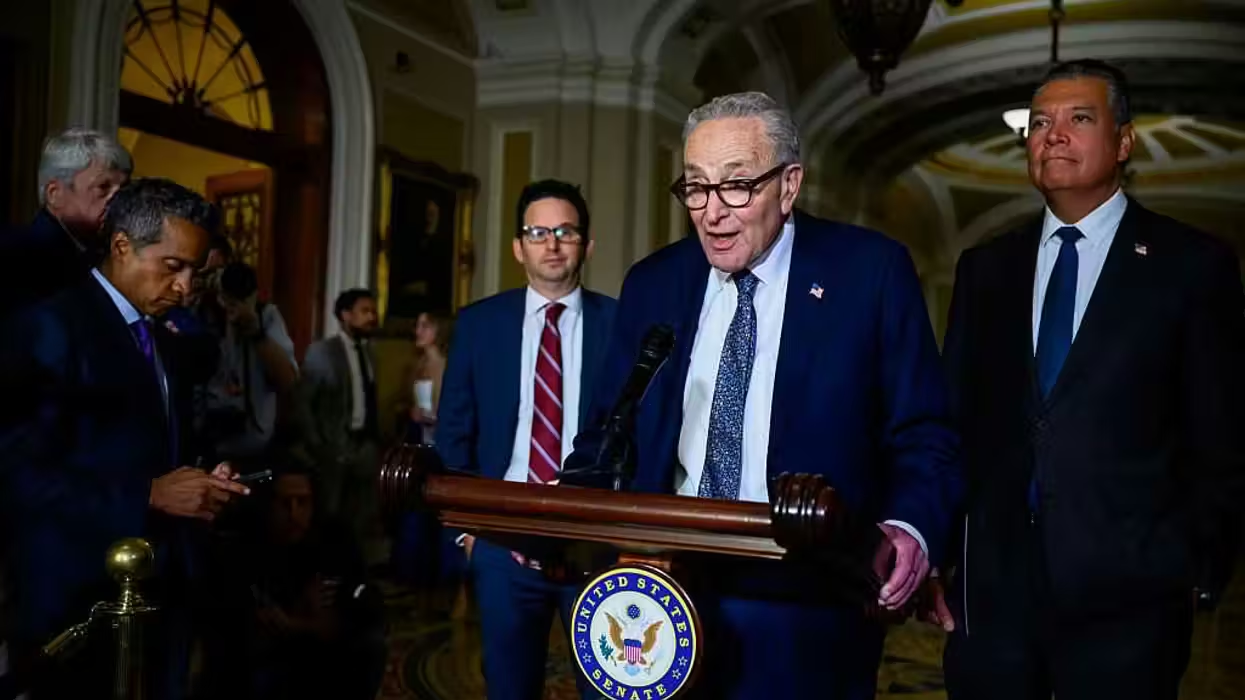
Multiple reports indicate that Democratic Party activists and elected officials are pressuring the party to adopt ranked-choice voting for its 2028 presidential primaries. Axios notes that the push has grown serious enough that top party officials met in late October with advocates including Rep. Jamie Raskin (D-Md.), pollster Celinda Lake, and representatives from FairVote Action.
Ranked-choice voting would pour accelerant on a process already pulling Democrats further left.
Such an effort fits a long pattern: For decades, Democrats have shifted presidential nominations away from party leadership. On ranked-choice voting specifically, several states already use it — Maine and Alaska among them — along with deep-blue cities such as New York, Minneapolis, San Francisco, and Seattle.
Ranked-choice voting takes multiple forms, but New York City’s model illustrates the dynamic. Voters rank up to five candidates. If no candidate wins an initial majority, the last-place candidate drops out, and those voters’ second-choice votes are redistributed. This “loser leaves” process continues until a candidate secures a majority.
Assuming rational behavior, Democratic voters would likely rank candidates from more extreme to less extreme. That pattern would advantage the leftmost candidates again and again as lower-preference votes transfer upward.
This structural boost would encourage both supply and demand for extreme candidacies. Candidates on the ideological edge would have more incentive to run. Voters who prefer them would have more influence. Ranked-choice voting’s supporters tout this expanded participation as a virtue.
Offering voters multiple choices would foster coalition-building. Knowing the race may go to multiple rounds, candidates would angle for second- and third-choice votes. The horse-trading once done in old convention “smoke-filled rooms” would unfold publicly through a series of ranked ballots.
But the key question is simple: Why would ranked-choice voting necessarily supercharge extremism inside the Democratic Party? Because the system rewards voters for casting marginal votes — and among today’s Democrats, “marginal” means “further left.”
The party’s ideological shift is measurable. In Gallup’s 2023 polling, 54% of Democrats identified as liberal — an all-time high. Support for democratic socialists in major-city mayoral primaries shows how rapidly the party’s activist base has moved left. In 1995, the liberal share of the party was 25%, roughly equal to conservatives. Three decades later, conservatives make up just 10% of Democrats.
Exit polling confirms the trend: In 2024, 91% of self-identified liberals voted for Kamala Harris; only 9% of conservatives did.
Extrapolate from this trajectory, and the danger becomes even clearer. Extreme candidates increasingly win Democratic primaries in major cities. Those cities dominate statewide Democratic politics. And in closed primaries, only Democrats vote — meaning the hyper-engaged activist left already sets the terms of competition. Ranked-choice voting would amplify that influence. The same voters who nominated democratic socialists in New York and Seattle would wield disproportionate power in a presidential contest.
RELATED: Democrats are just noticing a long, deep-running problem
 Photo by RYAN MCBRIDEDON EMMERTDON EMMERTKENA BETANCURROBYN BECKANGELA WEISSROBYN BECKROBYN BECKROBYN BECK/AFP via Getty Images
Consider how the 2020 Democratic primary might have played out under ranked-choice voting. Joe Biden — an establishment candidate favored by moderates — would have faced a field dominated by Bernie Sanders, Elizabeth Warren, Pete Buttigieg, Tom Steyer, and others to his left. Ranked-choice voting would have forced him through a gauntlet designed by the party’s most ideological voters.
This trend is not new. In 1972, George McGovern reshaped Democratic nominating rules and then benefited from the changes. Since then, the party has repeatedly weakened its establishment’s role (with key exceptions). Ranked-choice voting would accelerate that shift dramatically.
With moderates now only 36% of the party, according to Gallup, how could they resist a move toward ranked-choice voting? More importantly, which remaining moderate or establishment Democrat could survive a ranked-choice system dominated by the party’s left wing?
Ranked-choice voting would pour accelerant on a process already pulling Democrats further left. The only question is how long it takes for the party to adopt it — and how long the party can remain viable nationally if it does.