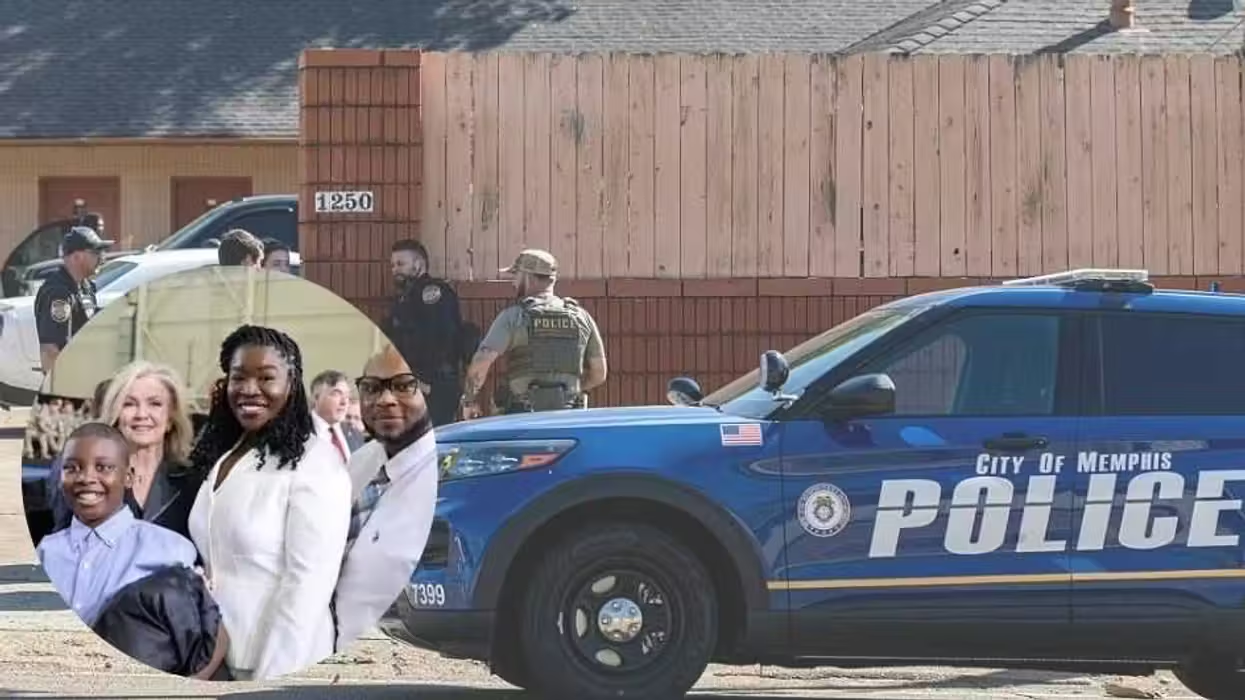
Sen. Marsha Blackburn/Austin Johnson/Getty Images
There was a time when the most effective weapon against crime in American cities was a badge and a gun. Today, it’s a boring old spreadsheet.
In Memphis, a city long defined by bruising battles with violent crime, the local political establishment has discovered something it fears far more than gunfire: public transparency.
For the first time in six years, Ballinger's family members were able to celebrate a birthday in their own back yard.
Dalisia Ballinger understands this threat better than the politicians currently spending taxpayer money to hide the truth.
A former Memphis news reporter and a mother, Ballinger knows exactly what a stray bullet sounds like when it tears through residential drywall. One sweltering evening, she stood in her living room when three men emerged from the bushes outside and opened fire on the neighboring house. Without hesitation, she grabbed her son and ran to the bedroom.
"My son, who was five at the time, started asking questions like 'why are we on the ground, Mommy?' I just hugged him tight until it was over," Ballinger recalls via email. "It had to have been about 10 gunshots. After it was over, we proceeded back to the living room, where I noticed glass on the floor and looked over into the wall, and there was the bullet hole.”
Directly below it were her son's toys — the place where he played every day. In other words, Ballinger's decision to take her son into the bedroom may have saved his life.
Ballinger eventually moved her family a few miles away, only to find a neighborhood trapped in an identical loop of daily robberies and shootings. The cycle broke when the Memphis Safe Task Force deployed to the area.
Launched as a joint federal, state, and local law-enforcement operation, the Memphis Safe Task Force targets violent offenders, illegal firearms, gangs, and fugitives. Supporters credit it with helping drive down violent crime in Memphis, while critics argue its aggressive tactics have raised civil-liberties concerns, pointing to several high-profile encounters — including the fatal shooting of Tyrin Johnson, which remains under investigation.
Ballinger says that for her and her neighbors, the results were immediate and undeniable. The gunfire stopped for weeks on end. For the first time in six years, Ballinger's family members were able to celebrate a birthday in their own back yard.
It was then that Ballinger committed the ultimate sin of modern journalism. She actually reported what she saw. She stated publicly that violent crime had dropped in her neighborhood because of the task force. For the crime of committing firsthand journalism that disrupted a preferred political narrative, her network promptly fired her.
Her termination illustrates a broader problem in contemporary newsrooms, where maintaining the approved narrative increasingly appears to be a prerequisite for keeping a job. Disagreement used to spark editorial debate; today, it can end careers. The establishment appears deeply terrified of what happens when citizens lay eyes on verifiable data.
"I don't think anyone should be afraid of transparency," Ballinger tells me. "If we're making decisions that affect the safety of our neighborhoods, then the public deserves to know what's happening and whether those efforts are producing results."
That principle now sits at the center of a political and legal fight in Memphis.
RELATED: Crime stats said her new neighborhood was 'safe'; then she saw what they left out
 The Washington Post/Getty Images
In May, Tennessee Governor Bill Lee (R) signed the Memphis Safe Task Force Accountability Act (S.B. 1467) into law.
Far from policing the task force itself, the legislation shines a light on what happens after the task force's work is finished. It requires prosecutors — not police — to publicly report when serious task-force cases are reduced, dismissed, or otherwise abandoned. Supporters argue that if the task force is delivering dangerous offenders to the courthouse, the public deserves to know what becomes of those cases.
Shelby County District Attorney General Steve Mulroy disagrees. In a lawsuit challenging the law, he argues that the act unfairly targets his office, infringes on the constitutional independence of locally elected prosecutors, and imposes reporting requirements. According to Mulroy, complying with the law would divert resources away from prosecuting crime while requiring reports on information prosecutors already disclose through existing channels.
To Ballinger, the law simply asks government to show the public how one of its most important public safety initiatives is performing.
A well-functioning bureaucracy relies on data to demonstrate its effectiveness. A bureaucracy that seeks to lock its files away sends a different message entirely. When government officials fight public disclosure, they inevitably invite questions about what, exactly, they fear the public might discover.
"When information is readily available, citizens don't have to rely on rumors, political spin, or competing narratives," Ballinger notes. "They can look at the information themselves, ask informed questions, and hold public officials accountable."
A growing coalition of residents refuse to allow the DA to litigate Memphis back into the dark. Ballinger is championing a Change.org petition demanding that Mulroy withdraw his lawsuit and allow the transparency law to stand. The petition is gaining momentum because it treats public safety as something larger than a jurisdictional dispute or partisan fight.
The political class views the Memphis Safe Task Force through the lens of institutional power and jurisdictional turf wars. For mothers on the ground, the reality is much simpler. It is the difference between a child growing up in safety and a child who never gets the chance to grow up at all.
"Facts shouldn't belong to one political party or another; they belong to the people," Ballinger says. "To me, transparency isn't about helping law enforcement, prosecutors, or politicians. It's about respecting the public."
Memphis residents deserve a justice system that operates openly rather than behind closed doors. If the DA's office believes its approach produces better outcomes than the task force, the numbers should be its strongest ally. If it is fighting to keep those numbers out of public view, skepticism is inevitable. The families of Memphis should not have to pay the price for that uncertainty with their safety.