Culture Club/Getty Images
We the People.
Three of the most famous words in American history. They’re a source of pride for every red-blooded American patriot. Why? What exactly do those words symbolize?
What is the first thing people do when the president, or a senator, or a local mayor whom you voted for does something 'bad'? They blame you for voting for him.
Believing in “we” is believing that we are in charge of our own destiny. It means that an American citizen believes that he or she possesses ultimate sovereignty. That we make the rules. Not some king or a small cabal of powerful men pulling the strings.
That is the story we tell ourselves. It is the belief in the power of popular sovereignty or, in plainer terms, democracy. As a nation of individual sovereigns, we come together every few years and “make our voices heard” by casting ballots for representatives who we then demand represent our best interests.
This idea, I argue, is just one big myth.
Specifically, the myth is the belief that we, the people, have any meaningful say in how our government actually gets picked or what it actually does.
I sincerely ask anyone reading this to ask themselves: Who actually picks and runs our government?
Is it you? Are you getting weekly progress reports mail-delivered to you by the Trump administration? Or are you personally funding the campaign expenses for a 2028 Republican primary contender?
No. You’re not.
So the question is, what exactly is the mechanism that drives all the logistics, funding, and management of our political apparatus?
The short answer is capital (and capital interests). Capital is the engine behind democracy. It is what finds and bankrolls new political candidates, helps staff their administrations, and politically pressures them in the media. And when ordinary persuasion isn't enough, those with money and influence have other ways of getting what they want. Crazy concept, I know.
What makes someone else “more” equal than you in a democracy where everyone’s voice is supposed to count the same?
Capital. Money talks. Bulls**t walks.
I can already picture the eyerolls and the groans.
“What an obvious statement! Just get the money out of politics!” —Disgruntled Reader
If your solution to our problems in government is “getting money out of politics” so that we can get back to voting even harder in the next election cycle, then you have a fundamental misunderstanding of the nature of democracy itself, which needs to be corrected at this very moment.
The mistake is in thinking our democracy is corrupt. It is not corrupt. Corruption implies a malfunction, a deviation from the design. There is no malfunction here. It is working as it is intended to work.
“But you have it all wrong! Our country isn’t even a democracy! It’s a republic!”
Yeah, that’s not the own that you think it is. Sure, our system is a representative democracy, a republic. But what do you think a republic is exactly? Who have our “representatives” historically been expected to “stand up” to? The big monopolies. Banks. Big Oil. Big Tech. That's not by accident.
And ask the obvious follow-up: Why does it always seem like our “representatives” fail to stand up to them? It’s because the real power doesn’t belong to the guy working a 9-to-5 standing in line at the polling station. The real power belongs to the class of people who bankroll the candidates on the ballot.
Think it through. If the candidate you’re voting for was brought to your attention in the first place by a big, mysteriously acquired pile of money, then who is the candidate actually working for? It’s not rocket science. It’s a simple 2+2 equation. It’s not that the republic is failing or that it’s corrupt. The republic is a machine that, whatever its stated ideals, gives people with money advantages that the rest of us can scarcely imagine.
Take a guy like Jeffrey Epstein, for example. Where would you say his power come from? Here’s a hint: It wasn’t from “making his voice heard” like every other schlub. He owned Little St. James, a private Caribbean island, and Zorro Ranch in New Mexico, where he reportedly entertained a bizarre scheme to impregnate multiple women with his own sperm. He had connections to powerful figures like Les Wexner and Bill Gates, and he maintained relationships in the highest reaches of business, politics, and academia even after his 2008 conviction for soliciting a minor.
Does any of that prove theories that Epstein controlled politicians through blackmail? No. But consider the extraordinary access he enjoyed. How many doors could a man like that open with a telephone call that would remain permanently shut to the average voter?
Ask yourself: Do you have access to these resources? No? Then how do you stand a chance of demanding accountability from your representatives when your only instruments are voting and protesting, while the instruments of capital include campaign contributions, lobbying, personal connections, and financial pressure?
RELATED: Why ‘Christian nationalists’ are liberals — whether they realize it or not
 UCG/Getty Images
The point is this: What America promises its people is a lie. Republics, whatever their promises to the “little guy,” have always given enormous advantages to the “big guys.” The little guy gets a delusion of hope and a sense of control, while the wheels keep turning for the people with real influence.
And if this is true, then what exactly would be the point of your vote? Why do the big dogs put on such an elaborate song and dance just to get you out to the polling stations? Why do they need you to buy this trash they’re selling about voting harder and harder every election cycle?
Well, think about the psychological effect of casting a ballot. You feel like you have done your civic duty. You feel like this is the one corner of your life where you have some semblance of agency, where you are truly demonstrating the power of the people.
That feeling is the entire product. It is the exact feeling the capital class wants you to experience and internalize. Because ownership comes with something else attached: responsibility.
“Responsibility?”
What’s the first thing people do when the president, or a senator, or a local mayor whom you voted for does something “bad”? They blame you for voting for him. What’s the first thing you do when a Democrat politician does something “bad”? You relish the opportunity to clown your liberal family, friends, or acquaintances.
“Those idiot liberals voted for this!”
Now, in reality, what does all this constant bickering, finger-pointing, and blame-shifting actually accomplish?
It takes the heat off the people who actually have and use their very real power to do the bad things. It shifts the blame from them and puts it all squarely on you. And that is because you, the voter, voluntarily take responsibility for it. Your belief in the central thesis of democracy — that you are the one with power — makes you take on the responsibility that comes with that perceived power.
Do you see the trick yet?
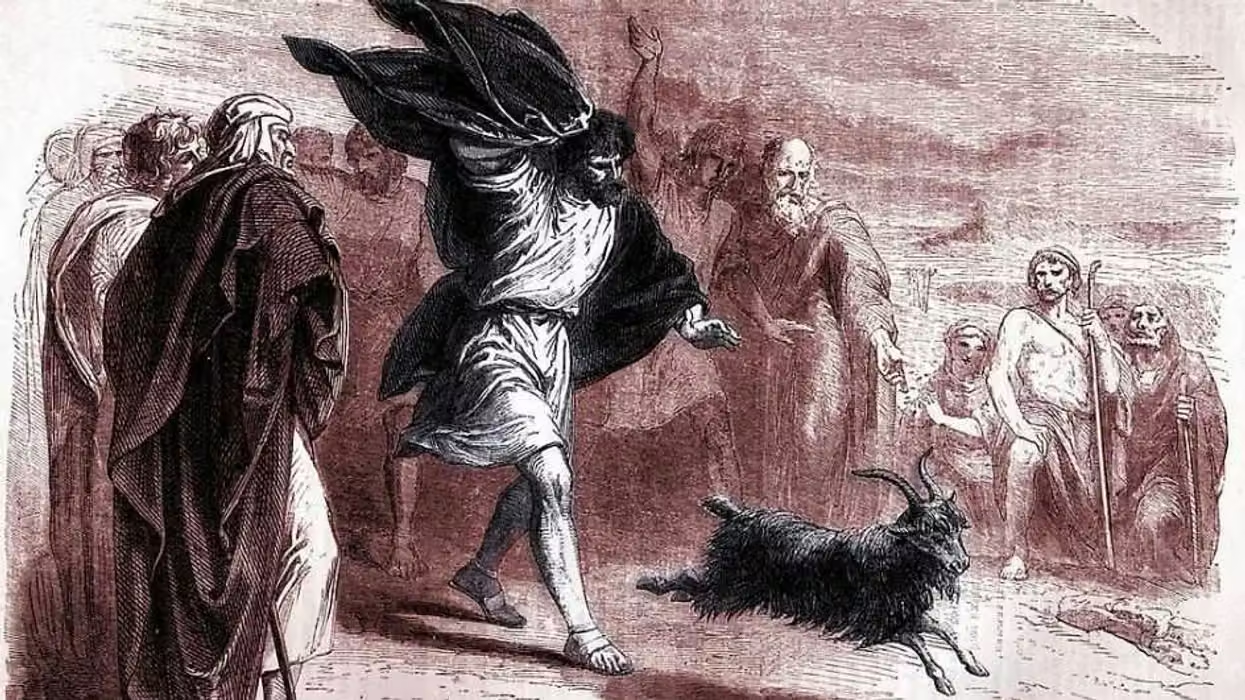
The elites are using you as a scapegoat. And I mean that in the oldest sense of the word. On the Day of Atonement, the high priest laid both hands on the head of a goat, confessed over it the sins of the people, and sent it out into the wilderness to carry those sins away. The community was cleansed. The goat was left to bear the burden.
That is what the idea we call “democracy” lets them do. They commit their sins, lay their hands on your head every November, and send you out into the wilderness to bear them. Democracy isn't the House of the People. It's Solomon's Temple. It’s the place where the priest unloads his sins onto the scapegoat and walks away cleansed while you carry the blame.