Photo by Alex Wong/Getty Images
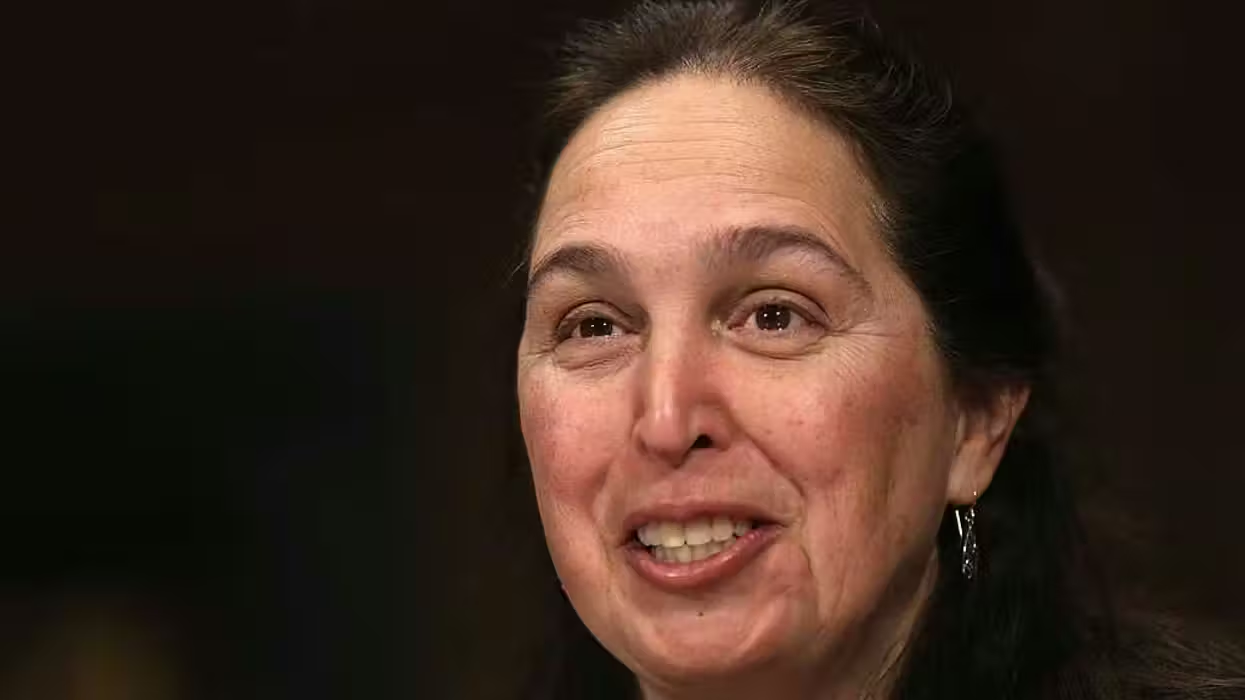
U.S. District Judge Indira Talwani, the Massachusetts-based Obama judge who blocked the Trump administration from cutting federal funds to Planned Parenthood last month, issued a temporary restraining order on Saturday preventing the Department of Homeland Security from revoking the legal status of tens of thousands of foreigners.
The Trump administration announced last month that it was terminating all categorical family reunification parole programs and corresponding work authorization for aliens from Colombia, Cuba, Ecuador, El Salvador, Guatemala, Haiti, and Honduras as well as for their immediate family members, effective Dec. 15.
Per the announcement, the "temporary parole period of aliens who have been paroled into the United States under the FRP programs, and whose initial period of parole has not already expired by January 14, 2026 will terminate on that date."
'We aren't in the clear.'
There are two circumstances under which foreign nationals' parole status would not immediately be revoked: if they have pending applications to register permanent residence or adjust status, or if DHS Secretary Kristi Noem determines otherwise on a case-by-case basis.
The DHS indicated that those set to be stripped of status — well over 10,000 noncitizens — who stay in the U.S. beyond their parole termination date with no lawful basis to remain would likely be removed.
According to the notice in the Federal Register, the FRP programs failed to achieve the goals set by past administrations and are at odds with President Donald Trump's current priorities and foreign policy objectives.
RELATED: 'You don't want this smoke': Philly DA and sheriff threaten ICE officers — DHS just laughs
 Photo by Michael Gonzalez/Getty Images
Not only did the programs fail to sufficiently discourage or reduce unlawful migration, the programs "increased administrative strain across multiple [U.S. Citizenship and Immigration Services] directorates and [Customs and Border Protection] ports of entry," said the notice.
"The desire to reunite families does not overcome the government's responsibility to prevent fraud and abuse and to uphold national security and public safety," the DHS said in a release.
"The FRP programs had security gaps caused by insufficient vetting that malicious and fraudulent actors could exploit to enter the United States, which posed an unacceptable level of risk to the United States," continued the release. "DHS is prioritizing the safety, security, and financial and economic well-being of Americans."
The Trump administration touted the move as a "necessary return to common-sense policies" and a matter of "prioritizing the safety, security, and financial and economic well-being of Americans."
On Dec. 29, plaintiffs in the class-action case Svitlana Doe v. Noem — represented by the liberal migrant advocacy groups Justice Action Center and Human Rights First — requested a restraining order and a preliminary injunction, claiming the DHS "fell well short of satisfying their most basic obligations under the [Administrative Procedures Act], due process, the parole statute, and its own regulations."
The plaintiffs' primary contention in the emergency motion appears to have been that the DHS allegedly failed to properly notify the so-called "future green card holders" of the programs' termination.
The government argued in response that the court lacked jurisdiction over claims challenging parole termination; that the termination of parole wasn't arbitrary and capricious as alleged; that Noem was within her statutory authority to make the change; and that the notice given complied with the law.
Indira Talwani, the daughter of immigrants from India and Germany, gave the migrant activists exactly what they wanted — a 14-day stay of the administration's termination of FRP grants of parole — and certified a new subclass of migrants, namely those FRP beneficiaries whose parole was terminated.
While the government previously indicated that individual notice would be provided to each parolee through their USCIS online accounts, Talwani expressed doubt about whether the parolees were ultimately provided with written notice of the termination and claimed that the publication of the announcement in the Federal Register "does not satisfy this requirement."
"The court finds that Plaintiffs have a substantial likelihood of success on their argument that the Defendants failed to provide proper notice of DHS's decision to revoke grants of parole under the FRP program in contravention of DHS’s own regulation, the Administrative Procedure Act ... and the Due Process Clause of the United States Constitution," wrote the Obama judge.
Karen Tumlin, director of Justice Action Center, celebrated Talwani's ruling, stating, "We join families across the country in breathing a huge sigh of relief. While we aren't in the clear, this immediate pause on de-legalizing individuals who came here with Family Reunification Parole means that people will not be forced to separate from their loved ones next week."
Tumlin added that it's "cruel and completely unnecessary for the Trump administration to try to yank the rug out from under them."
The White House did not respond to a request for comment from Blaze News.
DHS Assistant Secretary Tricia McLaughlin said in a statement to Blaze News, "Yet another lawless and activist order from a federal judge who continually desires to usurp President Trump’s authority to determine who can enter and remain in this country. Family reunification parole was a failed Biden-era policy, subject to shocking abuse."
"The safety of our nation comes before reunifying illegal alien families," said McLaughlin. "Under President Trump and Secretary Noem, we will safeguard this nation and end any exploitation of our nation’s immigration laws. We expect a higher court to vindicate us."
Despite drawing out the process, Talwani has acknowledged that the Trump administration can end the program.
The Supreme Court lifted her previous injunction in Svitlana Doe v. Noem on May 30, clearing the DHS to proceed with terminating humanitarian parole.
Editor's note: This article has been edited after publication to include comment from the DHS.
Like Blaze News? Bypass the censors, sign up for our newsletters, and get stories like this direct to your inbox. Sign up here!