© 2026 Blaze Media LLC. All rights reserved.
Young people aren’t just broke. They’re forced to buy what used to be free.
September 05, 2026
Last month, a viral X debate erupted among conservatives after Turning Point USA’s Andrew Kolvet shared a college student’s complaint that “a burrito shouldn’t cost $20,” prompting other conservatives to argue that the exorbitant price had more to do with poor spending habits than inflation alone.
While somewhat silly at face value, “burritogate,” says BlazeTV host Auron MacIntyre, reveals a contentious divide in conservative America over the nation’s affordability crisis. But while people are getting riled up debating charts and graphs, they’re missing a kind of loss that is much harder to quantify, he says.
On this episode of “The Auron MacIntyre Show,” Auron sits down with British author Johann Kurtz to discuss the social currency they believe is at the heart of America’s cost-of-living crisis.
Kurtz says it’s true that official numbers make young people look richer because goods like technologies, toys, cheap food, travel, and apps have gotten less expensive. But at the same time, the essentials that actually build a stable adult life — rent, homes, child care, school, and health insurance — have gotten much more expensive.
“Graduating from a good education, getting a stable career, finding a good spouse, buying a nice home, and having children — anchoring the debate on the price of a burrito, you know, it's an interesting flash point, but I do think that these deeper issues risk getting lost in the discussion,” he says.
One of those issues is social capital.
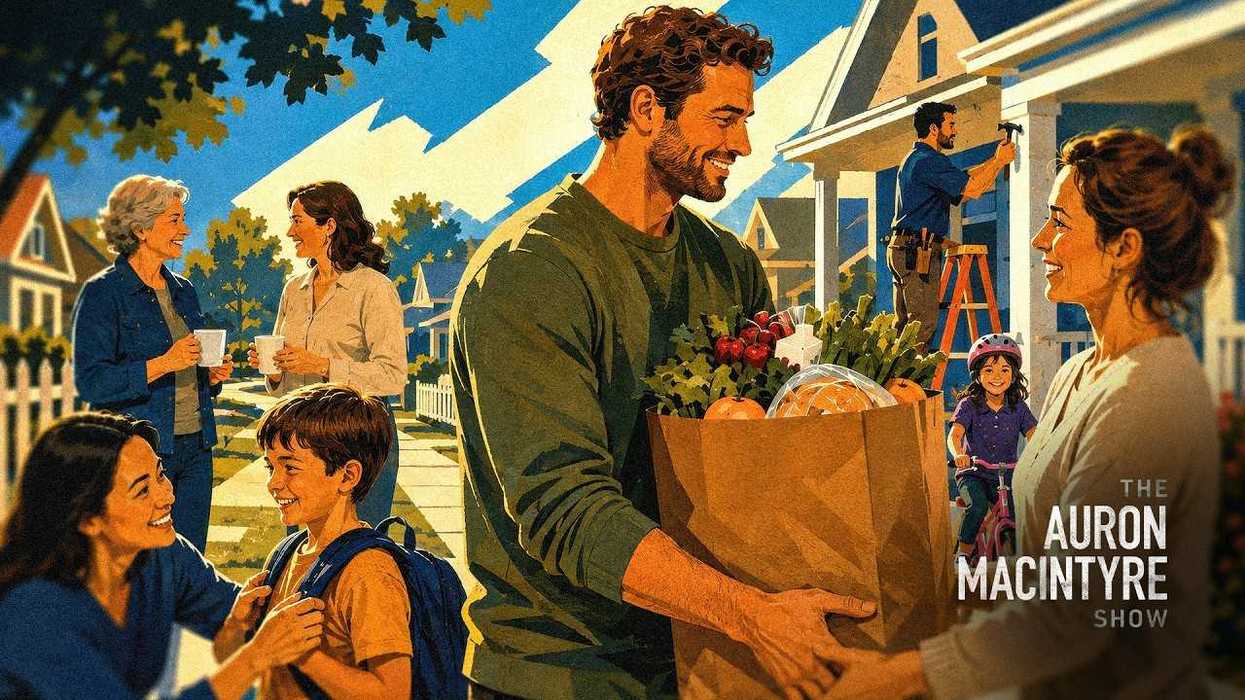
In his recent article “Young adults are poor despite every metric which suggests otherwise,” Kurtz argued that young people feel financially squeezed not only because prices are higher but because earlier generations got free social capital — trusted neighbors, functional schools, courtship norms, predictable careers, and a usable public square.
But in today’s world, that stock has been diminished, forcing young people to purchase expensive stand-ins.
“In London, where I'm from, the classic recommendation for middle-class parents is: You don't need an expensive home; you should just get a starter home in somewhere like Kentishtown,” says Kurtz.
But modern Kentishtown, he explains, is “full of unsavory characters” that make the area unsafe for families. “Material conditions have changed."
Today, “it is no longer often wise to opt for the public school. There is actually a good reason to choose the private school,” he tells Auron, noting that 50 years ago, 85% of the families of public school children were intact and likely upheld “implicitly Christian context.”
“Now that intact family rate has totally collapsed, and the only place where it can be predicted and relied upon as a kind of norm typically are in harder-to-access spaces — charter schools, public schools, classical Christian education, homeschooling,” Kurtz explains.
This trend isn’t showing up just in education, however, but in virtually all “easy, cheap public option[s].”
“[Easy, cheap public options were] good because they were embedded in a good culture populated by good people who sort of shared a vision and understanding and moral sense of life that you shared. And thus you could slum it a little bit,” he says.
But in the modern day, slumming it comes at exorbitant social cost. Such a lifestyle, says Kurtz, is more often than not shared by people who are “quite sketchy and are quite dangerous and are quite anti-family.”
Auron agrees. “In America, the famous example is Detroit. You know, people say, ‘Well, you can get a house for $50,000.’ Sure, and all you need is, you know, the machine gun perched on top of your roof in order to make sure that your home is safe all the time,” he says.
“What's really happened is the breakdown in all of those things that used to operate in the background that were built into the social fabric,” he continues. “The idea that you had intact households that cared for each other, that cared for the neighborhood, that made places safe, that made places affordable, that allowed for child care and all these things that weren't a paid job … that took a large amount of the burden off of young working families.”
But today, those built-in support systems are largely gone and therefore must be supplemented with paid child care, expensive housing in safe neighborhoods, private or classical Christian schooling, and other costly stand-ins for neighborly and family support.
What people are missing in the debates surrounding the affordability crisis, says Kurtz, is that “social capital is every bit as important as financial capital.”
“[When] you quantify everything and you host these very abstract arguments, which are exclusively framed in terms of a narrow set of poorly understood reductive metrics, it misses all of that context, which is why the lived reality on the ground can differ so radically from the kind of theoretical arguments that people make online.”
To hear more, watch the episode above.
Want more from Auron MacIntyre?
To enjoy more of this YouTuber and recovering journalist's commentary on culture and politics, subscribe to BlazeTV — the largest multi-platform network of voices who love America, defend the Constitution, and live the American dream.
Want to leave a tip?
We answer to you. Help keep our content free of advertisers and big tech censorship by leaving a tip today.
News, opinion, and entertainment for people who love the American way of life.
BlazeTV

BlazeTV Staff
News, opinion, and entertainment for people who love the American way of life.
@BlazeTV →more stories



Sign up for the Blaze newsletter
By signing up, you agree to our Privacy Policy and Terms of Use, and agree to receive content that may sometimes include advertisements. You may opt out at any time.
Related Content



© 2026 Blaze Media LLC. All rights reserved.
Get the stories that matter most delivered directly to your inbox.
By signing up, you agree to our Privacy Policy and Terms of Use, and agree to receive content that may sometimes include advertisements. You may opt out at any time.