© 2026 Blaze Media LLC. All rights reserved.
As Marshall McLuhan told us a few decades ago, media both extend and amputate the human. The digital realm feels slippery because of an apparent flatness. As digital translates analog, some things are lost, others gained.
Medieval paintings, which, without perspective and depth, acoustic and smooth, rhyme with our digital times. Things in the environment appear achingly simultaneous. The digital, too, makes texture and perspective smooth. It's easy to attack that attribute as inherently dehumanized or dehumanizing, but the history of art suggests otherwise. Many, myself included, appreciate and enjoy medieval paintings. With its slick devices and overwhelming amounts of information, digitization frequently makes me (and others) weary. But I've found that its slipperiness can be artistically helpful – with poetic composition, for instance.
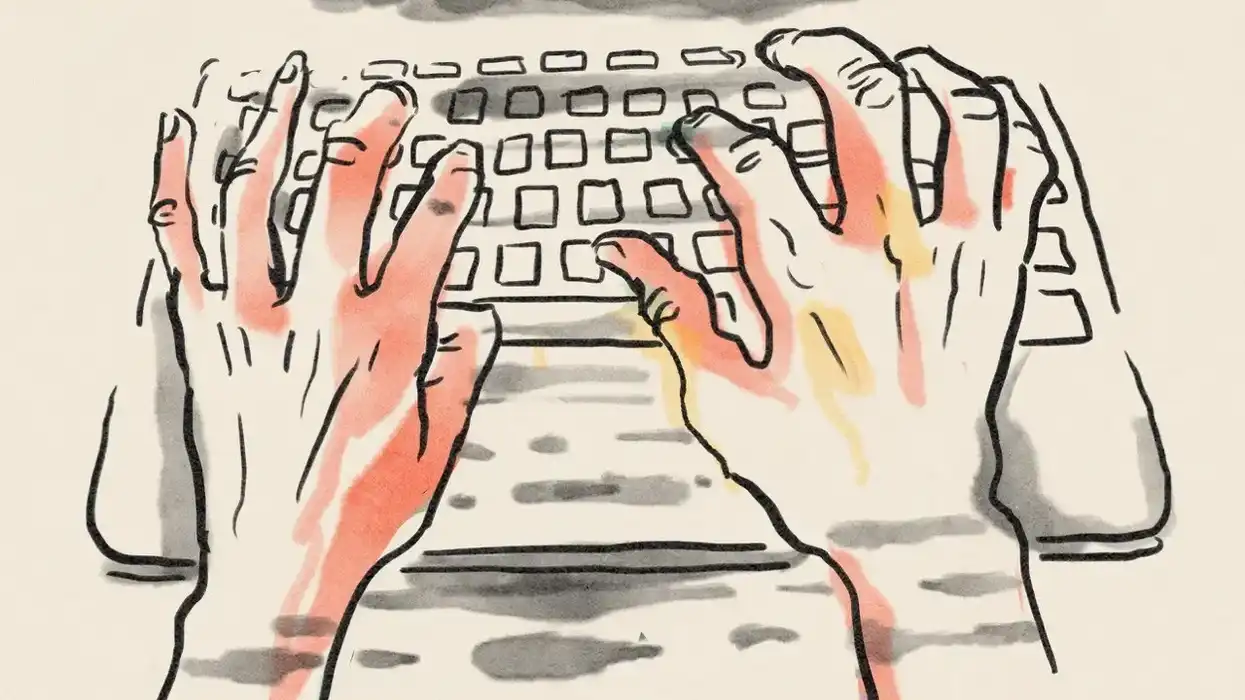
Writing on a computer is slipperier than writing by hand. What do you write? is generally considered a meatier, more important question than What do you write with or What do you write on? When I write (poems, essays, lists, dictations, things to remember…), which is often, it's frequently in the notes section of my phone or on my computer. Attempting to think and write about this digital slipperiness is disorienting yet revealing, like trying to think about the screen as it plays a movie. Media recedes so that what it transmits can fully come forward, play, and present itself. When my screen breaks, I notice it. When my hands and back ache, I realize the physical toll writing takes.
Hermes, whose Roman equivalent is Mercury, is the messenger god. He rules over travel, commerce, thievery, communication, and writing, including poetry. Mercury has a lot to do with hands. With our hands, we make decisions, gesticulate, type, scroll, solidify agreements, deliver messages, press send, wave hello/goodbye, and pick up and throw down pencils. Think about Robert Bresson's movies, with their frequent close-ups of hands, which reveal so much about their characters' inner lives: dropping a glass, petting a donkey, picking up broken glass, taking or receiving cash, starting a car, holding other hands tenderly or reluctantly, smoothly picking a wallet out of a stranger's pocket, getting bound by chains, resting calmly on legs, pouring drinks…
It's not the whole hand but the fingers – digits – which, true to form, the digital activates: scroll, type, click—my hand cramps often when I write longhand but rarely when I type. With less hold and more give, the digital allows thought to quickly move from head to fingertips. The hand's no longer dragging itself across the page as, quill in hand, it inks. Still, writing longhand is resistance and muscle, suitable for a certain kind of thinking. When I translate handwritten writing to the computer, particular textures and energies get lost just as new utterances, errors, and channels emerge.
Like all media, poetry is an intermediary that can, at turns, hide and reveal, foregrounding the difficulty of perception itself, that everything is hidden in something else. Poetic truth arrives obliquely, occluded. Poetry often feels like a glimmering web trickily bridging the two if the spoken word is software and the written word is hardware.
In Angels: A Modern Myth, Michel Serres argues that angels can help us understand our digital networking systems. Angels, he writes, are "functionaries in service of the Word" characterized by a certain detachment from the words they transmit: "If a transmitter does his job properly, he disappears. A true transmission is characterized by elimination, a false one by presence: a curious paradox." Think here of the Annunciation, when Mary is informed by the angel Gabriel that she will bear God's son.
In the countless renditions, my favorite being one by an unknown twelfth-century English illuminator, the recipient of news (Mary) looks alarmed. The angel extends his hand. Mary raises hers as if to say whoa. When we are presented with news bearers, there's a natural pause. What will this creature do? Injure, cure, inure, what? What is the quality of the news he'll reveal? Will it hurt me, help me, matter? Is it tragic, shocking, or sweet? The Annunciation shows the angel in this precarious and thrilling instant: delivering a message, hand to hand, just before receding.
If the properly working piece of media recedes, if the good angel steps away and resists the urge to glimmer more than the information given to him by God requires, then the bad angel shows himself too much, interfering with the message he's meant to herald. The medium, usually a background operator, comes to the front when something's amiss when a piece of news must be transferred when someone must be escorted between zones when the technology breaks … or when art gets made.
Poetry, as anti- or mis- or X'd information, has a unique capacity for making the medium appear and disappear in strange plays. Words appear unusual – broken up or pushed up against each other before they dissolve. Poetry, visible and invisible, lives somewhere in the creases of the oral, oracular, scribbled concrete. It's both impossible and very easy to miss. Georges Bataille suggests poetry is a form of creative sacrifice where the words can be the victims. The poet can become a kind of channel, a passively muscular vessel for taking dictation. The typewriter and its descendant, the computer, can be a cool tool for quick transmission as fingers move closer to thought's speed. Artists reveal how new mediums can be used for things other than what they're made for, not as instruments of quick communication but something else entirely – for instance, something sacred. I think of the weaver Anni Albers' typewriter poems, where typewritten letters become cloth and the typewriter a kind of loom. Albers said: "These varied experiments in articulation are to be understood not as an end in themselves but merely as a help to us in gaining new terms in the vocabulary of tactile language."
Writing a poem on the computer means return, spacebar, question mark, and every lettered key get used not necessarily to compute but to transport. OK, words and letters, as materials, get broken into bits, cut off midway, extended, chopped into lines and stanzas, and injected with great distances. Even when enacted on a typewriter or slippery screen, this process is always rough, a little resistant, and very hand-to-hand. Poetry razes words to raise them, knocks them around, takes them to limits, and Xs them out as instruments of information to raise them as other vessels. In hiding, it reveals. But talking about poetry also does a certain kind of violence to it. You know it when you feel it, and when you belabor it, you can lose it. "If I feel physically as if the top of my head were taken off, I know that is poetry," said Emily Dickinson. These are the only ways I know it. Is there any other way?"
Is typing on a screen's smooth surface, moving the fingers quickly and lightly across the keys, less work than handwriting? In some ways, yes. The computer atrophies the hands while extending their digits. The body gets slack, and the fingers activate. As I type this, the rest of me barely moves. Still, as twins, the hands and the brain continuously spin together. In a letter to Emile Bernard in 1889, Van Gogh made a telling confession not long before the infamous ear episode. Although he gave himself "free reign with abstractions," appropriately so "after a virile lifetime of research, of a hand-to-hand struggle with nature," he had come to prefer the constraint of the roughly concrete: "What I am doing is hard, dry, but that is because I am trying to gather new strength by doing some rough work, and I'm afraid abstractions would make me soft." The digital slip and the smooth clank of computer keys also make us soft.
McLuhan says machines have not stiffened life but melted it. The hands rolling across the keys and scrolling through squares of information aren't met with as much resistance as the hand-to-hand combat with nature that Van Gogh describes or the grueling process of writing for hours with the hand. Poetry and media (Mercury, angels, pens, paper, typewriters, computers…) are forever linked. They alter how we think, the very ground on which we type or handwrite. All of them are, like quicksilver, slipping away from me as I write.
In his new book Non-Things, contemporary philosopher Byung-Chul Han sets up a split between things and non-things. Possession relates to the thing. To possess is to have, own, live alongside, warm up, and form a lasting relationship with. Non-things replace things in our information-melted world, which is controlled "not by possession but by access." Han continues: "Attachment to things or places is replaced with temporary access to networks and platforms." Possession implies intimacy, inwardness, and intensity. The problem, in Han's view, is that we don't possess our electronic gadgets. We use them to access information. Fate, a sense of a whirling world having befallen us, doesn't mesh with the algorithmic and choice-driven digital order. Fate is an "alien power that immobilizes us," but with our smartphones and smart everything, it's easy to feel we have a grip, the world and its words at our literal fingertips.
Back to McLuhan: "literate man, when we meet him in the Greek world, is a split man, a schizophrenic, as all literate men have been since the invention of the phonetic alphabet." We can also think of schizophrenia, which comes from Greek words meaning split + mind and whose symptoms include hearing voices, faulty perception, and hallucination, a collective crisis of splitting. Though seemingly smooth, the digital introduces smoother, faster, more frequent splits as it's constantly in the process of breaking the analog information it translates into faster, if less accurate, bits. Serres says we should be interested in angels nowadays because "our universe is organized around message-bearing systems, and because, as message-bearers, they are more numerous, complex, and sophisticated than Hermes, who was only one person…" How do you sort the angels from the air? Or, how to read (and write) in what Mark Fisher calls the digital ether or what Byung-Chul Han calls the world of non-things, where airiness, for better or worse, reigns?
"Every angel is terrifying," according to the poet Rainer Maria Rilke, which has something to do with the startling and glimmering pause marked by The Annunciation. In a letter to his lover, Lou Salome, Rilke also wrote, "Somehow I too must manage to make things; written, not plastic things, – realities that proceed from handwork." Byung-Chul Han uses that quote in Non-Things to illustrate that we "cannot read a thing. A poem, as a thing, resists the kind of reading that consumes sense and emotion." A poem resists quick delivery of information or meaning, and this resistance doesn't "sit well with our pornographic and consumerist age." So, there's an anti-poetry air. Angels, strangely alarming, engine the beauty that is the beginning of terror, to (sort of) quote Rilke. And perhaps the digital slip, at least where it overlaps with the marketplace, doesn't have as much tolerance for terror, beauty, or disquieting angels you have to pause for.
In Han's view, art in the age of information tends to instruct rather than seduce. He charges contemporary poetry with a tendency towards predigested messages: legible and flat as a hi-res digital image. But good poetry can also make everything (including the digital liquid we swim in) seem strangely unhooked from its usual functions. We can't stay pure in the digital arena, as it's already mixed with the analog, like smoking and non-smoking sections in one restaurant.
Like those medieval paintings I mentioned, the digital flatness and its apparent slip bring about a perceptual rearrangement. Writing and art that use these technologies in their composition find their resistance to instantaneousness in the slip. I'm frequently pessimistic about the digital world and its disorientingly immediate meltiness. And yet these machines, with their vast flat libraries, fast and smooth, slippery and split, allot us a new way to receive, a new space for a new trembling.
Want to leave a tip?
We answer to you. Help keep our content free of advertisers and big tech censorship by leaving a tip today.
Want to join the conversation?
Already a subscriber?

more stories


Related Content


© 2026 Blaze Media LLC. All rights reserved.
Get the stories that matter most delivered directly to your inbox.
By signing up, you agree to our Privacy Policy and Terms of Use, and agree to receive content that may sometimes include advertisements. You may opt out at any time.