SvetaZi/Getty Images
On Thursday, Apple raised prices on basically every Mac, every iPad, the HomePod, the Apple TV, and the Vision Pro. Not a refresh-with-new-specs bump where they hand you a faster chip to soften the blow, but a global markup on hardware that didn't change, live on the store the same morning. Apple's stock fell 6.1%, its worst single day since April 2025.
The same day, Microsoft raised Xbox prices for the third time in 13 months.
Apple put the blame squarely on 'the rapid expansion of AI data centers.'
I've been telling you that you're already paying for the AI boom. You just weren't getting an itemized bill.
Back in May, the evidence was your electricity. Residential power prices are up roughly 30% since 2020, and they climb worse the closer you live to a data center. The point I kept hammering was simple: The cost of this build-out doesn't stay in Silicon Valley. It gets pushed downstream, onto you.
The numbers tell it better than I can. Here's the Apple damage:
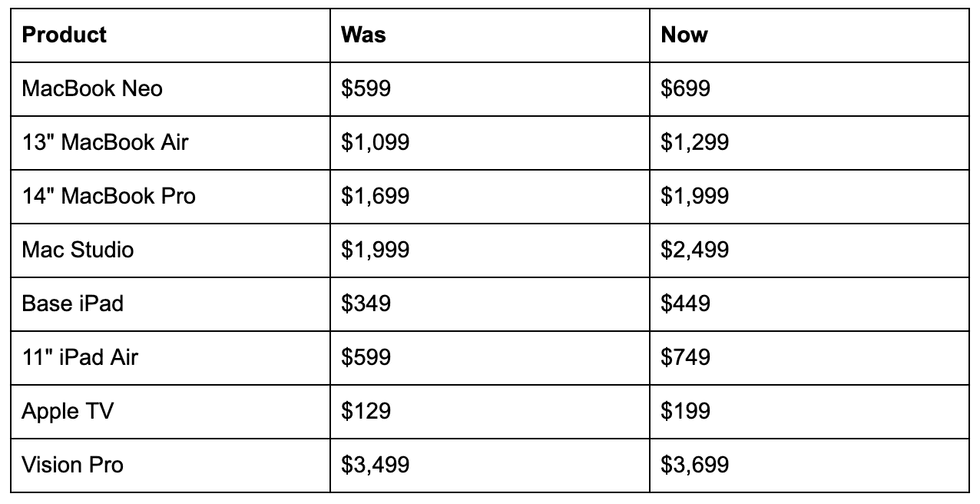 Table by Josh Centers for Blaze Media
A fully loaded 16-inch MacBook Pro now tops out at $10,149.00. Five figures for a laptop. Apple’s short reign as the best value computer manufacturer is over.
Tim Cook told the Wall Street Journal last week that Apple couldn't keep shielding customers from what's happening to component costs. He called it "a hundred-year flood" and said that in more than 40 years, he had never seen anything like it in any corner of the business.
Apple's own statement ran in the same direction: It says component costs have spiked farther and faster than anything it has dealt with before, and it put the blame squarely on "the rapid expansion of AI data centers."
Here's the thing about that. When Apple tells you it can't absorb a cost, believe it. This is the company with the most ruthless supply chain on Planet Earth, the one that squeezes suppliers for sport and gets first dibs on every new chip node. If Apple is raising your prices, the problem isn't Apple being greedy this quarter. It's a tell. The squeeze is real enough that even the apex predator is passing it down the food chain.
Microsoft's hike lands August 1: A hundred bucks more on the 512GB consoles, $150 more on the 1TB models, and the 2TB version gets killed off entirely. The flagship Series X with a disc drive jumps to $800. It was $650 not that long ago.
Now, the first two Xbox hikes, back in May and September 2025, were about tariffs. Microsoft danced around it the second time with "changes in the macroeconomic environment," but everybody knew what that meant. This time, Microsoft came right out and said console storage and memory are up 2.5x since October and the company expects those costs to double again by the fall of 2027. The story shifted from politics to physics.
And consoles are the worst possible place for this to hit, because of something most people don't know: Microsoft sells the box at a loss. The whole model is to eat that loss up front and make it back on games, accessories, and Game Pass subscriptions over the life of the machine. So a memory spike doesn't shave a margin here. It blows a hole in one.
RELATED: People still nagging you to get an Apple laptop? This news might silence them once and for all.
 SvetaZi/Getty Images
Which brings us to the detail that tells you everything you need to know about where we are: buy now, pay later.
Microsoft is rolling out interest-free installments so you can finance an Xbox. Amazon is offering up to 12-month payment plans. The companies are rolling out a layaway program for a video game console and calling it a feature.
Micron just reported that quarterly revenue more than quadrupled. Its gross margin went from 39% a year ago to 84.9%. That's fatter than Nvidia or Meta.
Memory makers are shoveling production toward high-bandwidth memory, the stuff that goes into AI servers, because that's where the desperate, bottomless money is right now. Every wafer that becomes an HBM stack for some hyperscaler's GPU cluster is a wafer that doesn't become the plain old DRAM in your laptop or the storage in your kid's Xbox. Consumer hardware and AI infrastructure are now fighting over the same finite supply, and consumer hardware is losing.
You're not imagining the squeeze. You're funding it. A video game console is now a layaway purchase in the same week a memory chipmaker posts a margin north of 80%. The money didn't vanish. It just changed hands on the way to your living room.
Earlier, I wrote that the AI bubble wouldn't burst with a headline. It would burst with a memo. A canceled license, a quiet budget revision, a company sheepishly rationing the miracle tool it told you would change everything.
This is the flip side of that exact coin.
Even as companies start trimming their AI spending behind closed doors, the hardware build-out they already committed to is still out there vacuuming up components by the trainload. The data centers are under construction. The memory orders are placed. And the bill for all of it lands on you, at the Apple Store, at the GameStop checkout, whether or not the AI revolution ever actually pays off the way they promised.
That's the part that ought to bother you. Nobody asked if you wanted to subsidize this. You just woke up Thursday and the MacBook your kid needs for the fall semester costs $200 more than it did Wednesday, the Xbox now ships with a financing plan, and somewhere a server farm is coming online that will consume more power than a small city.
Apple all but announced the next round. iPhone increases are coming, probably aimed at the Pro models where buyers don't flinch at a hundred bucks. Bloomberg Intelligence figures a $100 bump covers 78% of the added cost. There's also a foldable model expected to clear $2,000. John Ternus inherits the whole memory mess on September 1 when he takes over as CEO.
And it isn't just Apple bracing you for more. At the ISC 2026 conference, Lenovo warned, half in jest but pointedly, that memory prices have entered a structural climb that won't reverse to early-2025 levels even as Samsung, SK Hynix, and Micron race to add capacity and that high DRAM and NAND prices will become the "new normal" in 2030 and beyond. An actual hardware maker is now telling its own customers to budget for pricier PCs, consoles, and phones straight through the end of the decade.
The through-line of everything I've written on this is one ugly sentence: The era of cheap, open, owner-controlled personal computing is closing, and AI is the thing closing it. Not with a ban. Not with a law. With a price tag, applied a little at a time, until one Thursday you look up and the floor has moved out from under you.
The hardware is all still for sale. You just can't afford as much of it as you could last year. And next year you'll afford less.
And if you were planning to do what I told you in May — buy your own hardware, run your own models, stop renting intelligence from a company that loses money on you — here's the bad news. That hardware runs on the same memory everyone is now fighting over. The DRAM, the storage, the GPU you would buy to own your compute is exactly what is spiking. The escape hatch is closing.
Buy what you actually need now. It is not getting cheaper.