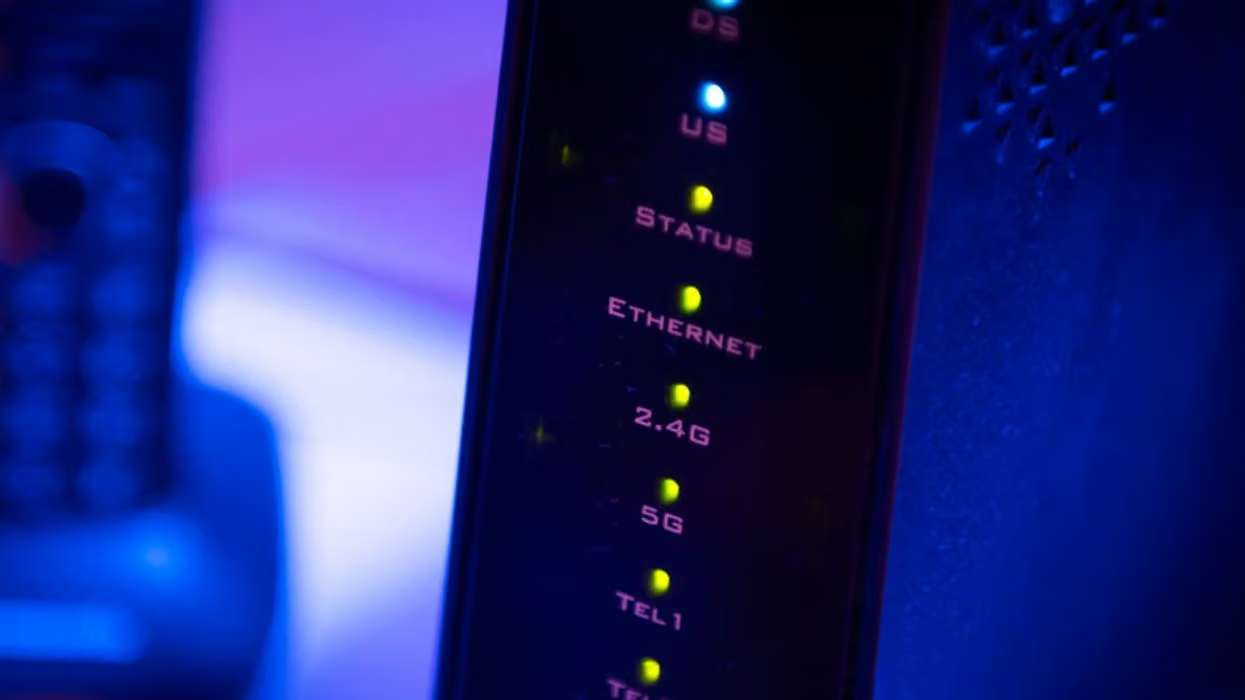
Jaap Arriens/NurPhoto/Getty Images
It seems like science fiction, but it's actually backed by frightening scientific evidence.
A viral post online showed Wi-Fi signals mimicking breathing patterns in a 3D model; but what was shown as a graphic is actually real and is only a small scope of what signals can track in the home.
'Breathing is enough to give you away.'
A post from an engineer claimed that "each breath slightly changes how Wi-Fi waves reflect off your chest" and effectively revealed that "breathing is enough to give you away" should bad actors want to know about your whereabouts.
The post, seen by nearly 2 million readers, said that these tiny changes in breathing rhythm are noticeable and match Wi-Fi signals in the same room.
Unfortunately for the consumer, these claims are corroborated by many reports — including those from the government — and are just the tip of the iceberg in terms of what can be tracked using Wi-Fi signals.
In fact, the study of Wi-Fi-based tracking has been widely studied, and the results are frightening.
By simply monitoring how the signals are bouncing back, programs can detect human presence, whether a person is walking/standing/sitting, and, according to a report from Stork.ai, even detect movement through walls in some conditions.
RELATED: ChatGPT is building massive psychological profiles of its users — without their permission
 Thomas Trutschel/Photothek/Getty Images
Blaze News has previously reported on how smart TVs and even HDMI cords can be used to pry into user privacy, and Wi-Fi can now be included with a vast list of capabilities that even extends to monitoring the amount of occupants in a room.
Moreover, a report from the National Institute of Standards and Technology — a federal entity — made this an open secret in a 2022 report when it positioned it as a good thing that could "help doctors fight the COVID-19 pandemic."
In a report titled "Wi-Fi Could Help Identify When You're Struggling to Breathe," the NIST said it could detect breathing rates, breathing patterns, slow breathing, or other disruptions with "already available Wi-Fi routers and devices."
RELATED: Android is beefing up scam protection for texts and calls — just in time
 Arterra/Universal Images Group/Getty Images
Heartbeats are also not off the table according to Taiwanese researchers.
Dr. Tzi-cker Chiueh, from a power management company called Delta, found in his research that breathing rates can be monitored through Wi-Fi signal disruptions with up to 95% accuracy at up to five meters. Heartbeats were tracked at 83% accuracy from up to one meter away.
Readers may recognize similar technology being utilized by the CIA to locate a stranded pilot in Iran.
Studies and reports appear to prove that Wi-Fi signals can be effectively used as distance-measuring devices that can also digitize and measure human function through the analysis of the constant burst of signals and any consistent pattern of disruption.
Like Blaze News? Bypass the censors, sign up for our newsletters, and get stories like this direct to your inbox. Sign up here!