Kevin Dietsch/Getty Images
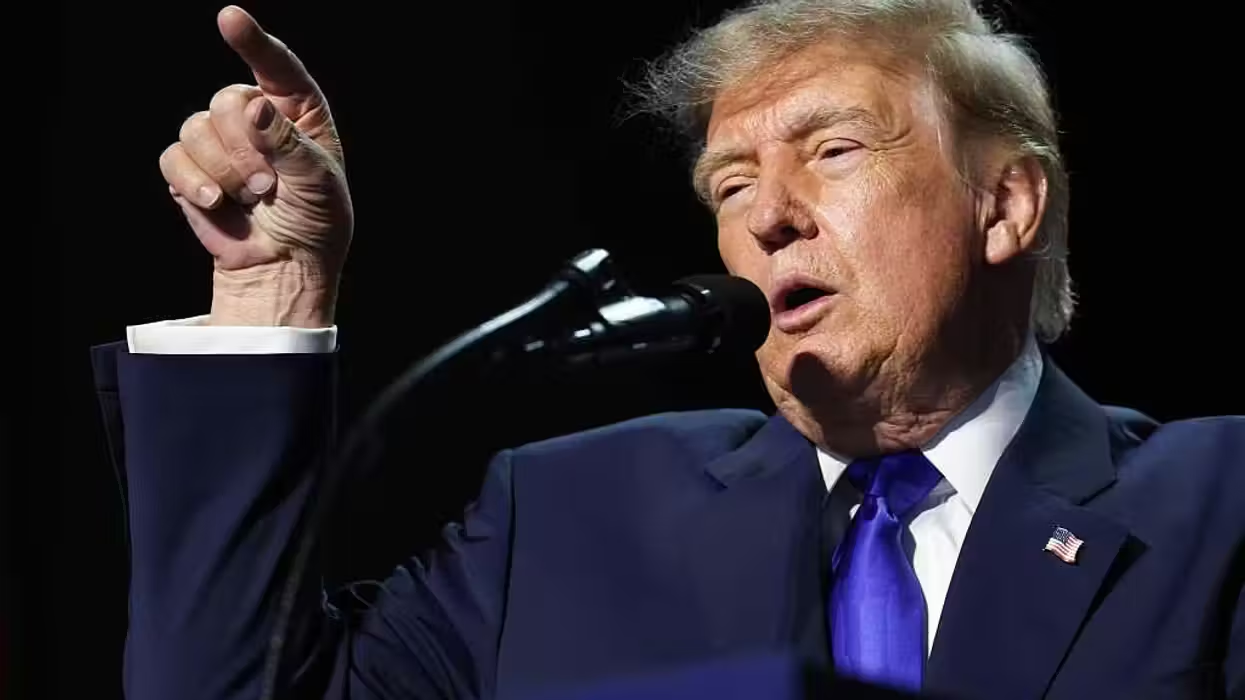
President Trump’s call for a $5,000 “dividend” payment to all adult U.S. citizens is being widely criticized as fiscally unsound, grossly irresponsible, a cynical vote-buying scheme, and another political promise that will never come to fruition.
Trump’s plan, as he presented it in just a couple of throwaway sentences at the Republican Midterm National Convention in Dallas last week, is indeed all those things. It amounts to a Keynesian-style attempt to stimulate the economy temporarily by making people feel richer than they are, to be followed by the usual consequences of such fiscal monkeyshines: violent inflation and a subsequent grinding recession.
An unprecedented economic boom or dramatic revenue surge cannot be assumed in advance.
Trump, however, is a habitual dealmaker. What if congressional leaders were to respond to the president’s idea as a starting point for negotiations?
My suggestion: Agree with the president to pass a one-time tax cut of $5,000 for the 2027 fiscal year, paired with a permanent spending cap set at the 2019, pre-COVID-19 level and mandatory 2% additional reductions in the spending cap each year through 2040.
The tax cut would be payable immediately upon enactment and designated as refundable to all U.S. households that file a personal income tax return (whether they pay any income tax or not), thus fulfilling Trump’s promise.
Republicans would make a simple deal with the American people: $5,000 today for every adult citizen, in exchange for serious, desperately needed cuts in federal spending beginning in the next fiscal year and continuing through the next decade. Any congressional Democrats who want to do the right thing will be welcome to vote for it as well, of course.
For practical reasons, the spending cuts would need to begin with the 2028 fiscal year in October 2027, but the 2% annual spending cuts thereafter would easily offset the extra interest costs on the additional federal debt that the delay would create.
To implement the cuts, Congress would convert the federal portion of spending on Medicaid, SNAP, housing programs, higher education, and the like into block grants to the states, with the expenditures scaled down to the 2019 level. The legislation would institute 5% annual reductions in those block grants for subsequent years through 2040, essentially phasing them out of the federal fisc.
The move to block grants with annual downsizing would steadily transfer responsibility for welfare spending to the states, where it belongs. Federal redistribution programs are not explicitly permitted under the Constitution, and the Supreme Court should never have allowed Congress to establish those programs.
These welfare programs account for about 24% of the $7 trillion-plus federal budget, around $1.7 trillion. In 2019, they composed about $1 trillion. A return to that number would pay off a $1.3 trillion refundable one-year tax cut in less than two years, with a dozen years of much lower federal spending on the way.
RELATED: Free money wins elections — and that’s why America’s debt will keep growing
 Tom Williams/CQ-Roll Call Inc./Getty Images
If a 40% cut in spending on federal welfare programs sounds draconian and cruel, remember that the 2019 spending level was far from stingy. We needed cuts then, and we need them much more urgently now, even without Trump’s dividend payments. Investigations during President Trump’s current term suggest that elimination of entitlement fraud could lead to even greater cuts than what this plan would call for.
Congress should also consider cutting defense spending to provide further spending reductions.
In short, this would be a temporary tax cut and permanent spending cuts — the very opposite of the way things are ordinarily done in Washington D.C. The key element, and the unique opportunity here, is the political goodwill and appealing trade-off the $5,000 dividend checks would provide.
The only way to reverse the spending cuts would be through legislation signed by the president or a veto override. Trump would have every reason to refuse any attempt by Congress to restore the spending, especially given his track record of trying to implement limits on entitlement programs through executive orders. The same would be true for any Republican successors.
Moreover, the transfer of welfare responsibility to the states would eliminate congressional spending junkies’ ability to use these programs as a slush fund for buying votes. In addition, the money simply will not be there, given the rising cost of Social Security and Medicare.
This plan would allow Congress fiscal breathing space to develop a plan to transition Social Security and Medicare into private taxpayer accounts and transfer future responsibilities for those programs to the states. Social Security and Medicare are just as unconstitutional as the other entitlements, with the important difference that these were funded by people’s paychecks with the direct promise of repayment, a pledge the government must keep for current and prospective retirees.
Americans would be relieved to know that major Social Security cuts are off the table.
The plan should also make permanent all of Trump's executive orders that have reduced federal regulations — and add further regulatory relief.
RELATED: Trump’s interest-rate fantasy runs into debt gravity
 Andrew Harnik/Getty Images
The large, one-year tax cut would spark an economic boom of possibly unprecedented proportions. Economic growth would cause federal revenues to rise dramatically in subsequent years, which would enable the government to begin paying down the existing federal debt.
The spending cuts would push down interest rates by greatly reducing the federal deficit and thereby raising the assurance that the federal government will be able to pay its debts, thus increasing the value of Treasury bonds and lowering interest costs.
This would reduce interest rates for all Americans, including for mortgages. That would help relieve the housing affordability problem.
The entitlement cuts would also put able-bodied people back to work and make them taxpayers instead of tax takers, raising revenues and cutting costs further. That would spur even more economic growth.
These would be impressive achievements. A political party that instituted this plan could create a permanent majority despite the inevitable mistreatment by the media and the opposition party, while returning the nation to constitutional rule. Most people dislike the current overspending, and people recognize that far too much of it goes to cheaters, grifters, and government cronies.
For the good of the American people, Trump and the congressional Republicans should prepare legislation to implement this full plan in the lame-duck session, immediately after the election, regardless of whether they win House and Senate majorities this fall. They would be giving the American people a great gift of economic prosperity and better government, and Democrats would not be able to reverse any of it, with a Republican president holding veto power.