Taylor Hill/Getty Images
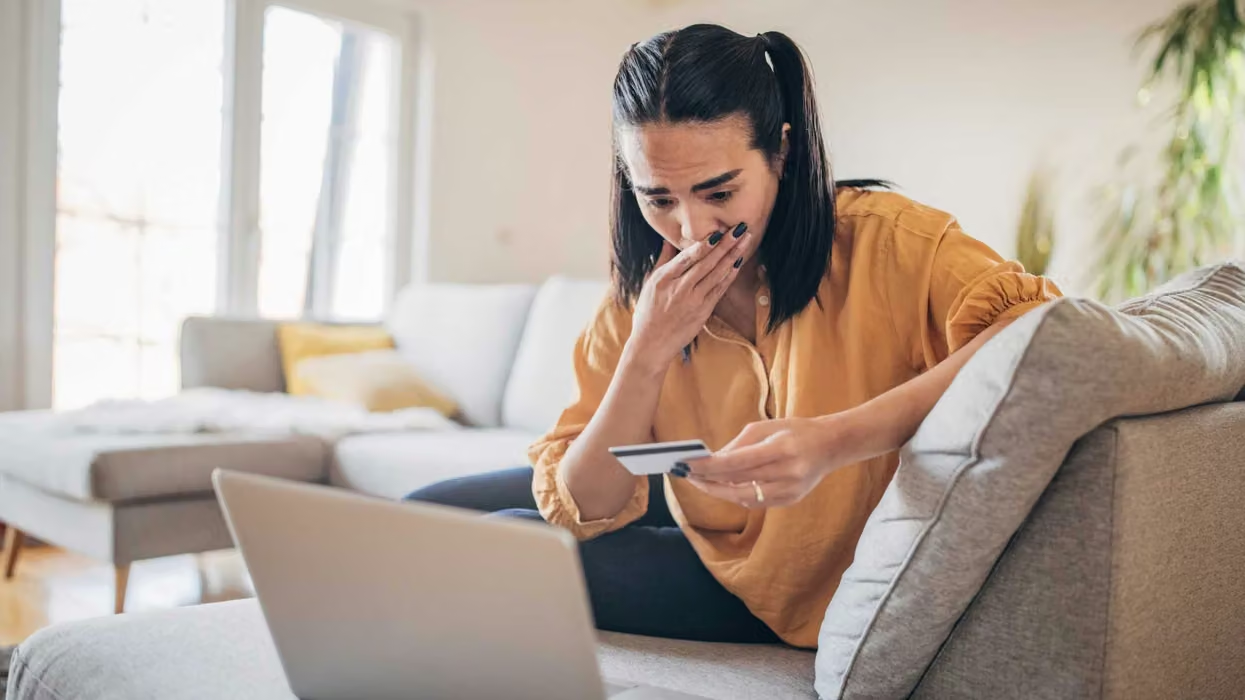
There’s a reason Democrats are focused on affordability: It is a daily reality, and many Democratic policies make it worse.
Democrats have been running on “affordability” since Joe Biden left office and broke the party’s direct political connection to the inflation surge of his presidency.
Yes, affordability is a problem. But you do not solve a problem by putting the people who helped cause it in charge of fixing it.
When Biden took office in January 2021, inflation was 1.4%. By March, it was 2.6%, and by December, it hit 7%. It reached 7.5% in January 2022, topped 8% in March, and hit 9.1% in June — a 40-year high. By December 2022, it was still 6.5%.
Inflation did not fall below 3% until the latter half of 2024, and it never returned to within one percentage point of the rate Biden inherited.
Democrats spent much of the Biden years defending the administration’s economic record. Now they talk constantly about affordability, even though today’s price level still reflects the inflation Americans absorbed during those years.
That distinction is vital. Slower inflation means prices are rising more slowly; it does not reverse increases already built into the economy. Those higher prices remain unless incomes eventually catch up or prices actually fall.
Politically, that creates an opening. Democrats can campaign against high prices after presiding over the period when those prices rose fastest, while hoping voters forget how they got there. Much of the coverage treats affordability as a fresh problem rather than the cumulative result of years of price increases.
Affordability is national, but it is not uniform. Some states are much more expensive than others, and the partisan pattern is difficult to ignore.
RELATED: Trump’s next tax cut should make Americans owners
 Jim WATSON/AFP/Getty Images
According to World Population Review’s 2026 Cost of Living Index by State, blue states dominate the least-affordable end of the rankings.
Hawaii ranks as the nation’s most expensive state. It voted for Kamala Harris 60.6% to 37.5% in 2024 and has had Democratic trifectas in state government for 27 straight years.
The pattern extends beyond Hawaii. Of the 10 least-affordable states, only Alaska voted Republican in the 2024 presidential election. The next Republican-voting state is Arizona at No. 15. Thirteen of the 15 least-affordable states, and 15 of the top 17, voted Democratic in 2024.
At the other end, Oklahoma is the nation’s most affordable state. It voted for Trump 66.2% to 31.9% in 2024 and has had 16 straight years of Republican trifectas in state government. All 10 of the most affordable states voted Republican in 2024.
Partisanship is not the only thing that determines a state’s cost of living. Geography, housing supply, energy, taxes, regulation, and labor costs all play roles. But policy affects several of those variables directly.
Democratic policies often push costs upward through heavier regulation, higher minimum wages, greater public spending, and higher taxes. Businesses pass many of those costs along. Residents pay the rest directly. Either way, affordability suffers.
That is the bind for Democrats. They see a powerful political issue in affordability, but many of their preferred remedies would add costs rather than reduce them. Fixing the problem would require reconsidering policies they have spent years defending.
Worse, they increasingly want to impose those policies nationally, exporting mistakes made in high-cost blue states to places that have so far avoided them.
Yes, affordability is a problem. But you do not solve a problem by putting the people who helped cause it in charge of fixing it.