James Willoughby/SOPA Images/LightRocket/Getty Images
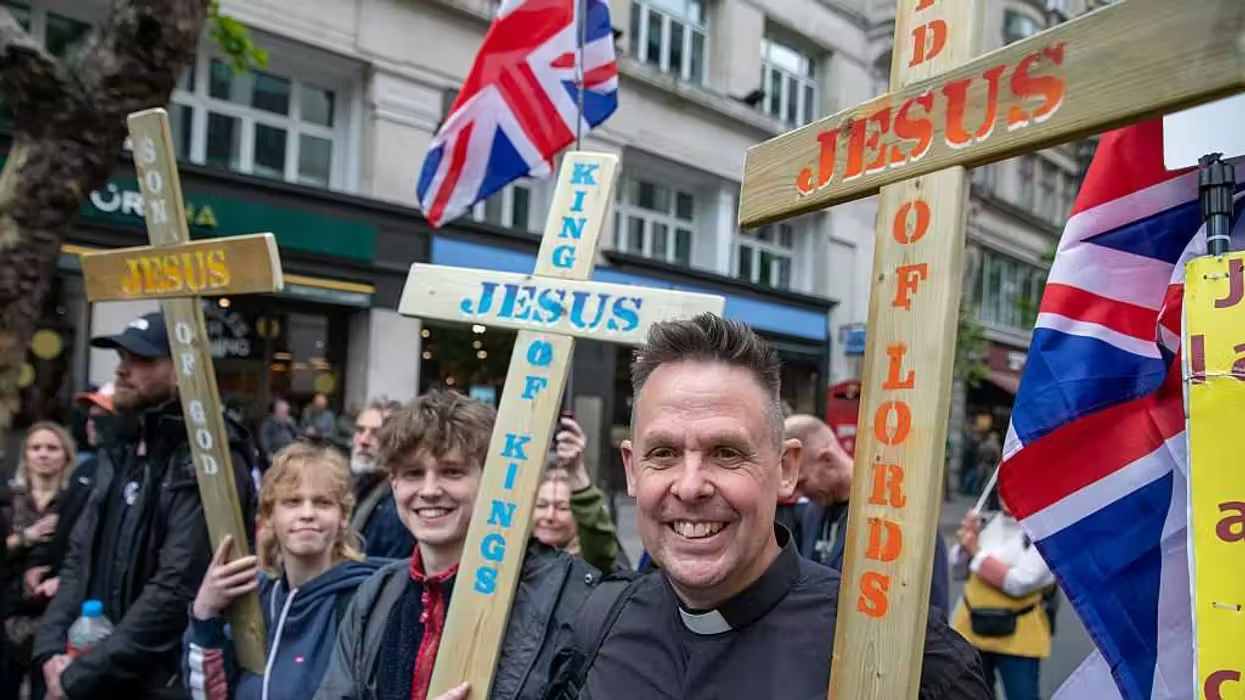
The United Kingdom is constitutionally a Christian nation.
Its king, Charles III, is "supreme governor" of the Church of England — England's established church — and an ordinary member of the Presbyterian Church of Scotland. Anglican bishops serve as members of the House of Lords, and the Anglican church's legislation requires parliamentary oversight.
'If we’re serious about the future of this country, we shouldn’t shy away from that heritage.'
The United Kingdom — whose flag is an amalgam of Christian crosses — is not, however, a majoritively Christian nation.
A Labour Force Survey survey conducted in summer 2025 found that only 44% of adults in Britain identified as Christian, down from 54% in early 2018. The 2025 British Social Attitudes survey found that just 5% of all adults attend a Christian service on a weekly basis.
Elements of Nigel Farage's Reform UK party and Rupert Lowe of Restore Britain have discussed in recent months bolstering or at least maintaining Britain's Christian identity. If serious about such a project, they might have to consider the matter of Christian representation in top government leadership roles.
 Richard Baker/In Pictures/Getty Images
The home secretary is the fourth most senior political office in the U.K. government after the prime minister, chancellor of the exchequer, and the foreign secretary. Yet a publicly self-identified Christian has not held the position for nearly a decade.
The current home secretary, Shabana Mahmood, is an avowed "practicing Muslim." Her six immediate predecessors were either non-Christians or individuals who do not appear to have publicly identified as Christian:
Blaze News did not receive comment from Cooper or the Home Office.
While the religiosity of Amber Rudd — home secretary from 2016 to 2018 — has not been publicly advertised, there is no mystery about former home secretary and Prime Minister Theresa May's affiliation. May — in the post from 2010 to 2016 — made clear on multiple occasions that she is a practicing Anglican.
Of the current and past seven chancellors of the exchequer dating back to 2016, two have been self-identified Christians; two hail from Muslim backgrounds; one is a practicing Hindu; and the other two have kept their religiosity out of the public eye.
Of the eight foreign secretaries the U.K. has had dating back to 2016, one — Cleverly — is an avowed atheist; one — Cooper — has signaled she might be a nonbeliever; four — David Lammy, David Cameron, Boris Johnson, and Jeremy Hunt — have identified as Christians; one — Liz Truss — has said she shares Anglican values but doesn't practice the faith; and one is an apparent enigma — Dominic Raab, who has a Jewish father, was raised in the Anglican Church, and married a Catholic, has expressed uncertainty about which boxes to check for "diversity questionnaires" with regard to his family.
As for prime ministers going back to 2016, half — Johnson, May, and Cameron — have been Christian, and the other half — Keir Starmer, Rishi Sunak, and Liz Truss, are, respectively, an atheist, a Hindu; and what statisticians refer to as a none.
The character of these so-called great offices of state have — like the public they represent — tended in recent years not to be Christian in character. The Christian character of the nation is, however, something that politicians right of center have fixated on in recent months despite polling indicating that the public is generally unfussed about the nation's de-Christianization.
Reform's Home Affairs spokesperson Zia Yusuf said in a February interview with the Times (U.K.) that renewing Britain's Christian faith was essential to tackling the "crisis of meaning culturally," especially among young men.
Yusuf emphasized that Christianity was "core to the history and the DNA of the country" and the country was losing its Christian values because of the "sheer quantities of people that came to the country in a short period of time."
"Regardless of whether somebody is of faith or not, or which faith they follow, I think the Christian heritage of this country is very important, and protecting our heritage and our culture is important. Otherwise the country is not a country; it’s just an economic zone," added Yusuf.
Danny Kruger, a Reform UK member of Parliament, said months earlier that he would "love us to be a more confidently Christian country that acknowledges its Christian heritage. A society aligned more closely with the teachings of Jesus would be a happier one."
Reform UK is not the only outfit signaling a keenness to reverse the U.K.'s atrophying Christianity.
Rupert Lowe, leader of the Restore Britain party, stated earlier this year, "Britain is a Christian country, and under a Restore Britain Government — it will remain a Christian country."
Like Reform's Yusuf, Lowe has identified mass immigration — particularly from Muslim countries — as a factor driving Britain's de-Christianization. He has, accordingly, advocated for halting mass immigration and reversing the "islamification of Britain."
Neither Reform UK nor Restore Britain immediately responded to Blaze News' requests for comment.
Even the Conservative Party has expressed a need to return to Christianity — if not to the roots then to its fruits.
Conservative Party Leader Kemi Badenoch stated in April, "Britain was built on a foundation of Christian values that have guided our institutions, our laws, and our sense of right and wrong. If we’re serious about the future of this country, we shouldn’t shy away from that heritage, we should be confident enough to embrace, promote, and defend it."
David Jeffrey of the University of Liverpool published a dashboard last year that provides some sense of how many members of Parliament are Christian on the basis of their public affiliation, their public speech about their affiliation, and what text they swore in on. The dashboard suggests that as of last year, 54.7% of MPs were Christian; 36.4% were nones; 3.9% were Muslims; 2% were Jewish; 1.9% were Sikh; 0.9% were Hindu; and 0.2% were Buddhist.
Like Blaze News? Bypass the censors, sign up for our newsletters, and get stories like this direct to your inbox. Sign up here!