© 2026 Blaze Media LLC. All rights reserved.
Shortly after September 11, the U.S. government passed the ingeniously titled Patriot Act. Are you a decent, self-respecting soul who loves America and hates those who hate you? Most Americans nodded vigorously and responded with a resounding yes. Citizens accepted federal wiretaps and financial monitoring as reasonable trade-offs for national security.
Over the next two decades, local police departments began using license-plate readers. Private companies cashed in on the madness, covering suburban front porches with internet-connected video doorbells. Flock cameras now turn ordinary commutes into one giant, searchable tracking database. And that guy sitting across from you on the subway? He might be wearing a creepy pair of Meta glasses, filming you without your permission, and preparing to do God-only-knows-what with the footage.
If it can happen in Texas, it can happen anywhere in America.
Things are bad, but as my grandmother used to say, when you think you’ve hit rock bottom, always remember that hell has a basement.
She was right.
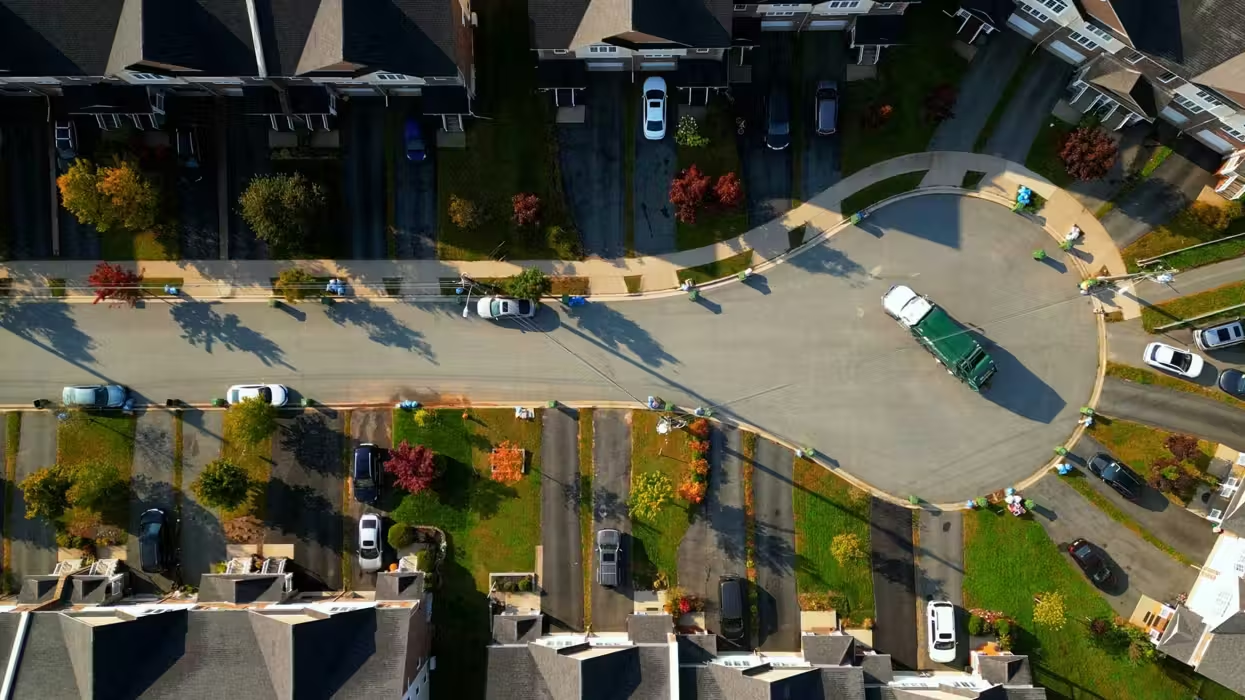
In Dallas, the city government recently partnered with a tech firm called City Detect to put AI cameras on ordinary garbage trucks. As the trucks roll through residential neighborhoods, high-resolution cameras photograph homes, driveways, and front yards. Algorithms then scan the images for potential violations, from overgrown lawns and peeling paint to structural disrepair and discarded junk. China gives citizens a social credit score. Dallas now has something that sounds eerily familiar: a “blight score.” To be clear, Dallasites aren’t being rated on political loyalty or on whether they should be allowed to purchase a plane ticket. But the underlying idea is unsettlingly similar. Technology collects information about ordinary people, then analyzes it and turns what a camera sees into a data point that can trigger authorities' attention.
And this is where the legal defense of public surveillance comes in. The traditional argument is simple. If something can be seen from a public road, you have little or no expectation of privacy in it. A police officer or code inspector standing on a public sidewalk can look at your front yard for hours without obtaining a warrant. City Detect relies on precisely this principle. The company says its software automatically blurs human faces and vehicle license plates before storing the imagery. In other words, you may not be personally identifiable in the database, but your house, driveway, lawn, and property can still be photographed, analyzed and flagged.
That distinction may satisfy the lawyers, but it doesn't necessarily satisfy the citizen, nor should it.
Surveillance creep
Applying continuous, AI-driven surveillance across an entire city fundamentally changes how local government operates.
This dynamic flips the traditional relationship between citizens and law enforcement. Throughout American history, government investigation required either initial suspicion or a formal complaint before it resorted to observation. Automated garbage truck cameras reverse that sequence by subjecting every property owner to preemptive, systematic photography. An algorithm evaluates the physical condition of a private residence first, and the city issues a notification second. Dallas residents now receive automated courtesy notices regarding their property conditions without a human inspector ever stepping foot on their pavement.
The immediate result is the industrialization of minor administrative oversight. Local governments purchase turnkey surveillance systems from private vendors because automated enforcement generates predictable revenue while reducing payroll costs. Cities may introduce these systems as simple administrative tools, but once the technology exists to continuously scan an entire city, its uses can easily expand beyond the original purpose.
RELATED: These popular Wi-Fi routers can detect motion — inside your home
 Iaremenko/Getty Images
And if it can happen in Texas, supposedly a conservative state that prides itself on individual liberty, it can happen anywhere in America.
City Detect insists that its databases remain separate from law enforcement networks and that private companies retain ownership of the operating algorithms. No one of sound mind should be reassured by these promises. Public records requests and corporate partnerships regularly bridge the gap between municipal records and law enforcement access. Once a high-definition image of a private driveway is stored on a cloud server, the legal barriers that restrict access by law enforcement, tax assessors, or civil litigants can quickly disappear.
Future shock
The primary danger of localized algorithmic monitoring lies in its future capabilities. Big Brother is a lot like the national debt; it never gets smaller, only bigger.
The software deployed on garbage trucks today identifies tall weeds, discarded mattresses, and stray trash. Upgraded models could easily detect subtle physical changes over time. The idea that your driveway parking patterns and home additions could be recorded in the not-so-distant future may sound absurd, but it shouldn’t.
Today, the surveillance state no longer requires specialized federal agents or hidden listening posts to monitor everyday life. You live in a country where every commute and porch delivery feeds an all-knowing database. That is troubling and infuriating. But perhaps the most worrying aspect is how difficult it will be to put the genie back in the bottle. Once those in charge learn they can watch everything, why would they ever choose to watch less?
Want to leave a tip?
We answer to you. Help keep our content free of advertisers and big tech censorship by leaving a tip today.