R.Satish Babu/Getty Images
If you want to glimpse the future of artificial intelligence, don't start in Silicon Valley. Start in a South Korean factory.
According to the International Federation of Robotics, South Korea now has 1,012 industrial robots for every 10,000 manufacturing workers — the highest robot density in the world. Put another way, roughly one in every 10 manufacturing "workers" is now a robot.
For now, however, even the world's most advanced humanoid robots still struggle with tasks that young children perform effortlessly.
That startling figure is one piece of a much larger story stretching from American AI labs to South Korean factories, Chinese assembly lines, and Indian garment workshops.
For most Americans, the AI revolution is something that happens on a screen. We think of ChatGPT writing emails, Claude summarizing reports, or Google Gemini answering questions. The race appears to revolve around Silicon Valley companies building ever more capable language models.
But the next phase of artificial intelligence is becoming much more physical.
Instead of asking how machines can write like humans, researchers are asking how they can move like humans — how they grasp a coffee mug, fold a shirt, stitch a collar, or crack an egg without crushing it.
That challenge has created an unexpected global division of labor: America builds the brains, South Korea builds the bodies, China provides the classroom, while India supplies the teachers.
Together, they're revealing something surprising: the future of artificial intelligence depends on ordinary human beings.
If robotics has an epicenter, it may well be South Korea.
The country's dominance in robotics didn't emerge from nowhere. It grew out of decades spent building some of the world's most advanced automobiles.
The same expertise that allows South Korean companies to manufacture electric motors, precision steering systems, sensors, braking technology, and other high-performance automotive components translates remarkably well to humanoid robots. Goldman Sachs Research estimates Korean companies could account for roughly 30% of global humanoid robot production by 2035, either by manufacturing robots directly or supplying the critical components that allow them to move.
Yet South Korea's embrace of automation has also exposed its tensions.
This week, Hyundai workers overwhelmingly voted to authorize strike action after contract negotiations stalled, with robots emerging as a central issue for the first time.
The union isn't simply demanding higher wages.
It wants guarantees over how artificial intelligence and humanoid robots will be introduced onto factory floors, arguing that workers deserve a voice before machines begin performing jobs currently done by people.
The dispute centers on Atlas, the humanoid robot developed by Hyundai-owned Boston Dynamics.
While company executives describe Atlas as a way to perform dangerous, repetitive, and physically demanding work, union leaders see a machine that could eventually replace the people who build Hyundai's cars.
The disagreement captures the paradox facing much of the developed world.
Countries like South Korea desperately need automation. It has one of the world's fastest-aging populations and one of its lowest birth rates, creating labor shortages that robots may eventually help fill.
Yet the workers whose jobs are most vulnerable understandably want assurances that they won't become casualties of the technological transition.
For now, however, even the world's most advanced humanoid robots still struggle with tasks that young children perform effortlessly.
Finding a coffee pot, identifying its handle, lifting it correctly and pouring without spilling remains astonishingly difficult for a machine.
The bottleneck is no longer the body or the brain. It is experience.
Engineers can now build remarkably capable robot bodies and increasingly sophisticated AI models. What they can't manufacture is the accumulated experience that allows humans to navigate the physical world almost without thinking. Like a child learning to walk — or an apprentice learning a trade — robots improve only through repeated interaction with the real world.
RELATED: Your child’s new best friend might be a Chinese surveillance device
 akinbostanci/Getty Images
South Korea may lead the world in robot density, but China wins on sheer scale.
According to the International Federation of Robotics, China had 2.027 million industrial robots operating in its factories in 2024. It installed another 295,000 robots that year alone, accounting for 54% of global robot demand.
That scale gives Beijing an enormous advantage in the next phase of AI.
Unlike ChatGPT, which learned from enormous quantities of text on the internet, humanoid robots must learn by interacting with the real world. Every object they grasp, every obstacle they navigate, and every task they complete generates valuable information that helps improve future models.
China has more of that real-world classroom than anyone else.
Part of the urgency stems from demographics. After decades of the one-child policy and collapsing birth rates, China faces one of the fastest-aging populations in history. Its working-age population is projected to shrink dramatically over the coming decades, threatening the labor force that powered its manufacturing rise.
Humanoid robots have become one response. Every robot deployed today becomes another teacher for tomorrow's robots. More deployment generates more real-world data, and better data produces better AI models.
Better models create more capable robots, which in turn generate even more data.
In the race toward physical AI, experience itself has become a competitive advantage.
If South Korea is building the machines and China is putting them to work, India is asking who benefits from the knowledge that makes them possible.
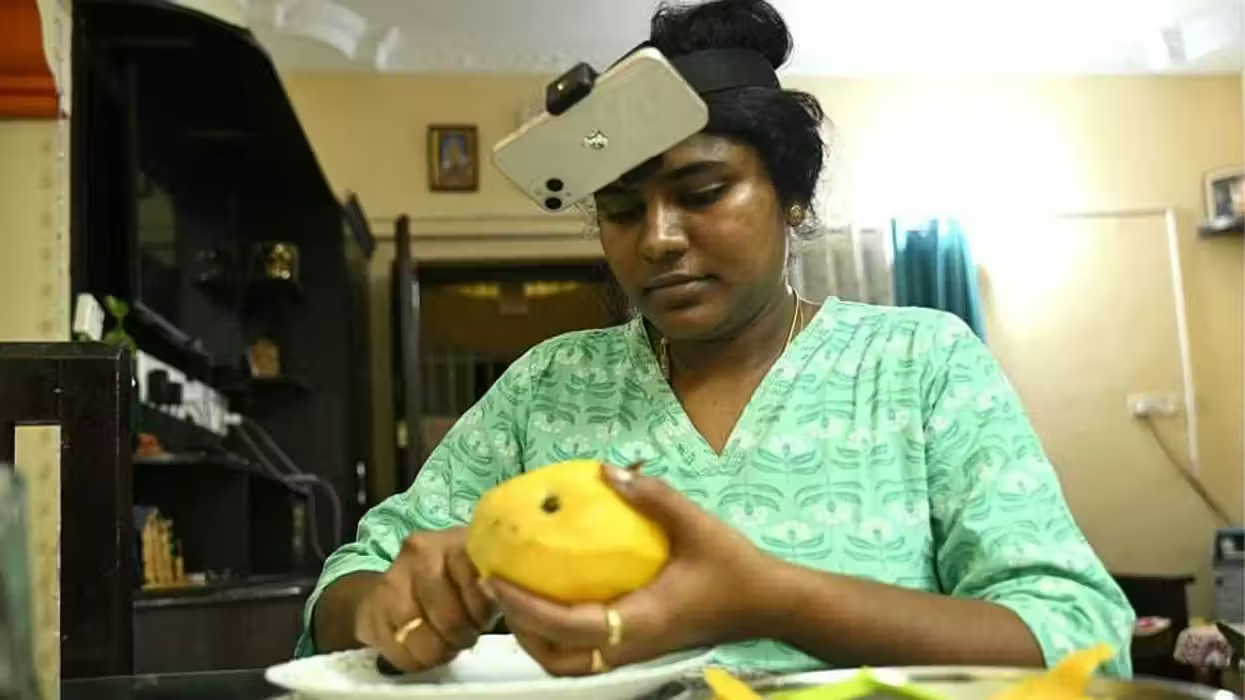
Across the country, companies are asking factory workers, construction laborers, delivery drivers, and homemakers to wear head-mounted cameras while they go about their daily routines.
No gesture is too small to escape the camera's eye: how a garment worker guides fabric through a sewing machine, how a mason carries bricks across uneven ground, how someone folds laundry, washes dishes, packs a lunch.
The recordings — known as "egocentric data" — have become one of the world's most valuable resources.
Many workers reportedly weren't told exactly why they were being recorded; in fact, some laughed when cameras were first strapped to their foreheads. That laughter changed to unease as they realized they were teaching machines that might someday replace them.
Labor advocates have raised new questions. If a worker's lifetime of accumulated skill is converted into an AI dataset worth millions of dollars, should that worker share in its value?
Can consent really be voluntary if refusing to wear the camera could jeopardize someone's livelihood?
And who owns years of accumulated know-how once it has been converted into a commercial AI dataset?
For perhaps the first time, the routines of ordinary life are becoming economically valuable in their own right.
Skills that were never considered professions — sewing a collar, folding towels, washing dishes, preparing meals, gripping an egg without breaking it, carrying heavy materials safely — are becoming indispensable training material for the world's most sophisticated robots.
Indian startup Neocambrian AI estimates it could require 100 million hours of first-person human activity before machines approach human-level dexterity.
The irony is impossible to miss.
As artificial intelligence becomes more sophisticated, researchers are discovering just how difficult it is to replicate the quiet competence of ordinary people.
The AI revolution has often been described as a triumph of silicon over flesh. Instead, it is becoming a lesson in just how remarkable ordinary human beings really are.
The machine doesn't know what an ordinary person knows: how tightly to grip an egg, how to instinctively shift its weight while walking across uneven ground.
These are forms of embodied wisdom acquired through years of living in a human body.
Christianity has long insisted that human beings are not merely minds that happen to inhabit bodies. In Genesis, mankind is introduced not simply as a thinker but as a worker — cultivating a garden, naming animals, building a family, and exercising stewardship over creation.
These are not incidental tasks. They are ways human beings express creativity, responsibility, and love.
One of the strangest consequences of the AI revolution is that it is reminding us of the enduring dignity of the same ordinary human work it seeks to replace.