Matthew Fowler/Getty Images
Data centers are hotly debated across the nation. Most Americans rage against the growing demand forged on the back of AI, while President Trump is adamantly in favor, claiming they will make communities rich.
After looking at the data, here’s why you should think twice before rejecting a data center proposal in your town.
At their core, AI data centers are much more sophisticated than the traditional systems before them.
There are two types of people in the data center debate:
Data centers are nothing new. Big Tech has relied on these facilities to bring a large number of tech innovations to the people for decades. Everything from search engines like Google and cloud storage like iCloud to streaming services like Netflix, online gaming platforms like PlayStation Plus, and so much more run on data centers. And for the most part, the people haven’t picked up their pitchforks in protest until now.
There’s something different about an AI data center that has sown an irrevocable discourse among the people. The MIT Technology Review puts it bluntly: “Everyone hates them.” But why? What makes AI data centers so different from the others that we have used and even enjoyed for decades? As it turns out, all data centers are not created equal.
According to RCR Wireless News, traditional data centers were designed to host various types of services, namely websites, apps, and cloud data. All of these tasks require far less processing power than the AI data centers of today. As a result, they don’t need the latest cutting-edge GPUs, advanced cooling systems, or high-speed data networks, and they don’t consume as much power.
RELATED: Water, watts, and workers: 3 persistent myths about AI and data centers
 Yuuji/iStock/Getty Images
AI data centers, on the other hand, are the exact opposite. Since they train and maintain frontier AI models, the latest equipment is a necessity. In fact, these facilities represent the pinnacle of data center technology — billions of dollars of hardware all assembled in one central location. They require new GPUs — like an Nvidia Blackwell GPU, which costs between $30,000 and $50,000 per unit — on a regular basis to achieve maximum compute.
AI data centers also need advanced cooling systems to keep these expensive GPUs from overheating. Don’t forget that GPUs are also incredibly power-hungry, especially when they start churning through training data and consumer requests. They require the latest SSDs for instant storage and data transfers, too.
At their core, AI data centers are much more sophisticated than the traditional systems before them. They’re big and expensive, and they consume plenty of electricity by the hour. AI data centers also make a lot of noise, and they strain the energy grid that wasn’t built for this level of constant processing power and output.
These reasons are why so many people don’t want them near their local communities.
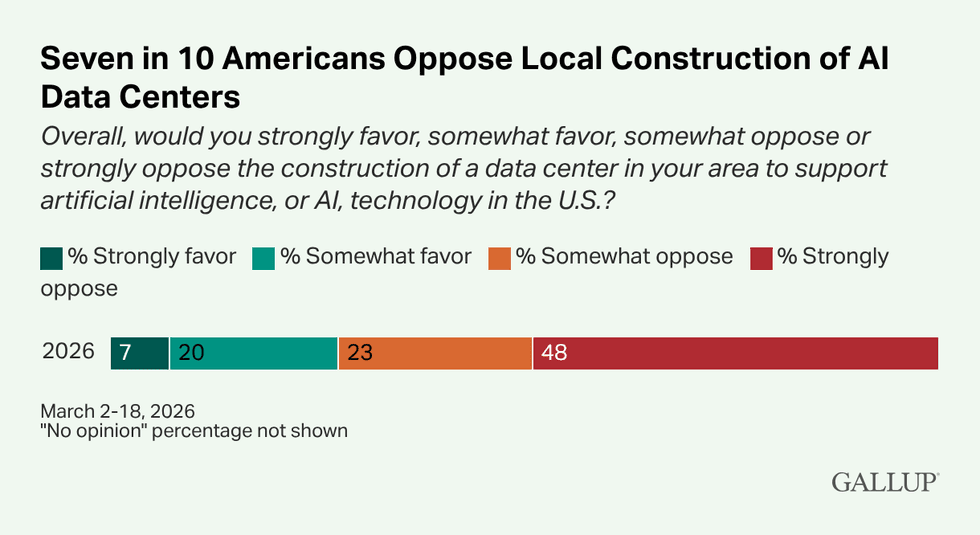
In a recent Gallup poll, 71% of the American people at least somewhat oppose the creation of new AI data centers in their communities, while 48% strongly oppose. That leaves only 27% that favor new AI data centers.
 Gallup
President Trump, however, takes a different stance. Where local communities see a disruption in public peace and resource sustainability, Trump sees business opportunities and money. In late August, he took to Truth Social to declare:
The only reason that communities throughout the U.S.A. should not want Data Centers is if they want to end up being backwards and poor. If they want to be successful and rich, with far lower taxes and jobs all over the place, let Data Reign. The good news is that there are plenty of other places that want them. If we kill the Golden Goose, you will only have yourselves to blame. China could not be happier with this anti Data Center movement. Actually, they can’t believe it is happening! President DJT
In his eyes, data centers are wealth-generation machines that will secure the United States’ position as an AI industry leader, beat back China’s attempts to leapfrog American frontier models, and spur the U.S. economy to new heights. On top of that, if the United States doesn’t build new data centers today, other nations will tomorrow, officially relinquishing our lead and influence in this space.
The only question now is whether or not President Trump is right. Are AI data centers actually good for local communities, or are they bad? According to the Consumer Energy Alliance, they will:
By the numbers alone, the people stand to gain a lot from allowing AI data centers into their communities. In fact, some smaller towns may even demand these facilities to boost their local economies.
RELATED: The data center backlash is getting spiritual
 Imaginima/Getty Images
As for concerns over the energy grid, President Trump says that new data centers are required to build their own power plants to run their systems. This will ensure that the local grid remains untouched, and in some cases, AI data centers may even dump extra energy back into the main grid, causing energy prices for families to go down instead of up.
For noise complaints, this issue is a difficult one to avoid. Cooling systems can hum anywhere between 55 and 65 dBA day or night, or about the same level as a busy office. Some people find this sound off-putting, while others may not mind. For this issue, it’s best to work with community lawmakers to construct new data centers within zones away from residential areas, instead of rejecting these money-making machines entirely.
Like Blaze News? Bypass the censors, sign up for our newsletters, and get stories like this direct to your inbox. Sign up here!