© 2026 Blaze Media LLC. All rights reserved.
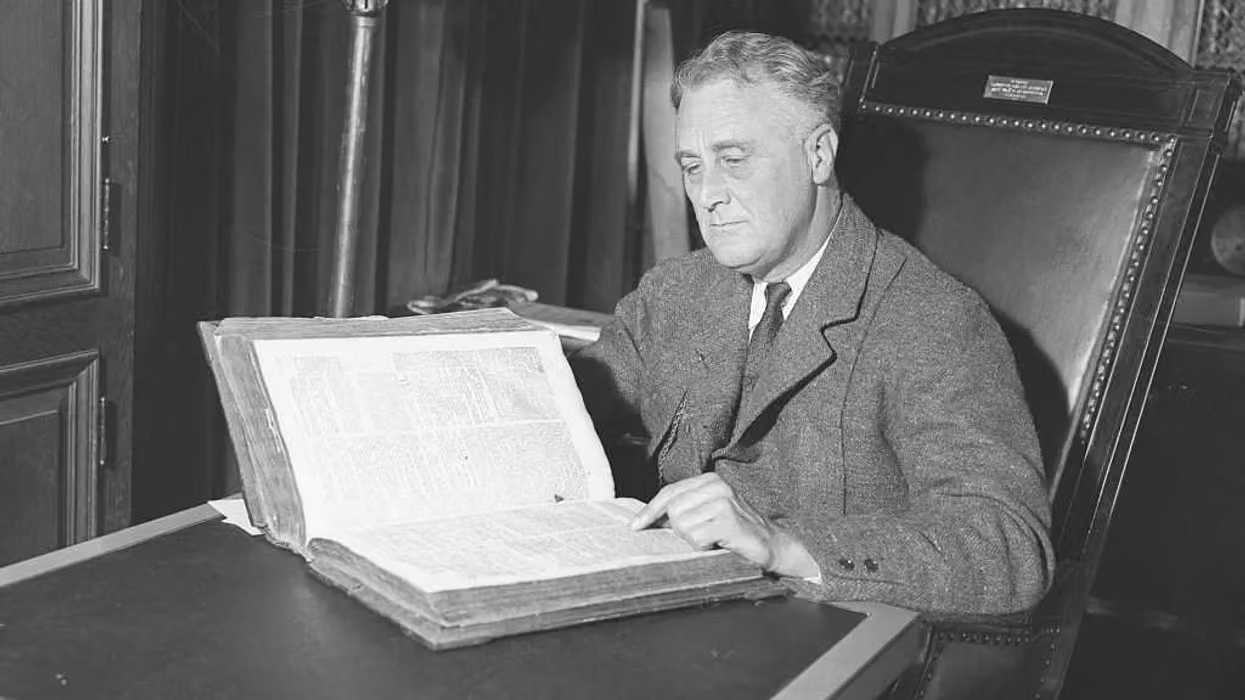
On Thanksgiving Day, a presidential proclamation sent me down an unexpected path. I was reading through past Thanksgiving messages when I came upon one from Franklin Delano Roosevelt in 1944. The Democratic president urged Americans to do something I have trouble imagining a president proposing today: “I suggest a nationwide reading of the Holy Scriptures during the period from Thanksgiving Day to Christmas.”
Roosevelt encouraged Americans to renew their acquaintance with the “eternal truths and majestic principles” of Scripture, which he credited with contributing to the greatness of the nation.
Government cannot regenerate the human heart. But surely our political leaders can acknowledge that the human heart needs regeneration.
Consider the circumstances. American soldiers were fighting and dying in Europe and the Pacific. Families wondered whether their sons would ever come home. Amid a world war, the president thought it important to remind Americans to read their Bibles.
As someone who studies and writes about the First Amendment, I can imagine the reaction if President Trump made the same recommendation. Critics would invoke the separation of church and state. I suspect we would hear warnings about Christian nationalism for weeks.
Yet this was FDR, a Democratic president and a favorite target of conservatives for his tremendous expansion of the federal government. His proclamation illustrates a distinction that many political leaders seem to have forgotten: A president may recommend a religious practice without compelling it.
Roosevelt did not order Americans to read the Bible or threaten them with punishment. He invited people “of every creed” to read their own versions of Scripture. His recommendation was unmistakably religious, but it left the decision to the people.
That distinction sets a limit on civil government. The state cannot command faith into existence. But a president can speak openly about spiritual concerns and invite Americans to consider them.
I would welcome a president who recommended that Americans attend a Bible-believing church, learn about their need for Christ, and discover what it means to live a life of faith. He could explain why, without a knowledge of God and our purpose in life, existence can become depressing, boring, and seemingly meaningless.
He might suggest that many of our social problems have spiritual roots. When we spend enormous sums treating the symptoms while ignoring the condition underneath, we are cutting down weeds without pulling out their roots.
Government cannot regenerate the human heart. But surely our political leaders can acknowledge that the human heart needs regeneration.
RELATED: Christian nationalism for thee, but not for me?
 Finn Gomez/Getty Images
And that brings me back to what I was thinking about on Thanksgiving: God is unchanging.
Much has changed in America since Roosevelt issued his proclamation. The eternal truths to which he directed Americans have not changed, because the God who revealed them has not changed.
God is the Creator of everything that has a beginning, including time itself. He is eternal, without beginning or end. He does not grow older, acquire more knowledge, or discover that He was mistaken about something. His wisdom, goodness, justice, and holiness do not fluctuate with the centuries.
“For I am the LORD, I change not,” God tells us in Malachi 3:6.
Yet this eternal God is no distant, impersonal philosophical abstraction. He has made Himself known to us. Perhaps the best-known verse in the Bible, John 3:16, tells us how: “For God so loved the world, that he gave his only begotten Son, that whosoever believeth in him should not perish, but have everlasting life.”
RELATED: The most dangerous evil can look remarkably like good
 Amanda Cassingham-Bardwell/iStock/Getty Images
Reading the Bible gives us more than timeless propositions of the sort we might encounter in a mathematics textbook. We learn about the eternal God who created us, against whom we have sinned, and who, in His mercy, offers redemption through His Son.
Beneath our economic, political, and even psychological troubles lies a deeper problem: We are alienated from the God for whose glory we were created. Our greatest need is to be reconciled to Him.
Presidents would be wise to recommend Bible reading and church attendance. Christianity contributes to the well-being of society, and the gospel addresses a need no government program can meet.
Whether our presidents recommend it or not, we would do well to take Roosevelt’s advice between now and Christmas.
The God Americans read about in 1944 is the same God we read about today. Nations rise and fall. Political parties change. Generations come and go.
But God has not changed, and neither has our need for Him.
Want to leave a tip?
We answer to you. Help keep our content free of advertisers and big tech censorship by leaving a tip today.