© 2026 Blaze Media LLC. All rights reserved.
Muslim communities are organizing politically in America, and they are not apologizing for it. Mosques in North Texas have become voter-registration hubs. In Michigan, Muslim candidates and activists have demonstrated the power of an organized constituency. The state has just elected the nation’s first Muslim U.S. senator.
What American Christians should learn from these examples is not theology. It is confidence in bringing religious commitments into public life. American Christians should pay attention. They have spent decades hearing that faith belongs in church and that explicitly Christian political action is somehow improper. That convenient rule does not seem to apply to everyone.
Christendom shaped the West, including America’s laws, customs, and understanding of human dignity. If Christians believe that inheritance is worth defending, they must speak up.
Christians must learn to fight for their faith in public. The future belongs to communities that intend to preserve their way of life, not those that apologize for having one.
America was founded by a population overwhelmingly shaped by Anglo-Protestant Christianity. That tradition formed its customs, moral assumptions, and public institutions. Several founding-era states required officeholders to profess Protestant or Christian beliefs. Georgia and New Hampshire explicitly favored Protestants. Other states adopted broader religious tests.
The U.S. Constitution was different. Article VI prohibited religious tests for federal office from the beginning. The First Amendment barred Congress from establishing a religion and protected its free exercise. Those protections did not change the basic reality: American life remained saturated with Protestant Christianity.
Yet the central cultural fact remains: Protestant Christianity shaped the country’s public life so thoroughly that its adherents rarely needed to think of themselves as a political majority. A fish does not know it is wet. When a nation's schools, holidays, and moral vocabulary largely reflect one religious inheritance, political organization around that inheritance can seem unnecessary.
Immigration changed the balance. Catholics had been present since colonial times, as had Jews, but immigration from Ireland, Italy, Germany, and Eastern Europe expanded the numbers and influence of religious minorities. The question was unavoidable: Could a culture built around Protestant assumptions absorb growing religious diversity without surrendering its own character?
In 1958, presidential hopeful John F. Kennedy published “A Nation of Immigrants” with the Anti-Defamation League. Its vision placed immigration at the center of the American story rather than treating Anglo-Protestant culture as the country’s defining feature. Kennedy’s election as the first Catholic president in 1960 marked another transformation in the nation’s religious imagination.
The Immigration and Nationality Act of 1965, signed by Lyndon Johnson after Kennedy’s assassination, abolished the old national-origins quota system, radically changing who would be allowed to enter the country. Suddenly the floodgates to America were open.
Something else changed alongside the laws: the meaning Americans attached to religious liberty. Freedom of conscience, once defended in a society largely governed by Protestant assumptions, increasingly meant public institutions treating rival faiths on equal terms.
Courts extended constitutional limits on religious establishment to the states. The prohibition against establishing an official state church was now interpreted as a prohibition against favoring Christianity at all.
RELATED: Brazil’s election is a chilling warning for America
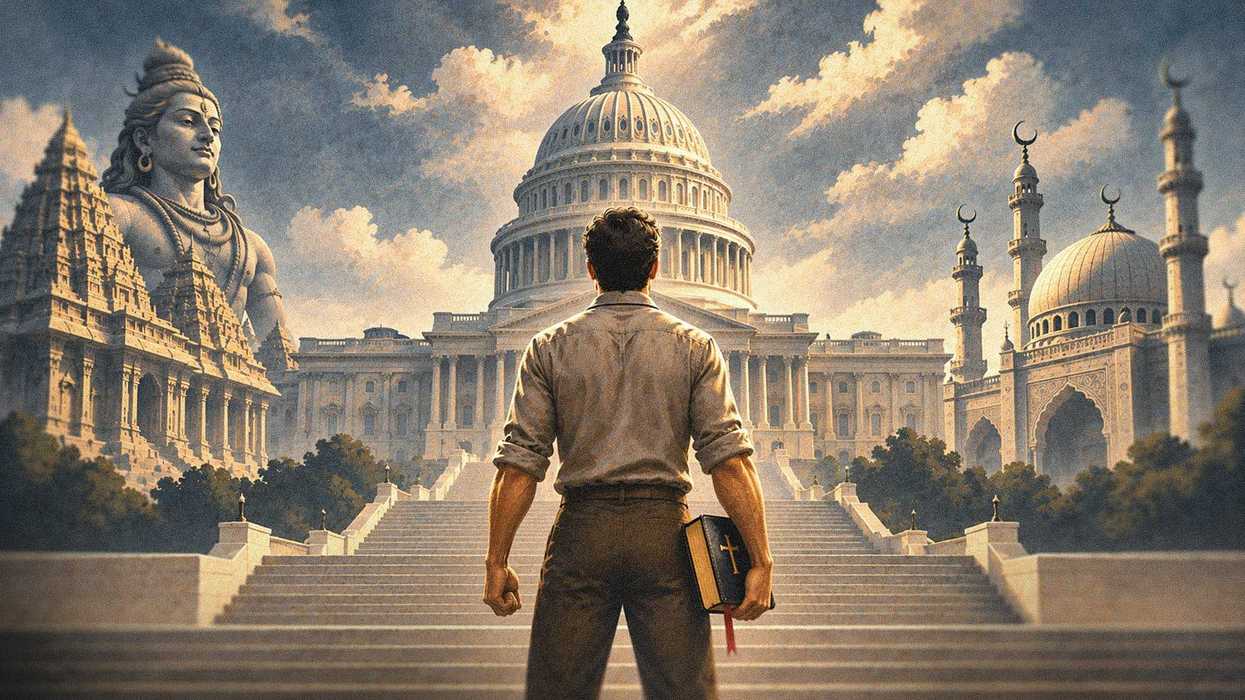
 Blaze News Illustration
Liberal mainline Protestant leaders embraced this transformation. Their participation in the civil rights movement brought a conviction that public Christianity, if too closely identified with the old social order, could become an obstacle to inclusion. Others accepted the proposition that politics should be conducted in a supposedly neutral language, with Christian commitments translated into secular terms before they could be heard.
The pitch to the churches was simple — and seductive. Render unto Caesar what belongs to Caesar. Christ rejected an earthly kingdom. Shouldn't Christians be content to preach the gospel and leave the business of government to professionals? Fear of being labeled backward or intolerant made retreat even easier.
But Christ did not tell His followers to pretend their convictions had no bearing on law, education, or the common good. The idea that Christians must be politically passive because the Constitution protects religious liberty turns that liberty into a gag order.
Conservatives helped sell this bargain. Reduce the power of government, they said, and stop trying to shape the culture through politics. Conveniently, their opponents had no intention of surrendering political power. The result was a right that treated withdrawal as principle while every competing movement treated political organization as common sense. In schools, public ceremonies, and debates over the family, that retreat handed the initiative to others.
For decades, the Christian political class has mistaken the rules of a plural society for an instruction to disappear. No secular activist interprets pluralism that way. No Muslim organizer needs to. They enter the political arena as people with convictions, constituencies, and interests. Christians should quit treating those facts of political life as a privilege reserved for everyone else.
The Moral Majority showed that Christians could act collectively. So have the religious conservative organizations that followed it. Yet too often their leaders have been content to defend yesterday's defeats rather than articulate a Christian vision of public life. They speak of “Western values” and “Western civilization” as though Christianity was an embarrassing family secret.
RELATED: The American dream now comes with upgrade fees
 Blaze News Illustration
Meanwhile, a spiritual vacuum does not stay empty. Secular humanism promised to supply moral purpose without religion. Wokeness took on the character of a rival creed, complete with its own saints, heresies, and rituals of public repentance. And now Muslim communities, confident in their religious identity, are also competing for influence in the public square.
Christians should stop acting surprised. Political power will not remain unclaimed simply because they refuse to reach for it. Nor will churches recover their cultural authority by pretending that doctrine has no public consequences.
Christendom shaped the West, including America’s laws, customs, and understanding of human dignity. If Christians believe that inheritance is worth defending, they must speak up. They must organize, argue, vote, and fight politically for the institutions and moral commitments they want their children to inherit.
The lie is that doing so violates the country’s principles. The truth is that religious liberty gives Christians the same right to organize that everyone else already exercises. A faith that refuses to defend its place in public life should not be astonished when others occupy the ground it abandoned.
Want to leave a tip?
We answer to you. Help keep our content free of advertisers and big tech censorship by leaving a tip today.