Sunset Boulevard/Getty Images
Horror has always had a respectability problem. But filmmakers eventually discovered a useful trick for getting around it: Make the monster a metaphor.
The creature in "The Babadook" isn't merely a boogeyman under the bed; it's grief and depression. "It Follows" has been read as everything from an allegory for sexually transmitted disease to a story about sexual trauma and mortality. Jordan Peele's "Get Out" turned body-snatching horror into an examination of race and liberal paternalism. Even "Hereditary," which gives us actual demons, comes wrapped in grief, mental illness, and inherited trauma.
Moore was said to have been decapitated, horribly echoing the death Richardson had devised for the movie.
Nothing wrong with that. Horror works best when it gives physical form to intangible fears.
But the metaphor also provides a convenient escape hatch. Whatever battles of principalities and powers we see on screen, we know the real horror lurks in our minds — best addressed with modern, morally neutral techniques like therapy.
Asking us to believe in monsters that stand for nothing more than themselves — real monsters, in other words — takes us uncomfortably close to an idea Christianity has maintained for 2,000 years: Supernatural evil actually exists.
It's no wonder filmmakers who want their commercial success with a side of art-house respectability don't often go there.
But there might be another reason as well. When filmmakers do attempt to depict the devil, he has a curious way of making himself known through strange disruptions to the production: fires, equipment failures, injuries, even death.
Almost as if he would prefer to be dismissed as a fairy tale.
Here are six movies that took supernatural evil seriously — and the strange things that happened while people were making them.
If any movie were ever cursed, surely it was "The Exorcist." William Friedkin's 1973 adaptation of William Peter Blatty's novel has plenty to say about a broken family, psychiatric medicine, and a priest suffering a crisis of faith.
But when Regan MacNeil starts speaking in strange voices and contorting her body, "The Exorcist" is blunt about the cause: demonic possession. Friedkin brings an almost documentary realism to material that might otherwise have been safely dismissed as gothic fantasy. Audiences fainted, vomited, and fled theaters. The movie became a cultural phenomenon.
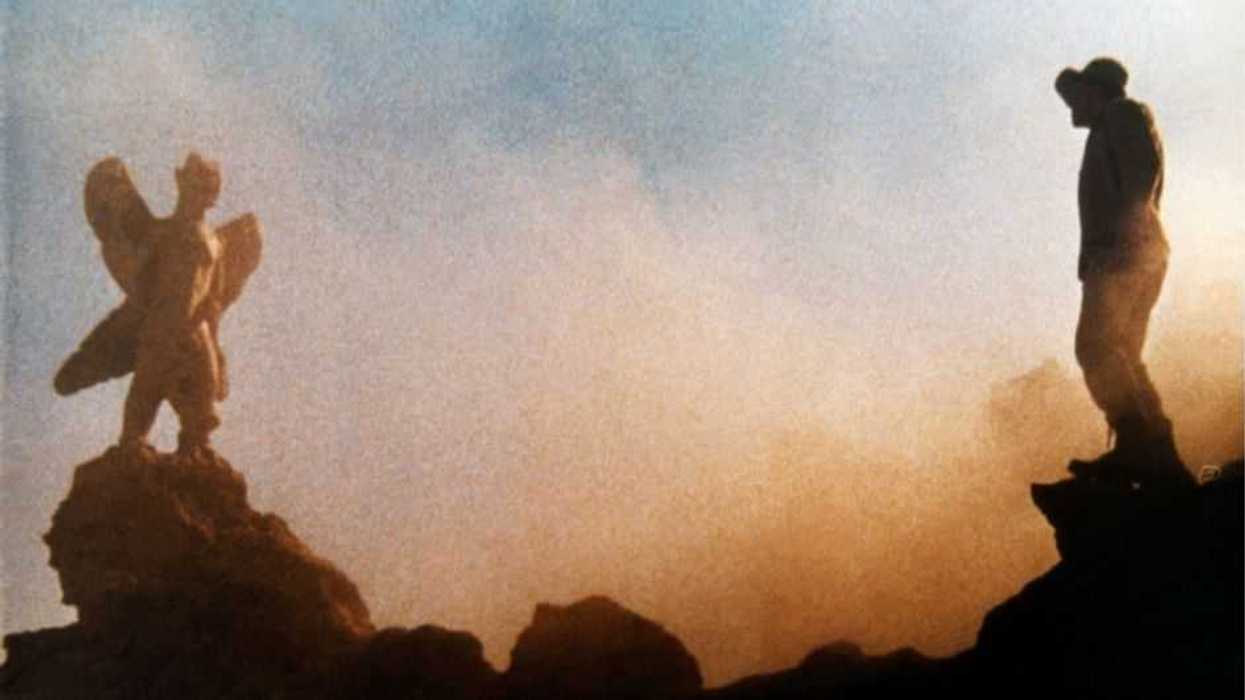
And if the stories that emerged from the production are to be believed, audiences weren't the only ones disturbed by its unflinching treatment of evil. The trouble started before Friedkin had even begun shooting in Iraq. A statue of Pazuzu, the demon who possesses Regan, had been built in Burbank and shipped to Mosul for the movie's opening sequence. It never arrived.
Somehow, Pazuzu ended up in Denmark. “It was lost,” Friedkin recalled years later. Shooting in Iraq was delayed for weeks while somebody presumably worked out how to get the demon to the right country.
Things got worse back in New York. In the early hours of the morning, a fire tore through the set of the MacNeil house at 20th Century Fox's studio on West 54th Street.
“The production manager called me at 4 a.m. and said, ‘Don't bother to come to work today,’” Friedkin later recalled.
“I said, ‘Why? Am I fired?’”
No. The set had burned to the ground. Well, most of it had. Regan's bedroom — the room where Friedkin was filming the exorcism — survived. Investigators never established what caused the fire. Friedkin later blamed a pigeon that had flown into a light box.
Production shut down for six weeks while the set was rebuilt. Then Ellen Burstyn hurt her back. During the scene in which Regan strikes her mother, a stuntman attached to a wire was supposed to yank Burstyn backward. After several takes, Burstyn told Friedkin that the stuntman was pulling too hard.
“Well, it has to look real,” she remembered him replying.
On the next take, she landed hard on her coccyx and screamed in genuine pain. Friedkin kept the camera rolling. Burstyn later summed up her relationship with the director rather neatly: “He was always great with me. Except when he permanently injured my spine.”
Burstyn went on to do many more films. Others in the cast weren't so lucky. Jack MacGowran, who plays director Burke Dennings — murdered by the possessed Regan in the movie — finished his work and died of influenza at 54. Vasiliki Maliaros, who played Father Karras' mother, also died during production.
In the 1998 BBC documentary "The Fear of God: 25 Years of 'The Exorcist,'" Burstyn remembers others connected with the production dying as well: the newborn child of an assistant cameraman, the man responsible for refrigerating the bedroom set, and a night watchman.
None died in accidents while shooting the movie. But there were enough deaths, injuries, delays, and other mishaps that people began talking about a curse.
The actor playing the conflicted priest and trained psychiatrist who attempts to save Regan got a more explicit warning. In "The Fear of God," Jason Miller recalls eating and studying his lines at the Jesuit residence while filming at Georgetown. One day, an elderly priest handed him a medal of the Blessed Virgin and asked whether Miller had ever heard of “intervention.”
“If you do anything on the devil, anything at all on the devil to reveal him as the trickster that he is,” Miller remembered the priest telling him, “he will seek retribution against you, or he will even try to stop what you're trying to do to unmask him.”
The priest told Miller the medal would protect him.
About three days later, Miller was walking through the Jesuit residence on his way to dinner when something caught his eye in one of the side rooms. He went back and looked, only to see the old priest lying there in a casket.
By 1974, Castle of Frankenstein magazine was running an article with the wonderfully unsubtle headline The Curse That Hangs Over "The Exorcist."
Eventually, Friedkin called the Rev. Thomas Bermingham, the Jesuit priest serving as a technical adviser to the movie.
“Would you come down and exorcise the set?” Bermingham recalled Friedkin asking in "The Fear of God."
Bermingham refused. “I don't want to increase anxiety or anything like that,” he told him. But Bermingham wasn't laughing off the possibility that they had gotten themselves into something strange.
“There was definitely a feeling that it could happen,” he says in the documentary. “We were playing around with something. I even felt it. I felt we were playing around with something I shouldn't be playing around with.”
He blessed the production instead, just in case.
Mel Gibson's 2004 "The Passion of the Christ" isn't a horror movie, although anyone who has sat through the scourging scene might dispute the point.
But neither is it the kind of "faith-based" film that confines the battle between sin and redemption to the dialogue. Gibson keeps the personification of evil in the frame.
Satan stalks Jesus through Gethsemane. He moves through the crowd as Christ suffers. During the scourging, he carries a grotesque child. After Christ's death, Gibson cuts away from Calvary to show Satan defeated. On screen, Satan can only howl in rage. What happened off screen suggests a more active opposition.
Jim Caviezel, the man playing Jesus, was struck by lightning. Producer Steve McEveety recalled seeing the bolt hit him from roughly 100 feet away. Assistant director Jan Michelini was struck too.
Which would already make for a pretty good story, except Michelini had reportedly been struck by lightning once before during the same production.
Caviezel later joked that the strike lit him up “like a Christmas tree.” Contemporary reports said neither man was seriously injured.
Caviezel had previously turned down three opportunities to play Jesus. He accepted Gibson's offer because, he later said, he sensed the director's commitment to telling the Passion story “without restraint.”
Be careful what you pray for.
The lightning strike was far from the only hardship. Caviezel separated his shoulder carrying the cross. He developed hypothermia while hanging nearly naked in bitter winds during the crucifixion scenes, followed by pneumonia and a lung infection. The elaborate makeup left his skin raw. During the scourging, one of the actors missed the protective board behind Caviezel and struck him across the back hard enough to tear the skin.
At one particularly miserable point, hanging on the cross in the cold, Caviezel remembered crying out to God:
“So you don't want this movie to be made?”
Caviezel kept making it anyway; appropriately enough, the suffering itself began to serve the movie. He received Communion daily, prayed the rosary during the long hours in makeup, and went to confession during production.
Caviezel also came to see his suffering as part of what made the performance work. Recreating the crucifixion on a comfortable soundstage, he later said, would have lost some of its “effect and reality.” The cold, the injuries, the exhaustion — things that might have stopped another production — became part of the movie Gibson and Caviezel had set out to make.
If "The Exorcist" created the cursed-movie template, "The Omen" perfected it.
The 1976 movie is even less interested in metaphor. The little boy at the center of the story really is the Antichrist, and the people who figure this out have a nasty habit of dying before they can do much about it.
Bob Munger, the advertising executive who helped originate the premise, later recalled warning producer Harvey Bernhard about making the movie in the first place.
“If the devil's greatest single weapon is to be invisible,” Munger told him, “and you're going to do something which takes away his invisibility to millions of people, he won't want that to happen.”
Bernhard eventually became convinced Munger was right. “The devil was at work,” he said years later.
The stories began before audiences had even seen the movie. In April 1976, New York magazine was already reporting that Gregory Peck's plane had been struck by lightning while he was traveling to London to make "The Omen." The magazine named screenwriter David Seltzer and director Richard Donner in connection with troubled flights as well. Executive producer Mace Neufeld later recalled a lightning strike on his own flight. The surviving accounts make it difficult to say exactly how many people were struck by lightning, which is not ordinarily a problem a movie production has.
The close calls continued once Neufeld reached London. He later recalled walking out of his London hotel with his wife when a bomb exploded about a block and a half away. The couple also had reservations at Scott's, the Mayfair restaurant bombed by the IRA in November 1975. Both bombings are real; Neufeld recounted his brushes with them in the 2020 documentary series "Cursed Films."
For one of the movie's most memorable scenes, Damien visits a safari park and the baboons go berserk at the sight of him. The sequence was filmed at Windsor Safari Park. During the production period, 22-year-old keeper Sidney Bamford was killed there by a tiger. Later curse accounts claimed the keeper died immediately after the filmmakers shot the sequence. Contemporary reports establish the tiger attack, but not that timing or that Bamford personally worked with the movie.
And then there was the airplane the filmmakers didn't take. Donner later recalled that the production had intended to use an aircraft for aerial filming, only to lose it at the last minute when it was reassigned to Chinese customers. According to the story, the plane subsequently crashed.
There was a remarkably similar accident during production. On November 20, 1975, a Hawker Siddeley executive jet carrying a Chinese delegation took off from Dunsfold Aerodrome in Surrey, flew into a flock of lapwings, lost power in both engines, overran the runway, and struck a passing car.
All nine people aboard the aircraft survived. All six people in the car died.
The timing and the Chinese passengers make it a plausible match for the crash Donner remembered. What the investigation doesn't establish is that "The Omen" crew had ever booked that particular plane.
The strangest story came after "The Omen" was finished.
Special-effects designer John Richardson had helped create one of the movie's most gruesome deaths. Photographer Keith Jennings is standing by the side of a road when a sheet of glass slides from a truck and takes off his head. Richardson's effects team accomplished it with a rigged dummy and replica of actor David Warner's head.
In August 1976, Richardson was in the Netherlands working on "A Bridge Too Far" when he was involved in a car crash. Richardson survived. Sculptor Liz Moore, traveling with him, did not. Biographical accounts date her death to August 13.
Over the years, the accident acquired two details that made it irresistible to anyone writing about the curse of "The Omen." Moore was said to have been decapitated, horribly echoing the death Richardson had devised for the movie. And Richardson was said to have emerged from the wreck near a road sign reading:
Ommen — 66.6 km.
The crash and Moore's death are well attested. Those two grisly details are not. No contemporary report or official record located in our research establishes that Moore was decapitated. Richardson did later recall a roadside marker involving sixes and a road leading toward Ommen, but the famous “Ommen — 66.6 km” sign has never been independently verified.
By then it hardly mattered. "The Omen" had acquired a curse almost as elaborate as its screenplay.
Fox eventually made the legend part of the product. By 2000, the DVD included a featurette called "Curse or Coincidence?"
The 2012 movie "The Possession" had something most demon movies don't: a supposedly genuine haunted object behind it.
The “dybbuk box” was an old wine cabinet whose strange history had first attracted widespread attention on eBay. Kevin Mannis supplied a terrifying history involving a Holocaust survivor and a malicious Jewish spirit. Owners supposedly experienced nightmares, illnesses, and other misfortunes.
The story spread online, made its way into newspapers, and eventually became the inspiration for a Hollywood movie.
Then odd things started happening on the movie.
Director Ole Bornedal recalled production lights exploding even though they weren't switched on. About a week after filming ended, he said, a warehouse containing props from the movie burned; Bornedal said he never learned what caused the fire.
Years later came a fairly devastating blow to the legend: Mannis admitted that he had invented the box's elaborate backstory. So much for the haunted box.
Except Mannis inventing a story about a wine cabinet doesn't explain why Bornedal said lights exploded. It doesn't explain the warehouse fire either.
Bornedal himself offered the best skeptical argument. “Would we have noticed if this had been a ‘Love Story’? Perhaps not.”
RELATED: Inside the mind of a Catholic exorcist: Fr. Chad Ripperger talks shop with Shawn Ryan
 Photo by SIMON WOHLFAHRT/AFP via Getty Images
Thirty years after the original "Omen," Fox decided to make it again, if only to take advantage of a uniquely demonic release date: June 6, 2006, or 6/6/06.
Director John Moore had been raised Catholic, and maybe that's why he found the strange happenings that befell him so unnerving.
Two days of footage involving the discovery of Damien's 666 birthmark were destroyed. Moore received an airfare costing exactly $666. And a promotional videotape apparently wound up overwritten with ESPN footage even though, Moore said, the machine wasn't capable of recording.
Moore was disturbed enough to wonder whether making the movie might offend God. Eventually, he reasoned that a movie acknowledging the existence of evil necessarily acknowledged the existence of good.
As for Fox, the curse was great publicity. Although perhaps even the box-office bean counters were a little shaken by the movie's first-day box office:
$12,633,666.
What were the odds? Pretty good, as it turned out. Fox distribution executive Bruce Snyder admitted that the studio had adjusted the reported estimate to give it the demonic final digits.
“We were having a little fun,” he said.
By the time Lee Daniels made "The Deliverance" in 2024, the old stories had become part of Hollywood folklore.
Daniels had read about what supposedly happened during the making of "The Exorcist" and "Poltergeist." His Episcopalian mother warned him about making a movie dealing with demonic evil.
“She was just like, ‘You are a portal. You work from a place of groundedness, and your soul is open, and I don't want anything bad happening to you,’” Daniels recalled.
He took precautions. The production brought in an ordained Christian who conducted deliverances on set. Daniels also instituted daily prayer circles.
“We prayed every day,” he said.
Netflix HR reminded him that Christian prayer couldn't be mandatory. Daniels told anyone who didn't want to participate that they were free to leave.
“There were a few that left, but for the most part, most of them wanted to be covered by the blood of Jesus,” he recalled. “They knew what was up.”
The precautions didn't prevent "The Deliverance" from acquiring a curse story of its own.
Daniels' sister had appeared in every movie he made as his “good luck charm.” For "The Deliverance," she appeared in a scene with Glenn Close involving chemotherapy.
Two days later, Daniels said, his sister was diagnosed with lung cancer.
“My dog died on set,” he added.
Mo'Nique had a more explicable brush with the supposed curse. While filming an outdoor scene involving a demon, Mo'Nique said material being blown around the set made it difficult for her to breathe. Afterward, she was hospitalized with an enlarged thyroid.
“It was a lot of things happening with ‘The Deliverance,’” she recalled.
None of this proves that anything supernatural was happening. Mo'Nique herself described a perfectly physical reason for becoming ill. Cancer diagnoses and dead dogs require no demonic explanation.
But half a century after "The Exorcist," Daniels went into another movie about demonic possession worried enough about the old curse stories to pray over his set every day and bring in someone to perform deliverances.
Then his sister got cancer, his dog died, and one of his stars wound up in the hospital.