Bloomberg/Getty Images
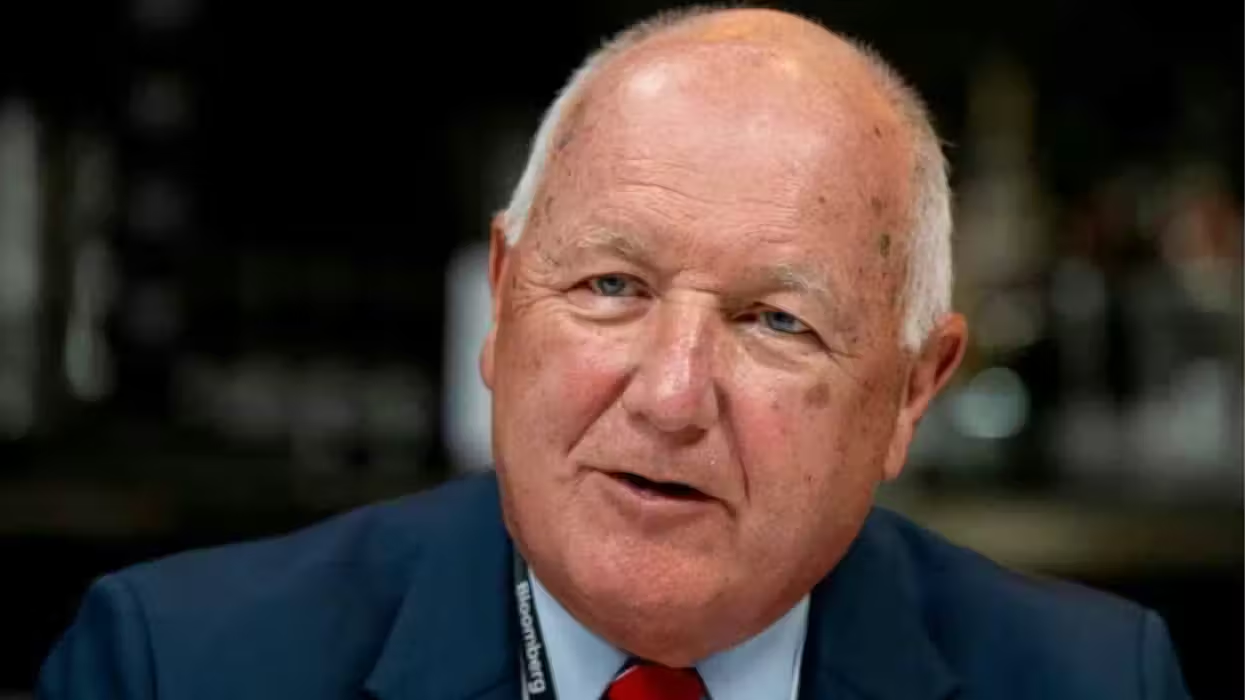
United States Ambassador to Canada Pete Hoekstra says Washington has lost patience with Prime Minister Mark Carney's handling of trade negotiations — and sees little reason to make further concessions.
“We thought we had reached an agreement on two occasions with Canada. On two occasions now, Canada has walked away from an agreement,” Hoekstra said in an interview with Blaze News. “As people from our side look at it, you know, this is the best trade agreement that anybody in the world has been offered. And if that's not good enough for Canada, you know, hey, we'll wait. We'll wait for Canada to come back and … ask to go back to the negotiating table.”
'If the Canadian government wants the Canadians to see the elements of a trade deal, it's the Canadian government's responsibility to release them.'
Hoekstra suggested that repairing relations will require more than resolving differences over tariffs. Anti-American rhetoric from Canada's federal and provincial governments, he said, has changed how Washington views its northern neighbor.
“We no longer necessarily view Canada as Canadians liking America. You have multiple numbers of your premiers who are saying, ‘Do not travel to the United States.’ I think you now have 11 provinces and territories that ban American alcohol. You have another that has put 50% tariffs on it. So that's 12 out of 13.”
The ambassador was particularly incredulous at Carney's characterization of the trade dispute.
“You call a trade disagreement where, for a period of time, you were getting 93% to 95% of trade across the border tariff-free … you call that a trade war, OK?”
Canada's rejection of the proposed agreement remains a source of contention. Carney has argued that American negotiators demanded concessions that would compromise Canadian sovereignty, including protections for French-language rights and Quebec culture. U.S. Trade Representative Jamieson Greer has disputed Canada's characterization of the negotiations.
Carney has refused to release the proposed agreement, even to Official Opposition Leader Pierre Poilievre, leaving Canadians unable to examine the terms for themselves.
Asked whether Washington would make the proposal public, Hoekstra placed the responsibility squarely on Ottawa.
“If the Canadian government wants the Canadians to see the elements of a trade deal, it's the Canadian government's responsibility to release them. We have decided not to release them.”
Meanwhile, Carney has been pursuing closer economic and political ties with the European Union. European Commission President Ursula von der Leyen recently floated the possibility of making Canada the EU's first “associate member,” an arrangement whose terms have yet to be defined.
Hoekstra indicated that Washington would assess the consequences once Ottawa decides how far it intends to go.
“We're more than willing to let Canada go through this process, determine exactly what it's going to do with the EU as an associate member, and we'll then take a look at how that may impact the relationship with the United States, either militarily or economically.”
Canada's growing relationship with China is another source of friction. Hoekstra warned that steel, aluminum, and other Chinese materials could enter the United States through Canadian products, circumventing American trade restrictions.
“Transshipment is a huge irritant,” he said.
Hoekstra argued that the practice allows Chinese producers to compete unfairly with American manufacturers.
“It's not putting Canadians to work except maybe shaping the steel and the aluminum, but it's putting Americans out of work through unfair competition because they are using ... in some cases ... slave labor."
RELATED: Want to avoid fixing Canada's problems? Just blame Trump.
 Bloomberg/Shauna Clinton/Getty Images
The ambassador was less concerned about the possibility of an outright military confrontation between the two countries.
Asked about a recent New York Times interview in which Carney acknowledged considering the “extreme tail risk” of an American invasion of Canada, Hoekstra recalled an American general's response to a similar question in Vancouver.
“I think one of our generals answered that question very effectively when he was asked about this a couple of weeks ago in Vancouver. ‘Yeah, and after that, why don't you ask me about our plans to invade … the Martian soil.’”
Hoekstra's outspoken style has irritated Canadian politicians, some of whom have even supported a petition to have him sent back to Washington.
The ambassador joked that not all of the petition's supporters would be Canadian.
“If you see an American out in front of Parliament gathering signatures, it very well could be my wife.”