The Washington Post/Getty Images
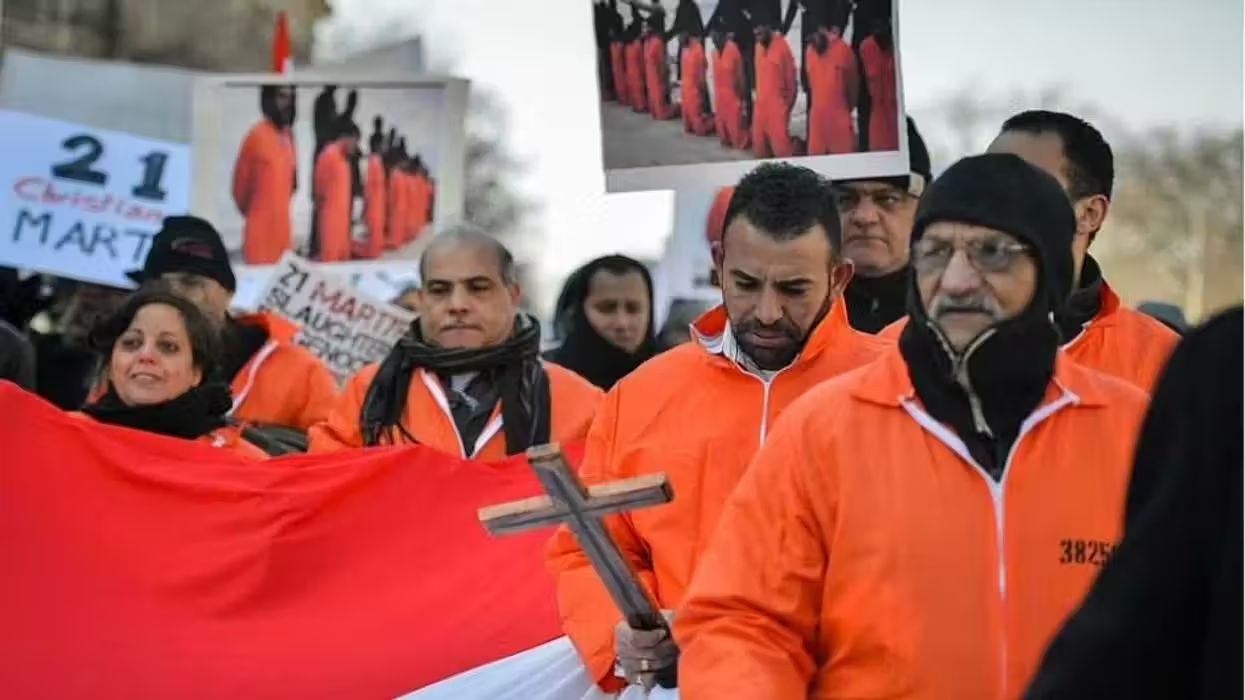
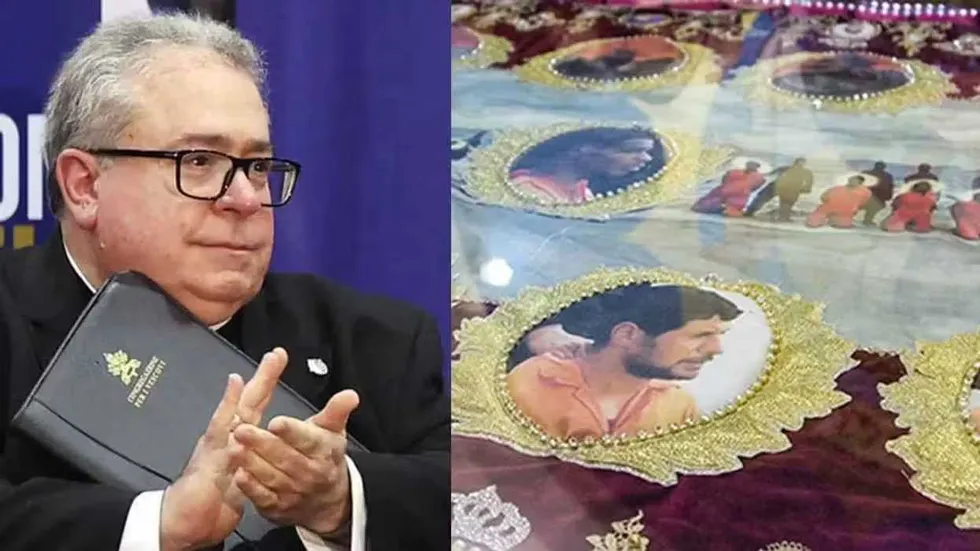
The newest Catholic parish in Arlington, Texas, is named for Matthew Ayariga, one of 21 men murdered by Islamic State terrorists on a Libyan beach in February 2015.
Ayariga was a Ghanaian migrant worker captured alongside 20 Egyptian Coptic Orthodox Christians. Little is known about his life before then, including whether he was already a Christian. Some accounts say the faith of his fellow prisoners inspired him to convert during their captivity, while others suggest that he had previously embraced Christianity.
When they asked whether she had a weapon, Stang raised her Bible. 'This is my only weapon,' she said.
What is known is that Ayariga chose to identify himself with the Copts when their captors demanded that the men renounce Christ. “Their God is my God,” he reportedly said before he was beheaded with them.
Last week, Michael Olson, bishop of Fort Worth, announced the establishment of St. Matthew Ayariga Catholic Church, the first Catholic parish anywhere in the world placed under Ayariga’s patronage.
The announcement points toward a fact at times easily forgotten in the comfortable West: The age of Christian martyrs did not end with Nero, the Roman arena, or even the totalitarian regimes of the 20th century. Christians are still dying for the faith.
In 2023, Pope Francis established a Commission of New Martyrs to gather the names and stories of Christians killed during the first quarter of the 21st century. By September 2025, the commission had compiled the names of 1,624 Catholic, Orthodox, Anglican, and Protestant martyrs and witnesses to the faith who died between 2000 and 2025.
The catalogue includes 643 Christians killed in sub-Saharan Africa, 357 in Asia and Oceania, 304 in the Americas, 277 in the Middle East and North Africa, and 43 in Europe.
Those figures do not constitute a complete census, nor does inclusion amount to formal canonization by the Catholic Church. In fact, the Vatican has withheld the full list because publicly identifying some of the victims could endanger Christians still living in the same regions.
Among those remembered by the commission is Father Ragheed Ganni, a Chaldean Catholic priest who returned to his native Iraq after studying in Rome. As violence against Iraqi Christians intensified, extremists repeatedly warned him to close his parish. Ganni refused to leave while his people still needed him.
“Without the Sunday Eucharist, we cannot live,” he said at a Eucharistic congress in Italy in 2005. “For us, the terrorists take life, but the Eucharist gives it back.”
On June 3, 2007, gunmen confronted Ganni outside his church in Mosul after Sunday Mass. They murdered him and three subdeacons.
 L/R: Amanda McCoy/Fort Worth Star-Telegram/Tribune News Service/Getty Images; IBRAHIM EZZAT/AFP/Getty Images
Another is Sister Dorothy Stang, an Ohio-born nun who spent nearly four decades working among poor settlers in the Brazilian Amazon. She helped farming families secure legal title to their land and promoted sustainable agriculture, bringing her into conflict with powerful ranchers and loggers.
Despite repeated death threats, Stang remained in the region. On Feb. 12, 2005, two hired gunmen stopped the 73-year-old nun on a muddy road.
When they asked whether she had a weapon, Stang raised her Bible.
“This is my only weapon,” she said.
As she began reading from the Beatitudes, the gunmen shot her six times.
The commission also remembers seven members of the Melanesian Brotherhood, an Anglican religious community devoted to evangelism and peacemaking in the Solomon Islands.
During civil unrest in 2003, militants took Brother Nathaniel Sado hostage and tortured him to death. Six other brothers went looking for him. Three were shot upon arrival; the remaining three were beaten, tortured, and killed the following day.
At their funeral, a banner preceded each coffin bearing the brother’s name and the words, “Blessed are the peacemakers, for they shall be called the sons of God.”
Two days later, the Melanesian Brotherhood admitted 48 new members.
The youngest of those singled out by Pope Leo was 10-year-old Abish Masih, a Pakistani schoolboy killed in the March 2015 Taliban attacks on two churches in Lahore. In a notebook he left behind, the child had written a simple aspiration: “Making the world a better place.”
These men, women, and children belonged to different countries, cultures, and Christian communions. Their inclusion in a common memorial reflects what John Paul II called the “ecumenism of the martyrs” and Pope Francis later termed the “ecumenism of blood.”
Those who persecute Christians often make no distinction between Catholic, Orthodox, Anglican, and Protestant believers. Martyrdom reveals a unity that centuries of ecclesiastical negotiation have yet to restore fully.
In September 2025, Pope Leo XIV gathered with representatives of numerous Christian traditions to commemorate the new martyrs. He called their witness an “unarmed hope” and warned that the persecution of Christians had not disappeared with the dictatorships of the last century.
“On the contrary,” the pope said, “in some parts of the world it has increased.”
The word “martyr” comes from the Greek word for “witness.” A martyr is not simply someone who dies tragically or becomes a victim of violence. A Christian martyr bears witness to Christ by remaining faithful when faithfulness exacts the ultimate price.
By naming the new parish for Ayariga, the Diocese of Fort Worth is helping preserve the witness of the 21 martyrs for another generation.
“Where violence seeks to erase a man’s identity, the Church remembers his name,” Bishop Olson wrote. “Where death boasts to have the final word, the Resurrection of Jesus Christ declares otherwise.”