Evelyn Hockstein/Getty Images
When Prime Minister Mark Carney recently accepted a civic scroll from the Mayo County Council in Ireland, he softened up the crowd with an anecdote about getting a gift from "another great leader."
The impression that followed was accurate enough that he never needed to utter the leader's name — Donald Trump — to score big laughs.
'It’s a cap,' Carney told Trump. 'A hard line. I thought you’d actually like that.'
They say imitation is the sincerest form of flattery. This lighthearted aside underscored a broader reality confronting the Canadian prime minister: Campaigning against Donald Trump is one thing; governing alongside him is another.
That tension has become a recurring theme of Carney’s first year in office.
During the 2025 federal election, Carney embraced an “elbows up” message that portrayed resistance to Trump as both a political necessity and a point of national pride. In one speech, he argued that “many of our former strengths, based on our close ties to America, have become our weaknesses.”
More recently, however, Carney struck a markedly different tone before the Economic Club of New York, declaring that “Canada Strong will help Make America Great Again” and emphasizing the importance of North American cooperation in energy, critical minerals, manufacturing, and artificial intelligence.
The shift has not gone unnoticed by the opposition. Conservative leader Pierre Poilievre recently posted the two statements side by side on social media under the caption: “Elbows Up Carney or MAGA Carney? Which one will we get next?”
The comparison makes for an effective political attack, but it may also reflect the realities of governing.
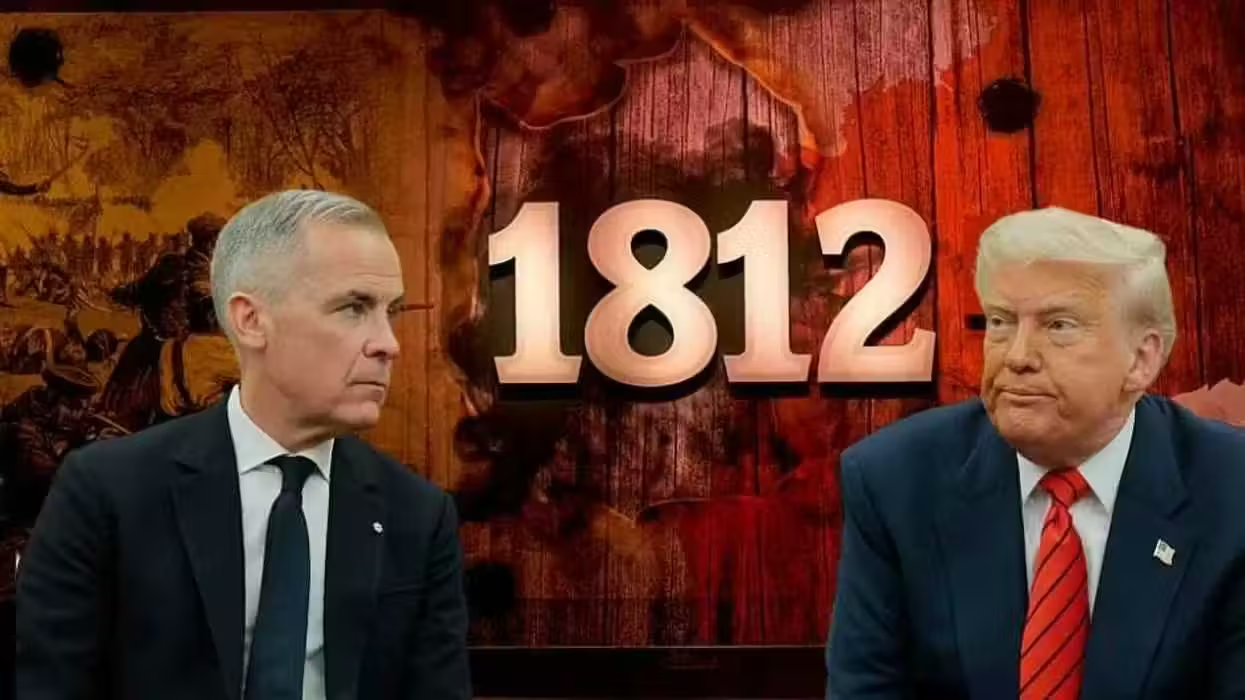
RELATED: 'AMERICAN INVASION': Flailing Canada PM Mark Carney invokes historical grudge in latest lob at Trump
 George Rose/Anna Moneymaker/Getty Images
Canada sends roughly three-quarters of its exports to the United States, and the future of the U.S.-Mexico-Canada Agreement remains critical to the country's economy. Whatever slogans may have resonated on the campaign trail, any Canadian prime minister ultimately has strong incentives to maintain a productive working relationship with Washington.
Carney has had to face this reality often since assuming office.
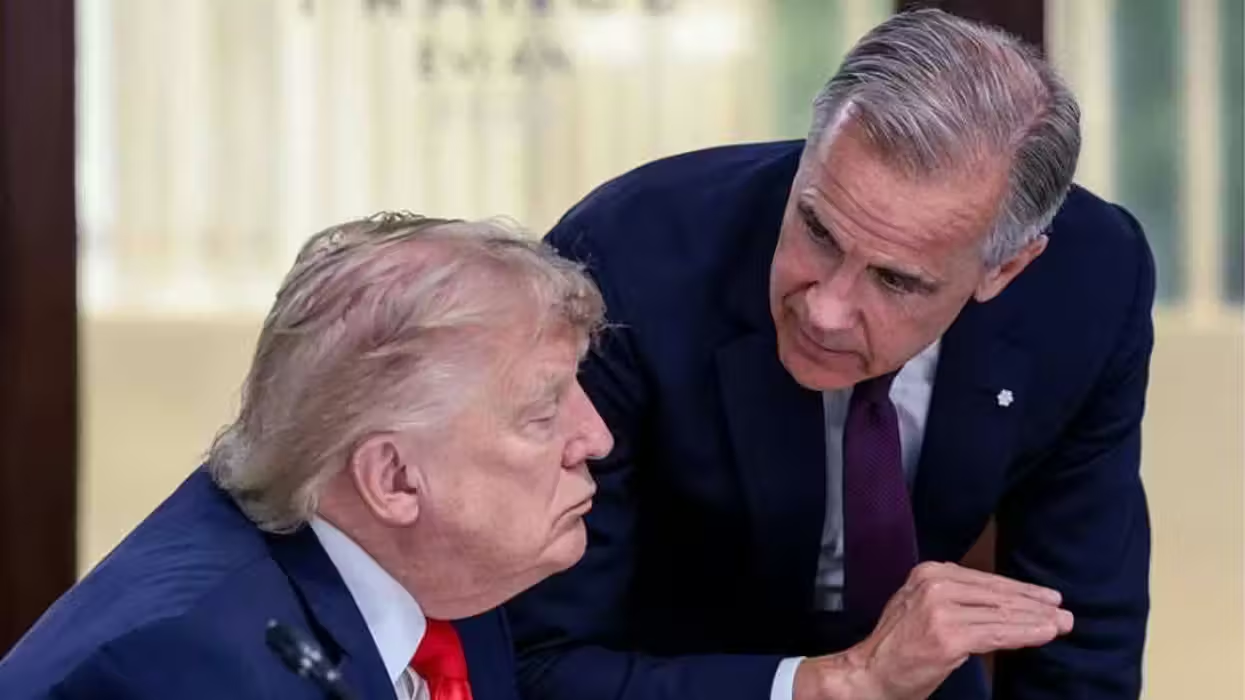
Seven months after taking office, Carney visited the White House and described Trump as “a transformative president.” At the G7 summit, a hot microphone captured the two leaders discussing Canada's cap on Chinese electric vehicle imports in what appeared to be a friendly exchange.
“It’s a cap,” Carney told Trump. “A hard line. ... I thought you’d actually like that.”
“That’s good,” Trump replied. “I like it.”
Carney’s response to the Iran conflict followed a similar pattern. While expressing concern that the initial military action appeared inconsistent with international law and noting that Canada had not been consulted, he later welcomed the resulting peace agreement and argued that preventing Iran from obtaining a nuclear weapon was "worth it."
Yet Carney's more conciliatory approach has not always produced visible diplomatic dividends. At the G7 summit, he departed without securing a formal bilateral meeting with Trump, a notable omission given the stakes surrounding trade negotiations and the future of USMCA. Carney brushed aside suggestions that he had been snubbed, emphasizing that the two leaders had spoken several times during the gathering.
Trump has also continued to revive his suggestion that Canada should become America’s “51st state” while maintaining pressure on trade and other bilateral issues.
The Ireland impression, then, is less significant than the political evolution it symbolizes. Carney campaigned as Trump’s foil, but governing has required him to cultivate a functional relationship with the American president.
Whether Canadians view that evolution as prudent statesmanship or an abandonment of the posture that helped elect him is ultimately a political judgment. But it illustrates a lesson many leaders discover after taking office: Running against a neighboring superpower is easier than running a country that depends on it.