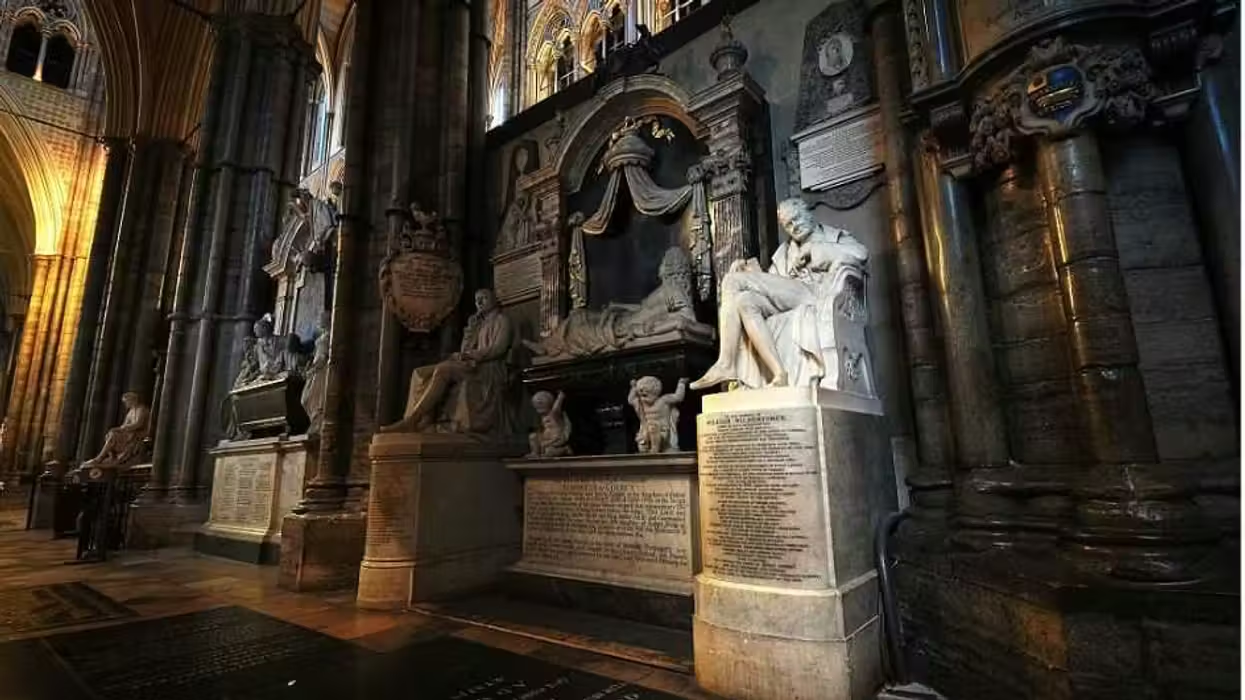
Jim Dyson/Getty Images
Most of us like to think we would be willing to die for a great cause, granted the courage. A harder question is whether we would be willing to spend 20 years losing for one.
More than two centuries ago, a young British politician named William Wilberforce confronted exactly that question. His answer changed the moral character of an empire.
'You have the far greater honour of being a Representative for the Lord, in a place where many know him not.'
Young, wealthy, and well connected, Wilberforce entered Parliament at just 21 years of age, quickly earning a reputation as one of the finest orators in Britain. Charming, witty, and socially connected, he was hardly known for disciplined seriousness. The writer and socialite Madame de Staël called him "the wittiest man in England."
Everything changed after a profound Christian conversion in 1785.
Politics suddenly seemed worldly, perhaps even incompatible with genuine discipleship. Wilberforce reluctantly considered resigning his seat in Parliament and entering the ministry. Had he done so, history might remember him — if at all — as an obscure Anglican clergyman.
Before making his decision, however, he visited St. Mary Woolnoth, a modest parish church in the City of London, to seek the advice of its rector, the Rev. John Newton.
Newton urged him to stay. Parliament, he insisted, was not an obstacle to Wilberforce's calling. It was his calling.
That counsel carried unusual weight. Newton, known mainly today as the author of the hymn "Amazing Grace," had once captained slave ships himself, enriching himself along with his country. His repentance forced him to confront an evil that Britain had conveniently learned to ignore.
It would become the defining cause of Wilberforce's life.
Wilberforce did not set out to become the face of the abolition movement. After his conversion, he found himself drawn into a growing circle of evangelical reformers increasingly alarmed by the slave trade.
At Barham Court in Teston, the Kent home of Sir Charles and Lady Middleton, he listened to James Ramsay, a former naval surgeon who described the horrors he had witnessed in the Caribbean. Around the same time, Thomas Clarkson and the Quaker abolitionists were traveling the country interviewing sailors, surgeons, and former slaves, collecting physical evidence from slave ships, and assembling what would eventually amount to some 900 pages of testimony.
They had built an overwhelming case but lacked one crucial thing: a champion inside Parliament.
Encouraged by his friend William Pitt, now prime minister, Wilberforce accepted that role. Clarkson would gather the evidence. Wilberforce would lay it before the nation.
In 1789, standing not far from where visitors stand today outside the Palace of Westminster, Wilberforce rose in the House of Commons to deliver what would become one of the most famous speeches in British parliamentary history.
"The nature and all the circumstances of this trade are now laid open to us," he declared. "We can no longer plead ignorance."
The slave trade was, in his words, "so enormous, so dreadful, so irremediable" that he had determined he would "never rest" until it was abolished.
The three-hour speech was a triumph. Newspapers praised its eloquence. Many believed abolition was now inevitable.
Instead, opponents shifted the battle from the moral arena to the procedural one.
The powerful West India lobby argued that the evidence was incomplete and demanded further hearings. Parliament agreed. More witnesses were summoned. More testimony was taken. Months slipped away. When time ran out, the debate was adjourned until the following session.
The next year the matter disappeared into a select committee. Then a general election dissolved Parliament, forcing much of the process to begin again.
By the time the House finally voted in 1791, nearly two years had passed since Wilberforce's celebrated speech.
The result was crushing. His first abolition bill was defeated by 163 votes to 88.
The cause had not been defeated by a single great rebuttal; it had been slowly drained of momentum through delay.
Wilberforce could have accepted the verdict as proof that the country simply was not ready. Instead, he rose and made a promise that would define the rest of his public life.
Never, never will we desist till we have wiped away this scandal from the Christian name, released ourselves from the load of guilt under which we at present labour, and extinguished every trace of this bloody traffic.
Notice what troubled him most.
Slavery was not merely an economic mistake or a political embarrassment.
It was "a scandal" upon "the Christian name." Britain claimed to be a Christian nation while enriching itself through the buying and selling of human beings. That contradiction could not simply be managed. It had to be removed.
And so Wilberforce returned, again and again. He introduced new motions, reopened old debates, and refused to let the issue disappear beneath the next political crisis.
Meanwhile, the defeat of 1791 energized the public. Hundreds of thousands of Britons signed petitions demanding abolition. An estimated 400,000 people — many of them women directing household purchases — joined a nationwide boycott of West Indian sugar produced by enslaved labor.
The pressure worked, and when Wilberforce returned to Parliament in 1792, immediate abolition suddenly appeared possible.
Then Henry Dundas proposed what sounded like a reasonable compromise. The trade, he agreed, was unjust. It should therefore be abolished — gradually.
With the insertion of a single word, Parliament transformed an urgent moral demand into an indefinite political process. On paper, Parliament had voted to abolish the slave trade. In practice, nothing changed.
The cause weakened further when Britain entered into war with Revolutionary France. Opponents of abolition portrayed reformers as dangerous radicals infected by French ideas. Government attention shifted toward financing the war and preserving stability at home.
Wilberforce's motion in 1793 failed by just eight votes. Public enthusiasm faded. Thomas Clarkson collapsed from exhaustion and withdrew from active campaigning. Wilberforce increasingly found himself carrying the cause almost alone inside Parliament.
Then came perhaps the cruelest setback of all. In 1796, after years of promises that the trade would be "gradually" abolished, Wilberforce made another determined push for immediate action.
The measure failed by four votes.
Afterward he learned that several reliable supporters had missed the vote because they had gone to a fashionable new Italian opera. His diary captured the heartbreak in a single sentence: "Enough at the Opera to have carried it. I am permanently hurt about the Slave Trade."
Seven years after taking up the cause, Wilberforce appeared scarcely closer to success than when he had begun. The defeat left him physically exhausted and emotionally broken.
Once again, he turned to John Newton. More than a decade earlier, Newton had persuaded the newly converted Wilberforce not to leave Parliament. Now he offered a different kind of counsel.
He did not suggest success was just around the corner; instead, he challenged Wilberforce's definition of success itself.
"You are not only a Representative for Yorkshire," Newton wrote. "You have the far greater honour of being a Representative for the Lord, in a place where many know him not."
It was a radically different way of measuring a political life.
Newton then pointed Wilberforce to one of Scripture's great public servants.
"Daniel likewise was a public man," he wrote, "and in critical circumstances. But he trusted in the Lord ... and therefore though he had enemies, they could not prevail against him."
Newton acknowledged that Wilberforce might never accomplish all the good he hoped for, but refused to judge the value of his work by legislative victories alone.
"Though you cannot do all the good you wish for," Newton wrote, "some good is done, and some evil is probably prevented."
RELATED: CS Lewis: Angry atheist surprised by God
 John Chillingworth/Getty Images
Wilberforce stayed. Over the next 11 years, one apparent breakthrough after another dissolved into disappointment. Some years Parliament rejected abolition outright. Other years it settled for minor reforms that regulated the trade rather than ending it. Constitutional crises, changes of government, renewed war with France, and shifting political alliances repeatedly pushed abolition to the margins.
In 1804, after fifteen years of labor, Wilberforce finally succeeded in carrying an abolition bill through the House of Commons. The House of Lords quietly buried it. Claiming they needed more time to examine the evidence, they postponed consideration until the parliamentary session expired.
It was, in essence, the same procedural tactic that had greeted his first great speech 15 years earlier. Yet Wilberforce again refused to conclude that delay meant defeat. Year after year he returned to the same chamber, made the same arguments, presented the same evidence, and asked the same question of his country.
Then, in 1806, everything changed. William Pitt was dead. A new government under Lord Grenville and Charles James Fox made abolition a priority rather than a private sympathy.
On February 23, 1807, after nearly 20 years of defeats, delays, compromises, and disappointments, the House of Commons voted overwhelmingly to abolish the British slave trade.
As members rose to cheer, Wilberforce remained seated with bowed head and tears streaming.
The applause was not for a brilliant speech delivered that evening. It was for two decades of quiet perseverance.
The victory belonged to many people: Thomas Clarkson, who gathered the evidence; John Newton, whose counsel twice kept Wilberforce at his post; the Quakers who organized, petitioned, and sacrificed despite having no seats in Parliament; and the hundreds of thousands of ordinary Britons who signed petitions and quietly changed their buying habits.
But none of them would have witnessed that day had Wilberforce concluded, somewhere along the way, that 20 years of apparent failure was enough.
Christians today still debate the best strategy for engaging an increasingly hostile culture. Some emphasize building institutions. Others speak of retreat. Those are important questions.
But Wilberforce reminds us of something more fundamental.
He never discovered the perfect political strategy. He never enjoyed ideal political conditions. He spent most of his public life with little prospect of victory. Yet he refused to postpone obedience until circumstances became favorable. He simply remained at the post God had given him.
Most of us imagine faithfulness as a single dramatic stand. Wilberforce reminds us that it often looks much quieter. Doing the same work, year after year, long after applause has faded, allies have drifted away, and success seems impossible.
That is how, by God's grace, the moral character of an empire was changed.