NASA/Getty Images
America has unlocked in-orbit construction that 'can scale to your imagination.'
A U.S. defense agency says it has accomplished what has never been done before in outer space and that it didn't need advanced artificial intelligence to do it.
The landmark event is being called a historic first and could mean rapid expansion for the United States in (or out) of the Earth's orbit.
'Good old-fashioned rigorous engineering.'
Four years into its NOM4D space program, the Defense Advanced Research Projects Agency has demonstrated an outstanding capability it says is the first of its kind.
With the help of advanced engineers from the California Institute of Technology, DARPA says it is the first agency to autonomously build a structure in space.
The inaugural moment was achieved using Caltech's Autonomous In-Space Tensioned Reflector Assembly robotics system, which ScienceDaily described as an automated arm that assembled structural tubes and joints from storage dispensers into repeating sections that form a truss.
Even more impressive, the team at DARPA said the project was completed without the use of advanced artificial intelligence models (or astronauts) and was simply a product of "good old-fashioned rigorous engineering."
The ASTRA builder was launched with two pre-built bays, the lab explained, with a third bay built by the system in orbit. Photos captured by one of the 11 on-board cameras showed additional composite fiber tubes and "netlike reflective material," Caltech stated.
"This is the first time that a structure has been autonomously constructed in space," said Sergio Pellegrino, senior research scientist at Caltech's jet propulsion laboratory. "Developing a payload of this complexity on such a short timeline was an enormous undertaking for our small team," he added.
NOM4D program manager Andrew Detor boasted about the program's future capabilities to scale at large, adding to Caltech's claim that the team has demonstrated the feasibility of the concept.
"This approach that the Caltech team is taking can scale to your imagination. It can scale to very, very large things. They've done it in a way that is really elegant," Detor said.
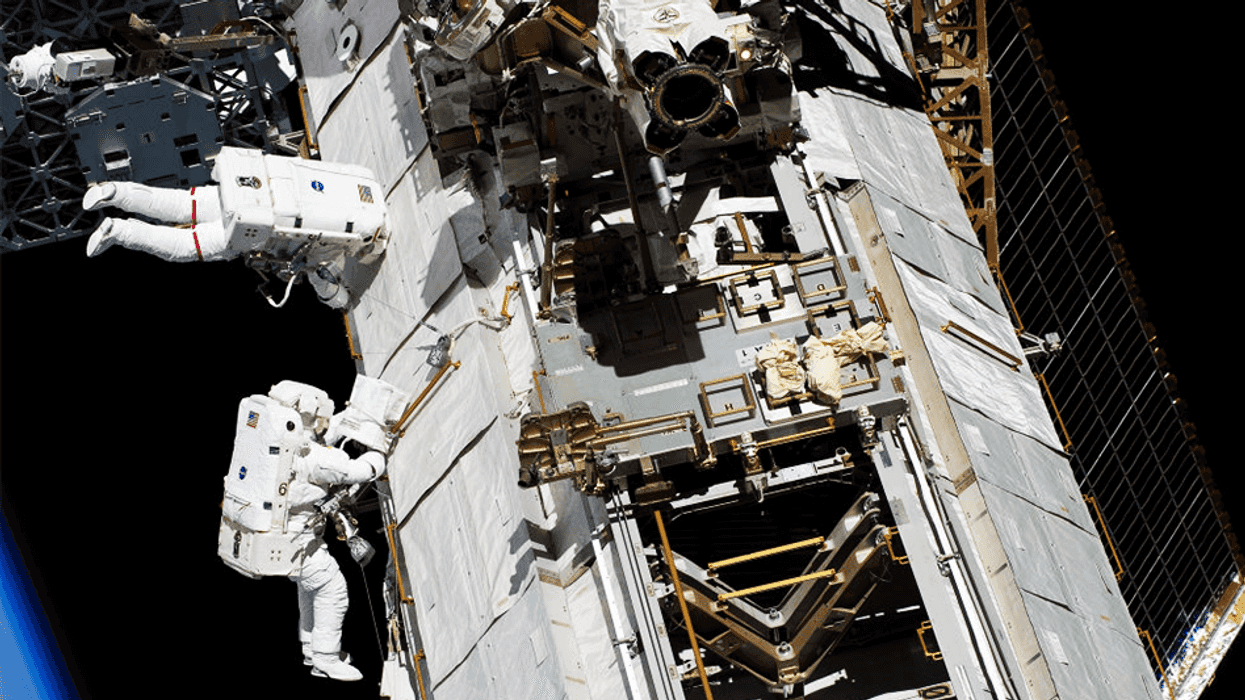
For comparison, Detor explained that current approaches had modular structures being built on Earth and sent into space over "many, many launches," including the International Space Station that took "over 40 launches to build up its roughly 100-meter size."
RELATED: Beware: The top AI detector is now shockingly good — even at video
NOM4D refers to the defense agency's Novel Orbital and Moon Manufacturing, Materials, and Mass-efficient Design program, with the stated goal of manufacturing and assembling enormous structures in space.
These structures are meant to be "precise, mass-efficient" space structures that withstand "maneuvers, eclipses, damage, and thermal cycles inherent to the space environment."
The project began in 2022 with the intent of eventually ferrying "raw materials from Earth for in-orbit manufacturing," which has now seemingly been accomplished.
The latest demonstration served as the third phase on the project timeline, with the first being the development and design of the concept, followed by a demonstration in Earth settings.
Like Blaze News? Bypass the censors, sign up for our newsletters, and get stories like this direct to your inbox. Sign up here!

Andrew Chapados