Pool/Getty Images
Is Canadian Prime Minister Mark Carney deliberately jeopardizing yet another trade deal with President Donald Trump and the United States?
U.S. Ambassador to Canada Pete Hoekstra told Blaze News in October that Carney had already walked away twice from “the best trade agreement” Canada could ever expect from the Trump administration.
Just as Carney's criticism of the United States has been on public display, so has his enthusiasm for closer relations with China.
Carney cited a number of reasons for rejecting the proposed deal, including claims that it would compromise Canadian sovereignty and threaten French-language protections and Quebec culture. American officials disputed those claims, but Carney has steadfastly refused to publicly reveal the details of the deal to Canadians.
Now Carney's growing relationship with China is threatening to complicate negotiations with Washington.
In January, Carney reached an agreement with Beijing allowing up to 49,000 Chinese electric vehicles into Canada annually at a tariff rate of just 6.1%, exempting them from the additional 100% tariff imposed in 2024. In return, China agreed to lower tariffs on Canadian agricultural products.
Trump responded by threatening a 100% tariff on Canadian goods if Canada pursued a broader trade deal with Beijing.
And in July, U.S. Trade Representative Jamieson Greer explicitly raised concerns about Canada's deepening economic ties with China as Washington resisted renewing the existing North American trade agreement. Greer warned that Chinese automakers could use Canadian operations to gain access to the American market, circumventing restrictions designed to protect U.S. manufacturers and workers.
Now Carney is raising the possibility of bringing even more Chinese investment into Canada's automobile industry.
On Monday, November 16, Carney said Canada could turn to Chinese automakers if negotiations with Washington fail to preserve an integrated North American automotive industry. He said such investment would need to involve substantial manufacturing in Canada, rather than simply assembling imported vehicles.
Asked whether potential Chinese investment was leverage against Washington, Carney replied: “It's not leverage. But action, reaction.”
He insisted that negotiations with the United States remained his priority. But he was equally clear that Canada would pursue alternatives if those talks failed.
“Canada is going to move forward either way,” he said.
Carney is also wandering into treacherous diplomatic waters with his remarks about the security implications of Canada's growing partnership with China.
On November 10, he made a startling comparison between the security risks of Canada's relationship with Beijing and those facing the United States in its own dealings with China.
“Yes, I will be meeting with President Xi Jinping next week at APEC,” Carney told Canadian reporters. “We will discuss many things. We'll discuss security situation around the world. We'll discuss our economic partnership, which is something that is deepening but has clear guardrails in terms of the areas in which we're involved.”
He then added: “In terms of the security risks of our partnership, they are much, much, much, much less than the security risk, for example, of the United States.”
The remarks drew accusations that Carney considered the United States a greater security threat than China, although his comparison appears to have concerned the risks arising from the two countries' respective economic relationships with Beijing.
It sounded much like the Carney who spoke fondly of the War of 1812 while criticizing American threats against Canadian sovereignty. Or the Carney who savaged U.S. economic policy during a major speech to the World Economic Forum.
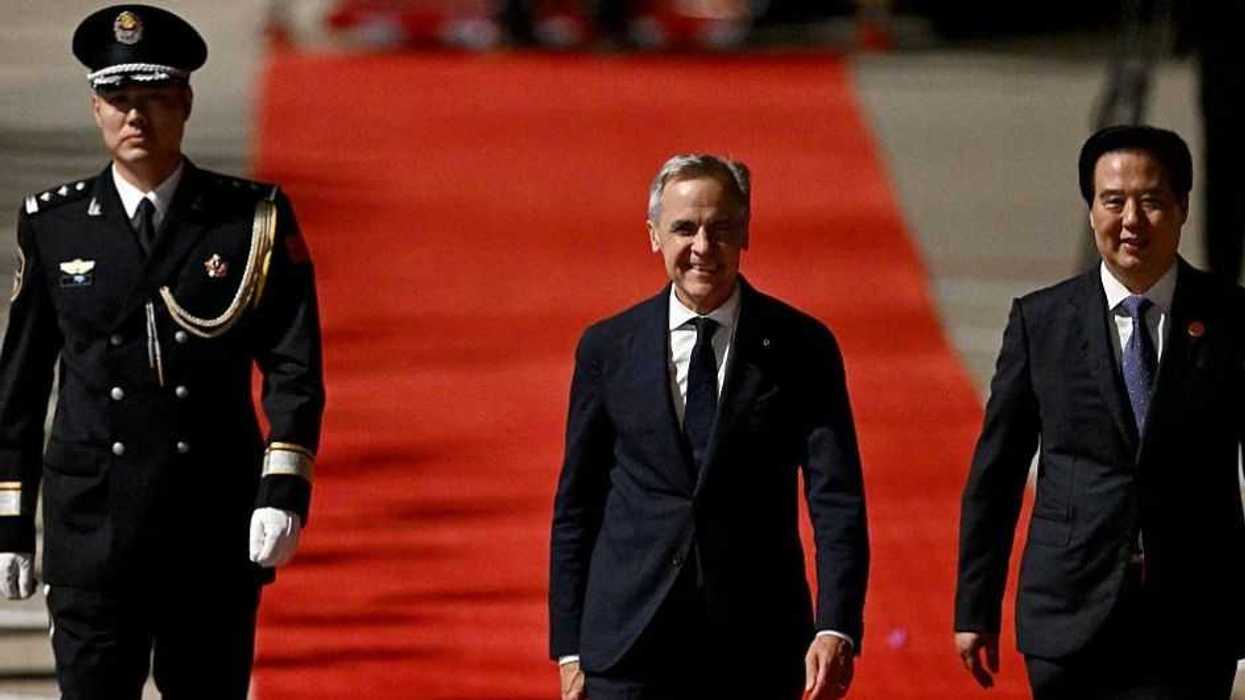
Just as Carney's criticism of the United States has been on public display, so has his enthusiasm for closer relations with China. During a January 2026 visit to Beijing, he welcomed a renewed strategic partnership with the communist dictatorship and invoked the prospect of a “new world order.”
“The world has changed much since that last visit,” Carney said. “I believe the progress that we have made in the partnership sets us up well for the new world order.”
His words shocked critics who wondered why Canada's prime minister was so eager to deepen relations with Beijing while relations with Washington were deteriorating.
But Carney's enthusiasm for a greater Chinese role in the international financial system stretches back years, including his time as governor of the Bank of England.
Carney has long advocated reducing the dominance of the U.S. dollar in the global financial system and allowing the Chinese yuan, or renminbi, to play a larger international role.
RELATED: Canada killed this family's ostriches. One year later, they fight back.
 Katie Pasitney
In a March 2024 interview with China's 21st Century Business Herald, Carney argued that the international reserve-currency system would benefit from better reflecting China's growing weight in the world economy.
He said expanding the renminbi's international use would be an important step toward establishing it as a reserve currency, although China would also need greater currency convertibility and more open capital markets.
He made a similar argument in 2019, during Trump's first presidency, at the Jackson Hole Economic Symposium. With Trump imposing tariffs on China and battling Federal Reserve Chairman Jerome Powell over interest rates, Carney advocated reducing the dominance of the U.S. dollar through a more diversified international monetary system, including the possibility of a new “synthetic hegemonic currency.”
Carney argued that the dollar's extraordinary influence over international trade and finance exposed other countries to economic shocks originating in the United States. A stronger dollar, he said, could tighten financial conditions abroad even when those countries' own economies did not warrant it.
His proposed solution was greater international monetary cooperation and, eventually, a system in which the dollar would no longer exercise such overwhelming influence.
An SHC, Carney argued, “could dampen the domineering influence of the U.S. dollar on global trade.”
He also considered the possibility of the renminbi eventually emerging as a major reserve currency.
“And the most likely candidate for true reserve currency status, the renminbi, has a long way to go before it is ready to assume the mantle,” Carney said. “The initial building blocks are there.”
He pointed to China's position as the world's leading trading nation and the growing international use of its currency.
But Carney did not propose simply replacing the dollar with the yuan. He advocated a multipolar monetary system in which several currencies would compete for international influence.
Seven years later, Carney is Canada's prime minister, pursuing closer economic ties with Beijing while trying to negotiate a trade deal with Washington. Whether his China gambit will cost him another deal with Trump remains to be seen.